From Mumbai to Heilbronn — Your Lunch in the Tiffinbox

Your lunch break is 30 minutes. Maybe 45. Ten of those go to standing in line, five to reading the menu, ten to waiting for the food to be ready — which leaves about a quarter of your break for the one thing it is actually for: eating. Mumbai solved exactly this problem over a hundred years ago, and the solution still reads as elegant today: stacked stainless-steel boxes, a clockwork schedule, and a meal that waits for you to the minute. We are bringing that idea to Heilbronn — it's called a tiffinbox. Available every day except Monday, 11:30–15:00.
What is a Tiffinbox?
The promise behind it is simple: you open your phone between two meetings, see in seconds what's on today, build your box in under a minute, pay online. From that moment you know, to the minute, when your food will be ready for pickup. You walk in, you take it, you walk out — warm box in hand, one minute flat, no waiting, no queue, no question marks. Exactly the same energy Mumbai has been running on for over a hundred years: clockwork, just-in-time, zero friction in the system.
It's built for people working at an office or from home who want a quick break in the fresh air — walk over to the restaurant, in, grab the warm box, out again, one minute flat. Or pull up in the car, three steps to the door, box in hand, back in. For shift workers on a fixed window. For anyone who wants to glance at the clock, glance at the menu, tap through an order — and trust they'll leave on time, eat on time, and be back at the desk on time. We've talked to a handful of companies in Heilbronn, and nearly all of them described the same core problem: not enough time for a proper break — so they default back to the canteen, not because it's better, but because it's right there. The tiffinbox is built for exactly that gap. That's the promise.
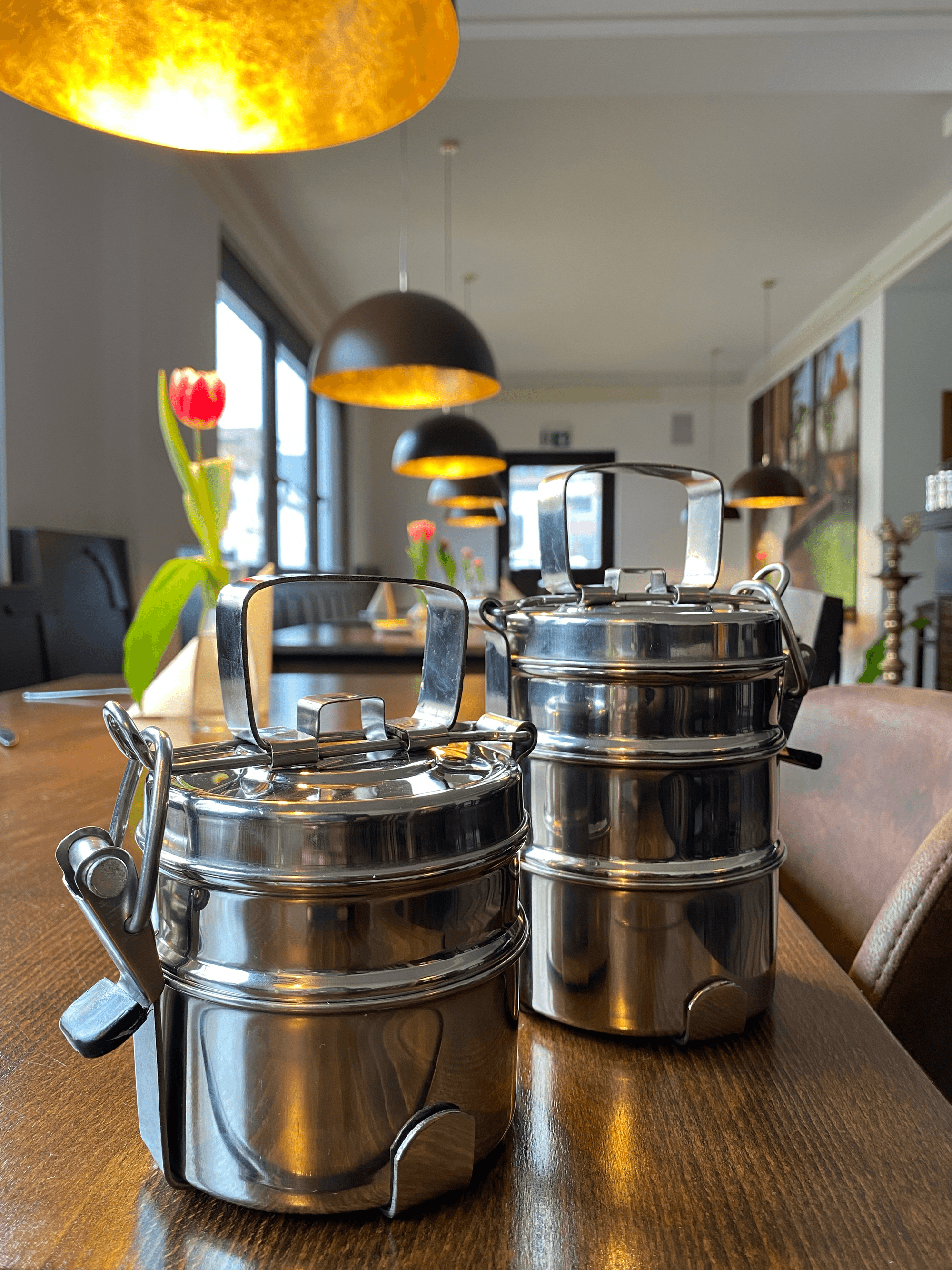
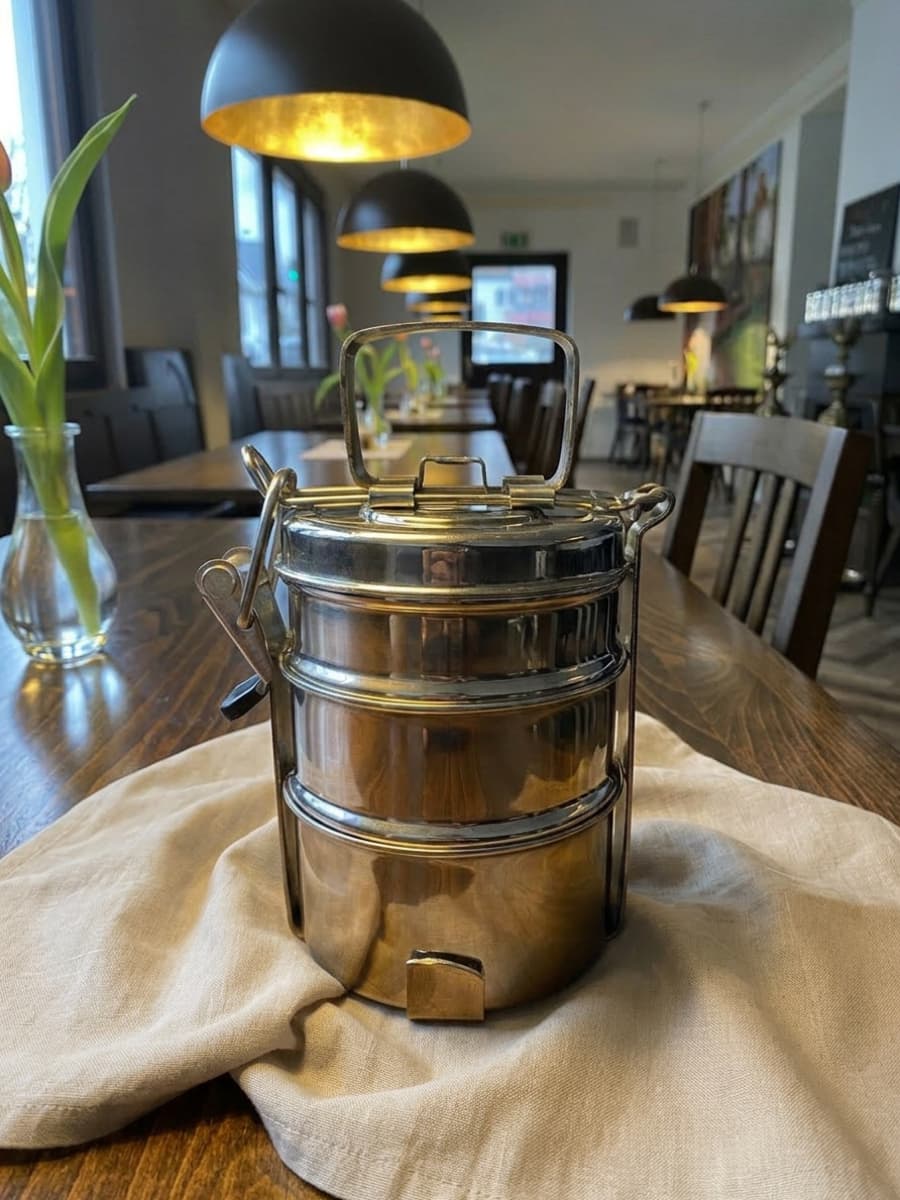
The tool that makes it work is the tiffinbox itself: several stainless-steel compartments stacked vertically, held together by a single clip — an invention that has needed no upgrade for a century. Leak-proof. Reusable. Flavour-neutral. And, more than anything, a quiet promise that someone took the time this morning to cook this food for you.
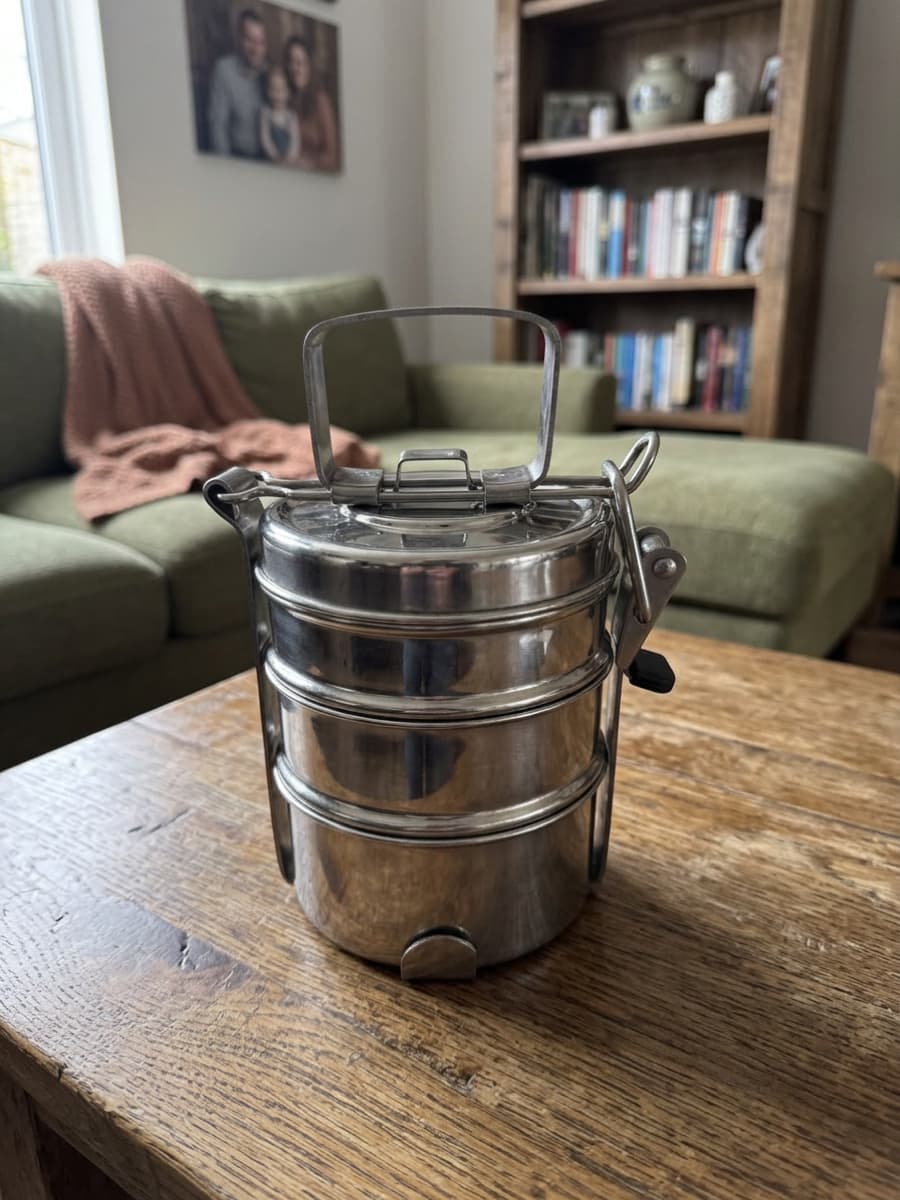
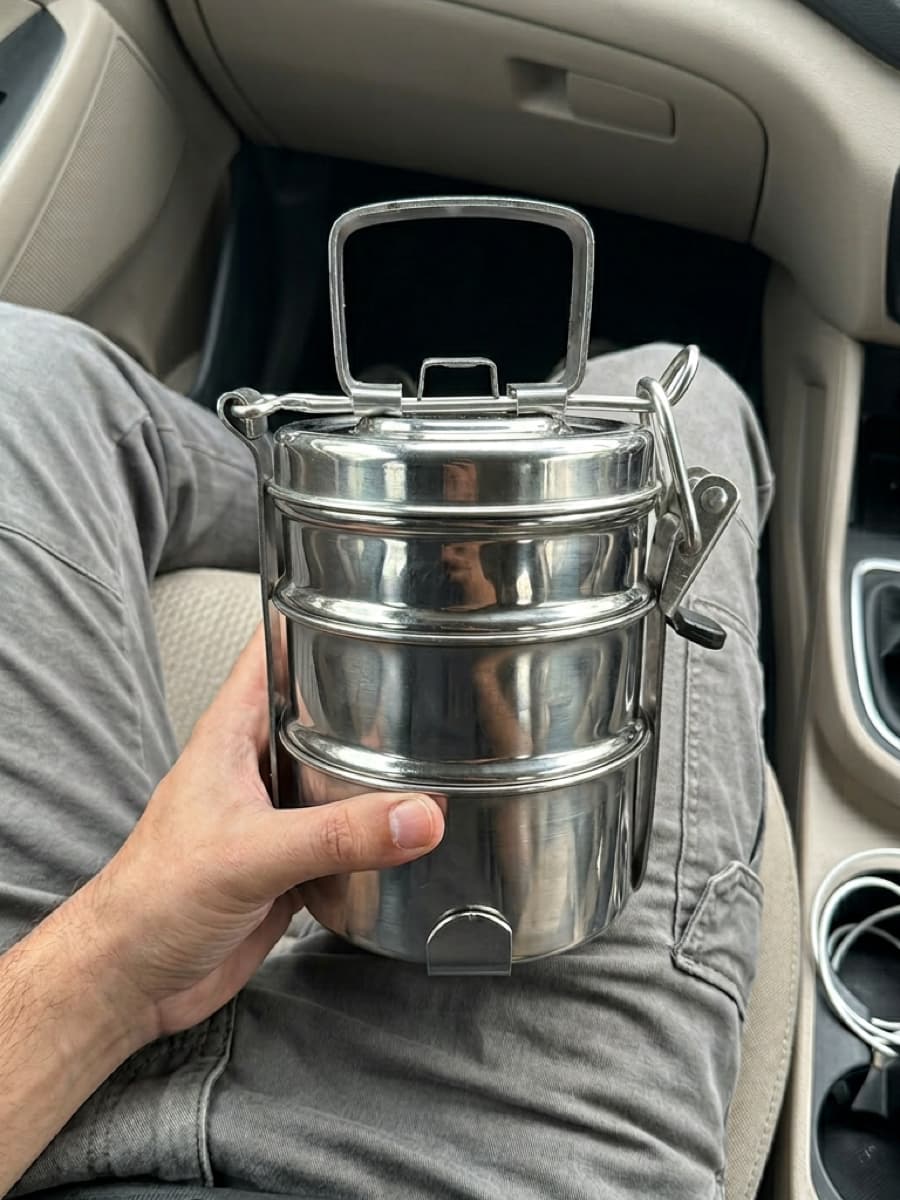

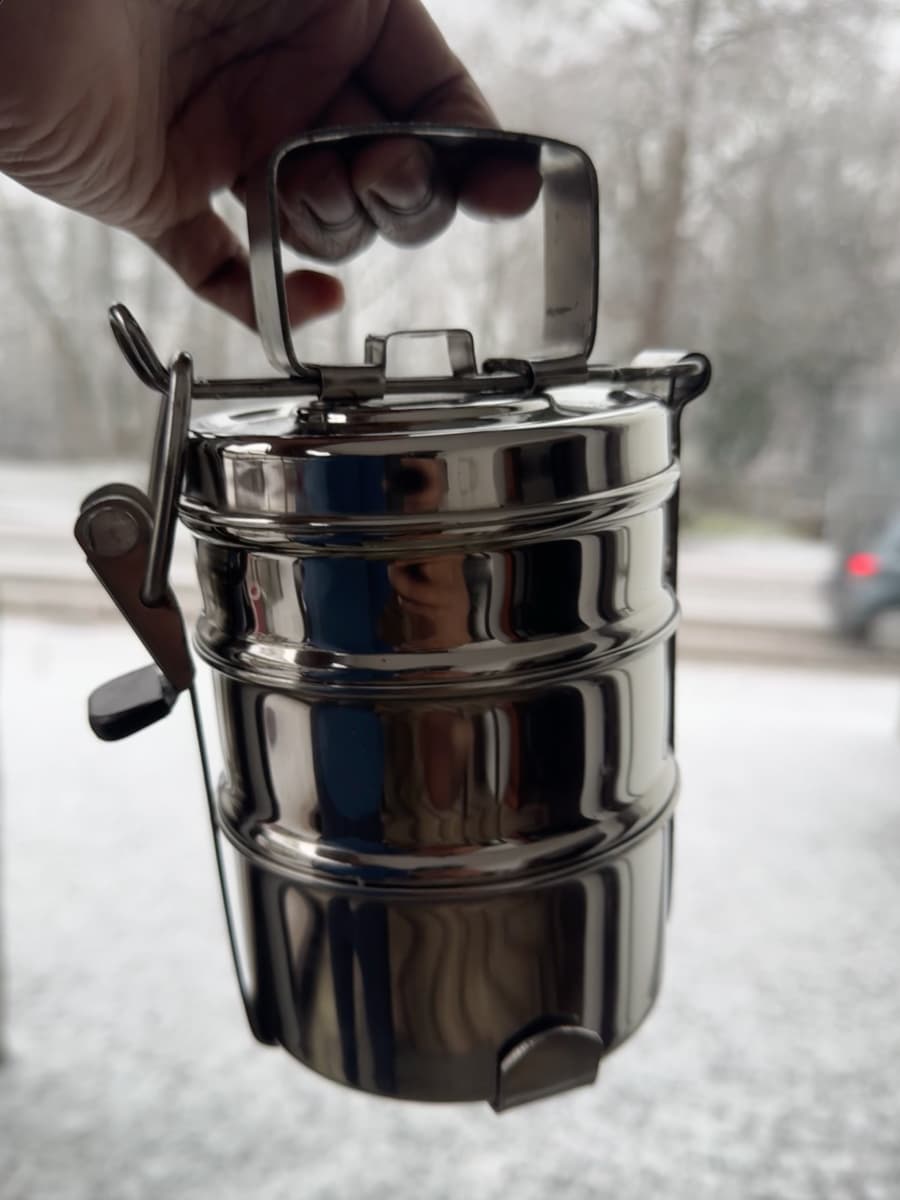
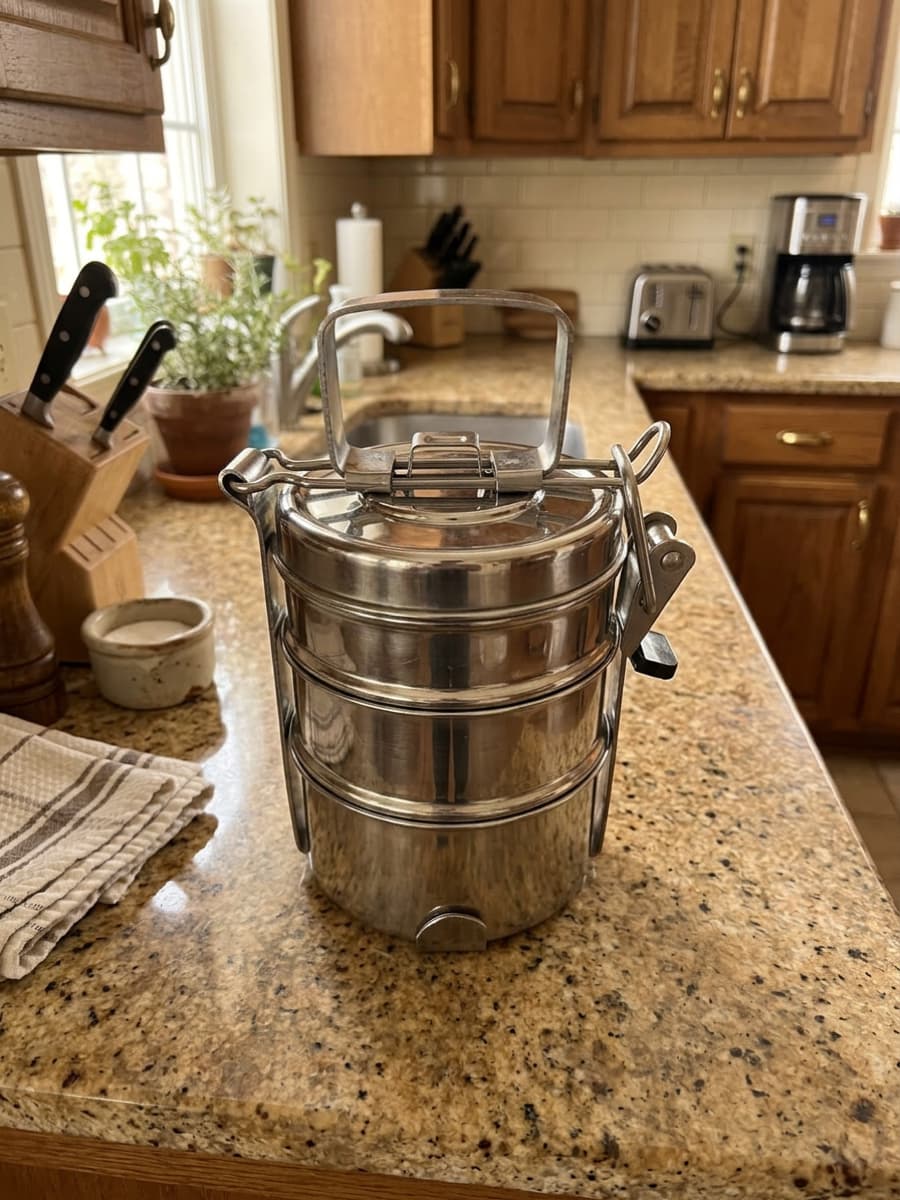
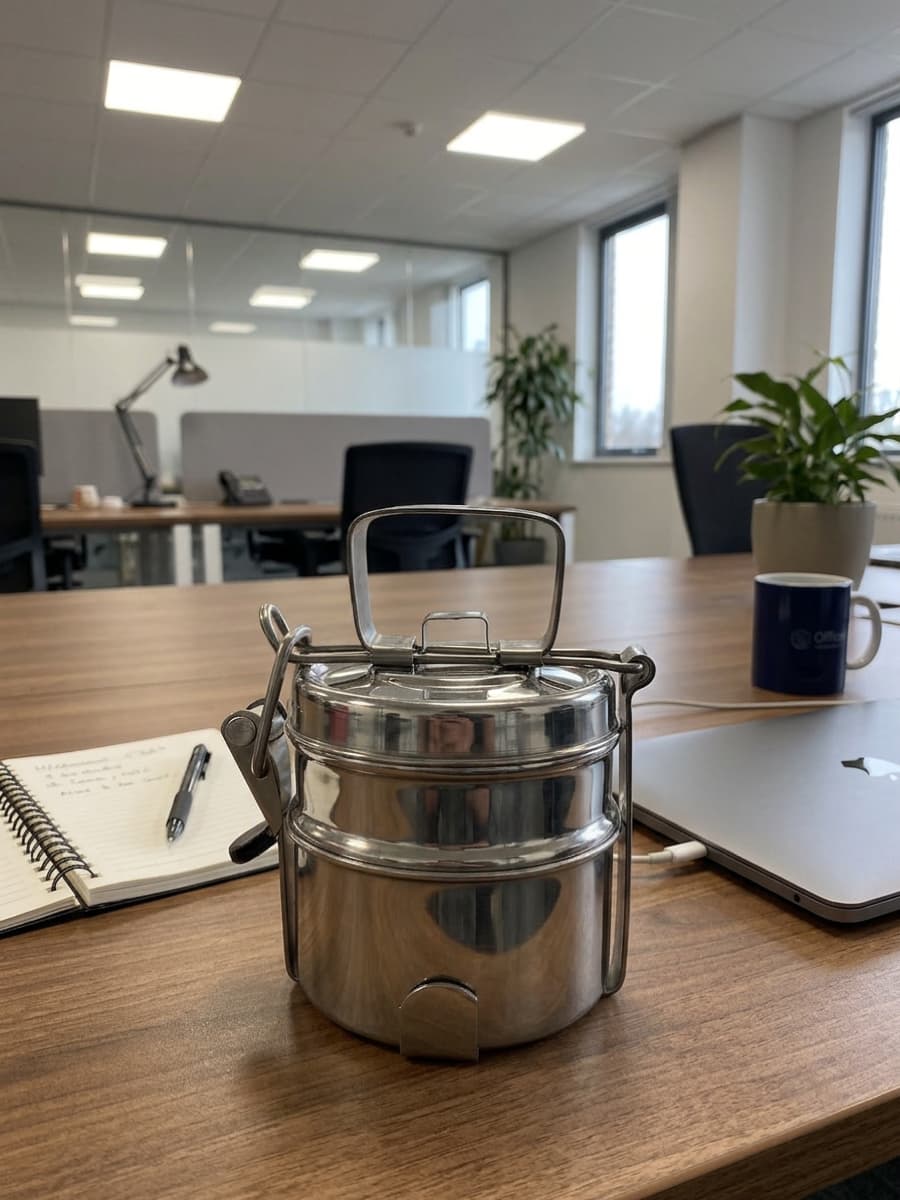
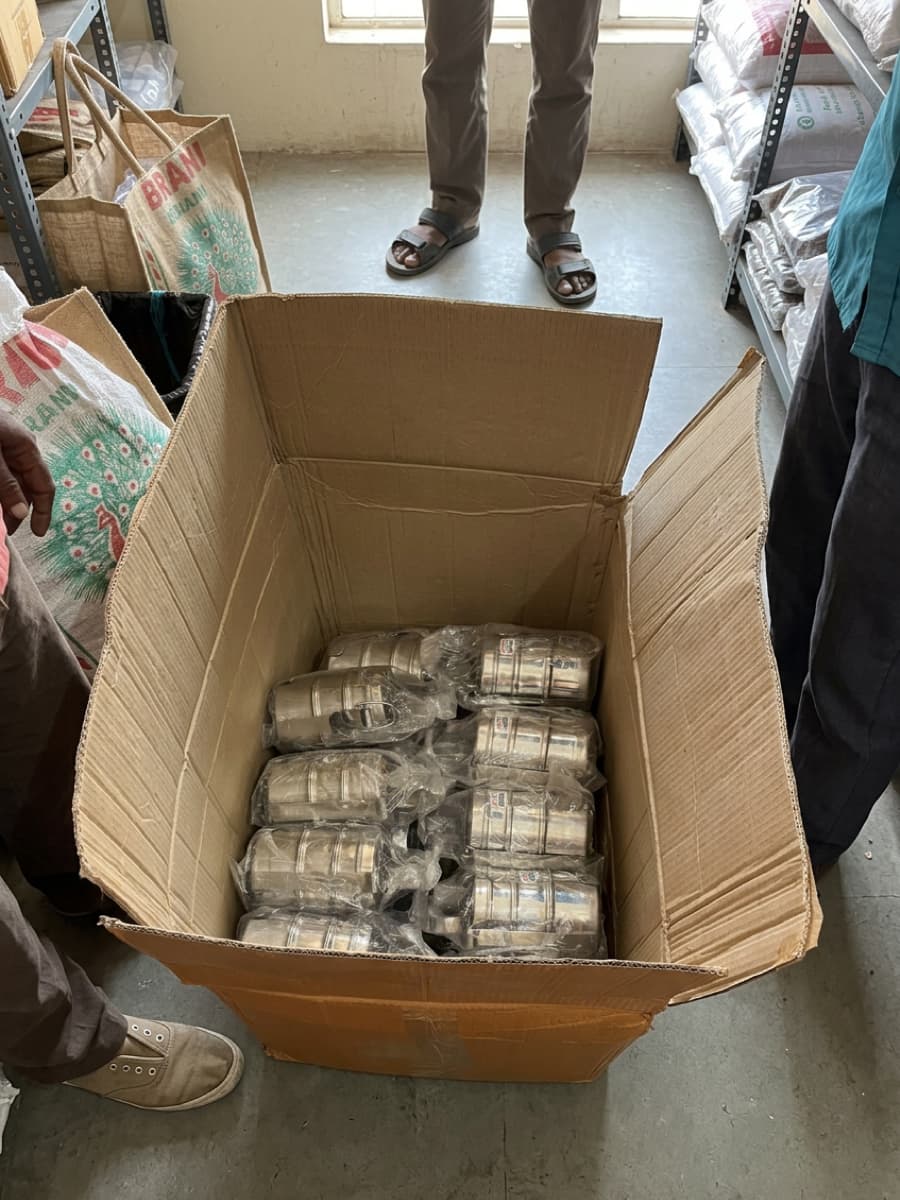
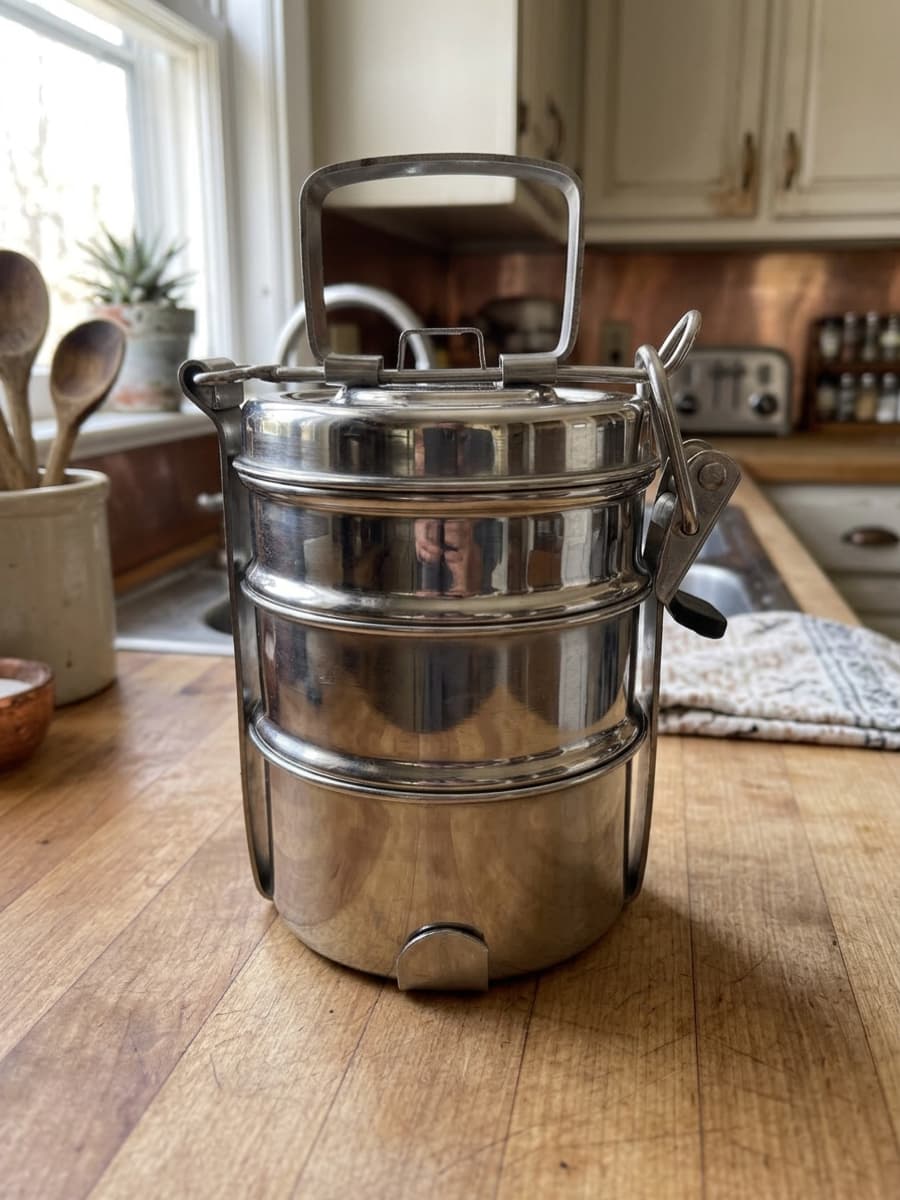
Spotted your tiffinbox out in the world — on a desk, under a tree, mid-team-lunch? Send us the photo at kontakt@thamarai.de. With your permission, we'll feature the best "Tiffinbox in Action" shots in the gallery above.
Gameplan: tiffin in three levels
Building a tiffinbox with us is a small lunchtime game. On our site you'll find a 3D model of the box that you can rotate, open, and interact with. Three levels sit stacked on top of each other, each waiting for a decision — and the moment you pick an option, a video of that exact dish starts playing inside the box itself. You see what you're getting before you order. No guessing from a menu, no surprises you didn't ask for: a visual decision that is unexpectedly fun.
Every tiffinbox is built from a base and one or two karis that you combine as you like. For the base you pick basmati rice, dark Sri Lankan rice, or house-made rice noodles — the line-up rotates regularly so no lunch feels like the last. On top of that comes your first kari: creamy or thin, mild or fierce, with meat, fish, lentils, or vegetables. If you're hungrier, you add a second kari — in Sri Lanka and Tamil Nadu a single kari rarely shows up alone, and the whole idea is to layer flavours: creamy beside sharp, vegetarian beside non-vegetarian. In the background the tiffinbox quietly filters out anything that doesn't work culinarily, so you can't accidentally land on a pairing that no one in Jaffna or Chennai would ever put on a plate. You mix, experiment, and no two of your meals with us will taste the same.
A full tiffinbox with all three levels is yours for €14.90. If the hunger is smaller, there's a compact tiffinbox with just two levels — base plus one kari — for €12.90.
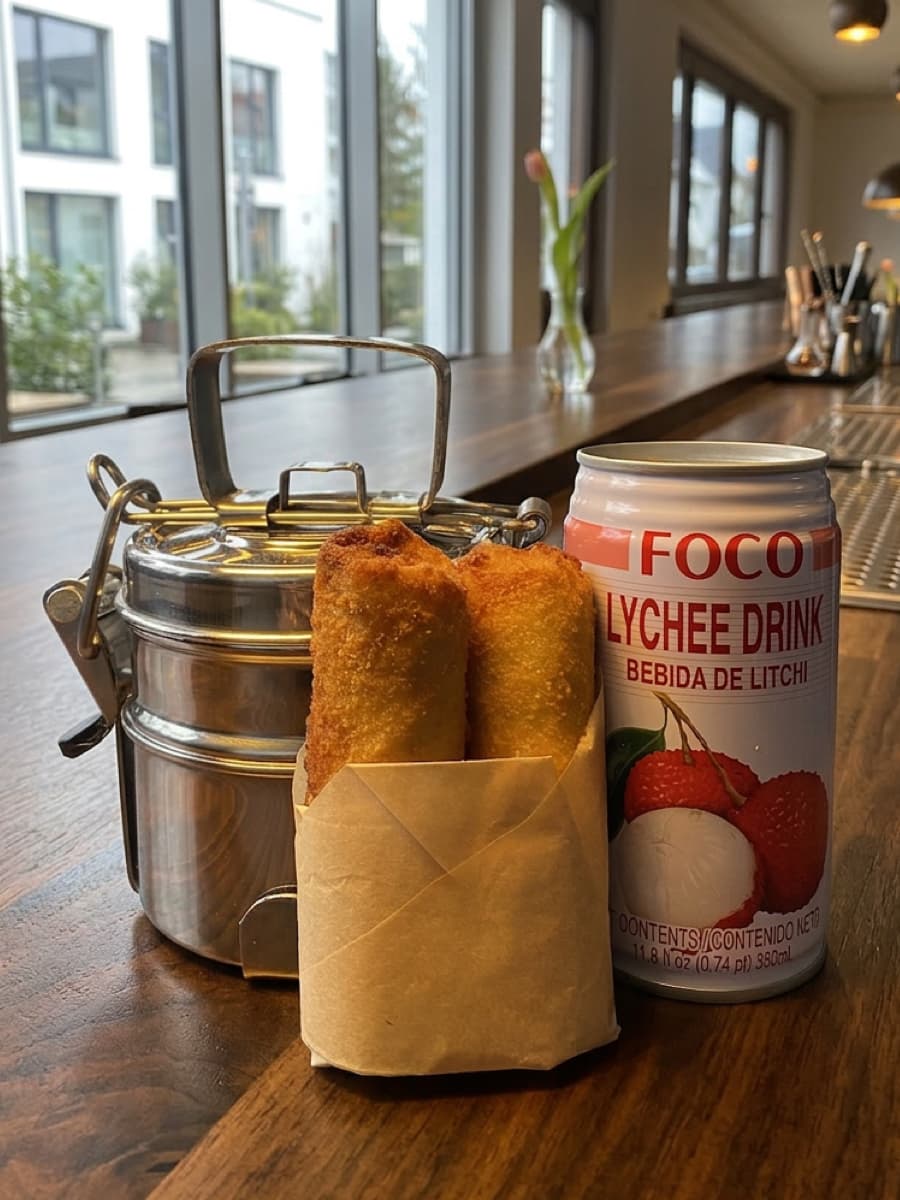
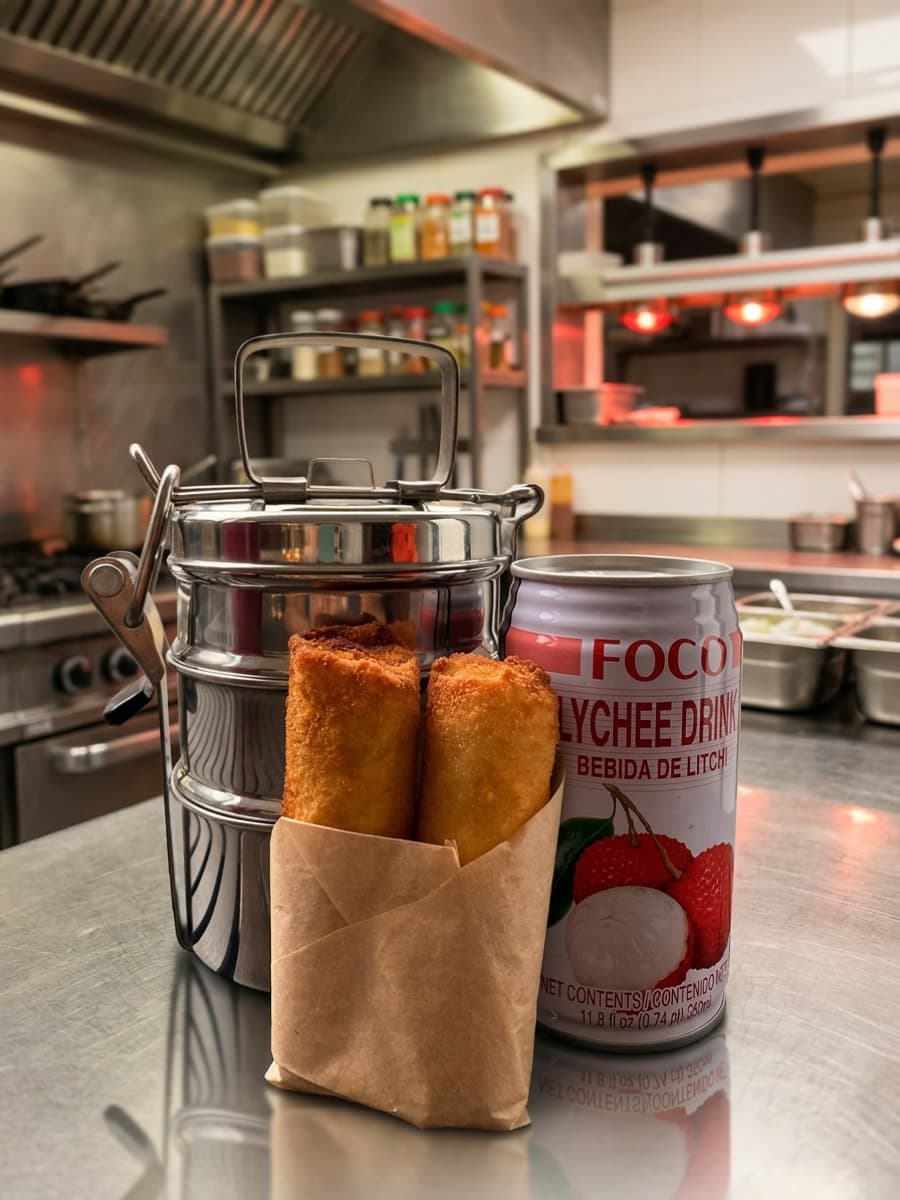
And when you're really up for lunch, the combo upgrade is the one worth taking: for just €5.00 more you get a can of FOCO Exotic juice and two rolls (chicken or veg) on top — a complete lunch package that would cost noticeably more bought separately. Warm meal, cold juice, crunchy rolls: the full midday experience in one hand-off, at a price that quietly adds up in your favour.
Tiffin Loop — honestly considered reuse
We chose against single-use packaging on purpose. No cardboard tray, no plastic clamshell, no aluminium foil container with a snap-on lid. Instead: high-grade stainless-steel boxes that last as long as a good bicycle. The box you're carrying today already has twenty lunches behind it and will see two hundred more — provided it makes its way back to us.
A tiffinbox isn't free. We charge a one-off deposit of €5.00 per box — on the very first order, not every time. After that, the same deposit travels with your box until you bring it back. When you order next time, you tell us in the order form how many boxes you're returning today, and the amount is credited against your current bill on the spot. You trade empty for full — a closed circuit where stainless steel, not waste, moves between our kitchen and your desk.
Why it matters: a single aluminium tray weighs about 40 grams — sounds trivial. But two lunches a week across fifty weeks adds up to four kilos of aluminium per person per year. Every tiffinbox that hits its twentieth use has displaced 800 grams of it. Across a thousand boxes with a hundred uses each, that's a hundred tonnes of packaging waste that simply doesn't show up in Heilbronn — and that isn't a small difference.
We've been at this for only a few months — our first hundred boxes are in circulation. The first months look encouraging: boxes come back, sometimes with a small note, sometimes with a recommendation for a kari we haven't put on the menu yet. For now the mutual trust is paying off — and if it stays that way, we won't need to adjust the system.
Tiffin Club — your lunch on autopilot
If you eat with us regularly, you'll eventually arrive at the obvious question: why not subscribe? That's exactly what the Tiffin Club is for. Every subscription runs on the same rhythm — one tiffin per week, 1 a month. What differs across the 4 tiers isn't the count, it's what's inside the box. If a week gets too busy, your tiffin waits — up to 30 days to redeem it later.
Tiffinclub Madurai is the simplest — two levels, one kari plus a side; classic, filling, from €39.00 a month, which works out to under €10 a week. Tiffinclub Bangalore brings three levels with two karis and a side — more variety, more combinations to try, built for those who want lunch to be a small highlight of the workday. From €49.00.
Tiffinclub Chennai is for snackers: two levels with kari and side, plus the combo pack of a FOCO Exotic juice can and two rolls — made for lunch at the desk or on a train, where something to nibble alongside is welcome. From €59.00. Our premium tier Tiffinclub Mumbai combines three levels with the combo upgrade — the full tiffin experience, every week, no compromises. From €69.00.
All tiers are cancellable monthly, and you can switch between levels at the end of each billing cycle. Hungrier in summer? Step up. Quieter in autumn? Step down. It's your plan, not ours.
Madurai


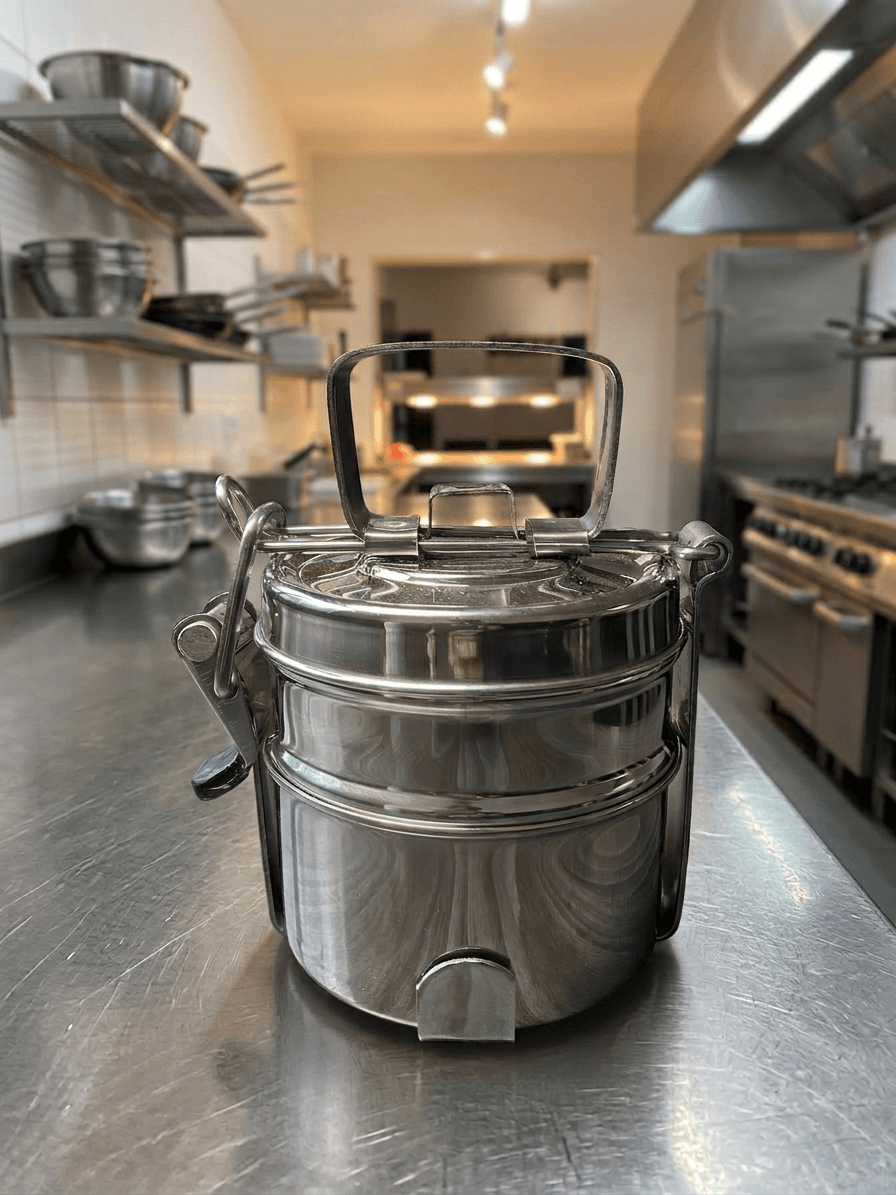
Madurai ist unser Einsteiger-Abo mit der kleinen 2-stöckigen Tiffinbox: Unten die Basis, oben ein Kari deiner Wahl – einmal pro Woche. Ideal, wenn dir ein Kari plus Beilage für ein ausgewogenes, sättigendes Mittagessen reicht.
Tiffin Team — a shared lunch break
Lunch is more fun with company. The Tiffin Team is built for exactly that: everyone on your team orders their own tiffinbox, all of them arrive at the same time, and then you sit down together, click them open, and get curious about what your neighbour picked. Kari-swapping included. It's lunch worth looking forward to — not a quiet canteen routine, but a small daily ritual with your team.
Here's how it runs: your company signs up once and gets its own team link, which you share in Slack, Teams, or WhatsApp. Whoever wants to eat clicks it, sees today's menu, builds a box, orders directly — no prior registration. On the team page you see in real time who has ordered and who is still on the fence. One person starts, the rest follow, and someone eventually shouts "Are the boxes ready?" across the office.
Ten or more boxes and we deliver them on time, right at the start of your lunch break — one person accepts the delivery, everyone else keeps working. Below ten, you pick them up from us; the team page shows in real time who's on pickup duty and exactly when the boxes are ready. For the person coordinating the lot — we call them the Tiffinbox Lead — there's a dedicated cockpit: past orders, team favourites, monthly billing, feedback channels. Everything behind one shareable link.
More details and the corporate signup are on our Tiffin Team page. We've started small with a handful of pilot teams because we want to learn what works before we scale — if your team wants to be in early, get in touch. Whether you order solo, sign up for a subscription, or bring your whole office along: the tiffinbox at its core stays the same — honest lunch, packed in steel, made for people who don't want to leave their lunch break to a vending machine.
Weiterlesen
Mehr aus der Thamarai-Küche.