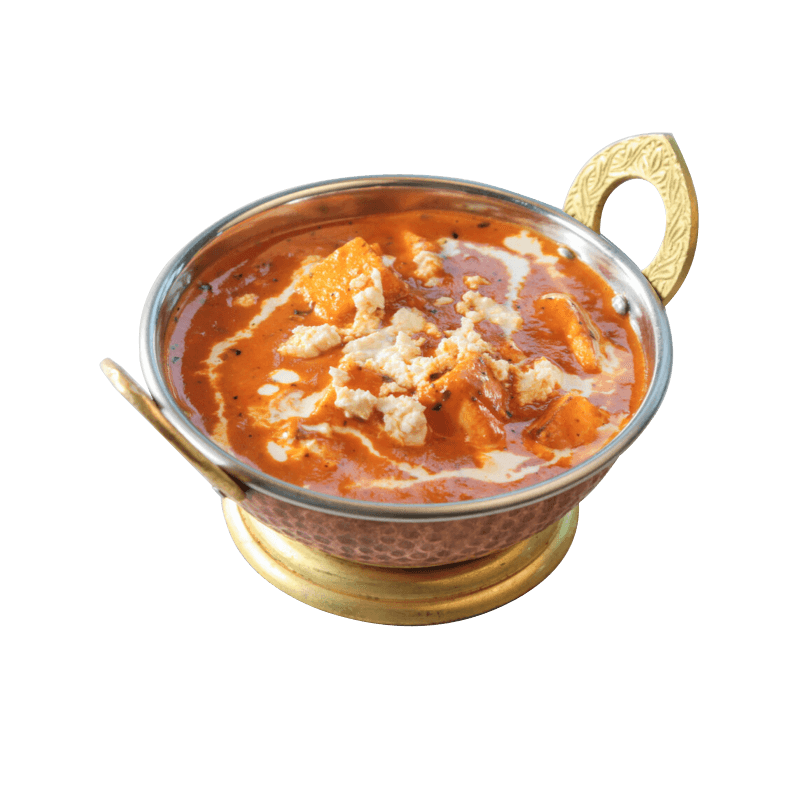
The vegetarian answer to Butter Chicken.
Fresh paneer, slow-cooked tomatoes, roasted cashews, butter and cream. A North Indian classic at THAMARAI Heilbronn.
What Is Paneer Butter Masala?
Paneer Butter Masala is soft, pillowy cubes of fresh paneer cheese — a pressed Indian cottage cheese, mild and milky, with a texture somewhere between firm tofu and fresh mozzarella — bathed in a velvety sauce of slow-cooked tomatoes, roasted cashew paste, butter, cream, and a careful arrangement of warm North Indian spices. The sauce is silky rather than chunky, rust-orange rather than red, and so gentle in its spicing that it reads as comfort food even to palates encountering Indian cuisine for the first time.
If you have read our Butter Chicken page, you already know this sauce. You know its history — born in a refugee's kitchen in 1947 Delhi, refined at Moti Mahal, carried across oceans by millions of Indian cooks. The sauce that conquered the world. Paneer Butter Masala is its vegetarian sibling: the same velvety tomato-butter-cream architecture, the same gentle warmth, but with fresh paneer standing where tandoori chicken once stood.
At THAMARAI in Heilbronn, we source our paneer fresh, simmer the masala until the tomatoes break down completely into a glossy, rust-coloured gravy, and add the paneer at the very end — just long enough to warm through and absorb the first layer of sauce, never so long that it loses its softness. The result is one of the most popular vegetarian dishes in Indian cuisine, and one of the most beloved vegetarian dishes on our menu.
Not Our Grandmother's Dish Either
Our other stories about our dishes begin in a kitchen in Jaffna. A grandmother grinding spices on a stone. A mother cycling to the market in Urkavathurai. Memories carried across the Indian Ocean to a German city.
This is not one of those stories.
Our parents did not grow up with Paneer Butter Masala. They had never heard of it. In the Eelam Tamil kitchen — the kitchen of the Jaffna peninsula, of Manipay and Kopay and Chavakachcheri — paneer simply did not exist. Not the word, not the ingredient, not the concept. The protein in a Tamil vegetarian meal came from lentils, chickpeas, and the mighty coconut. If you had described paneer to our grandmother — a cheese made by curdling milk with lemon juice and pressing it into a block — she would have nodded politely and then gone back to making her Paruppu Kari, because why on earth would you deliberately curdle perfectly good milk when you could drink it, feed it to the children, or let it become curd naturally?
Paneer Butter Masala arrived in our family's life the way so many adopted dishes do: through curiosity, through necessity, and through the simple realisation that our vegetarian friends deserved something extraordinary.
The Vegetarian Problem
Here is the truth that nobody in the restaurant industry likes to say out loud: vegetarian guests have historically been treated as an afterthought.
Walk into any average restaurant — Indian or otherwise — and the vegetarian section of the menu is shorter, less inspired, and less celebrated than the meat section. The chef's attention, the kitchen's creativity, the glamour of the description — all of it gravitates toward the non-vegetarian dishes. Vegetarians get the side dishes, the fillers, the apologetic last entry on the menu. We also have a vegetable curry.
We knew this was wrong. We knew it because we grew up in a culture where vegetarianism is not a dietary trend or a lifestyle choice — it is a philosophical tradition stretching back thousands of years. In Hindu thought, the principle of ahimsa — non-violence, non-harm to all living beings — has shaped the eating habits of hundreds of millions of people across the Indian subcontinent. Roughly thirty to forty per cent of India's population identifies as vegetarian, with rates as high as seventy-five per cent in states like Rajasthan. This is not a fad. This is an ancient, deeply held conviction about the relationship between humans and the world they inhabit.
And yet even in Indian restaurants, the vegetarian menu was often the quieter sibling. The Butter Chicken got the spotlight. The Rogan Josh got the love. The vegetarian guests got a Dal and a Palak Paneer and a polite smile. Good dishes, certainly — but rarely the hero dish, rarely the one that made you close your eyes and forget where you were for a moment.
We wanted to change that. We wanted a vegetarian dish that could stand on the same stage as our Butter Chicken — the same richness, the same depth, the same feeling of occasion. And the answer, it turned out, had been sitting on menus across North India for decades.
How Paneer Butter Masala Came to Exist
Paneer Butter Masala does not have a single inventor. There is no Kundan Lal Gujral moment, no refugee kitchen epiphany, no court case between rival families claiming credit. If you have read our Butter Chicken page, you know that origin story — the Partition of India, the tandoor, the dried-out chicken, the improvised sauce. Paneer Butter Masala emerged from the wake of that invention, quietly and without fanfare, in the restaurants and dhabas of North India during the 1960s and 1970s.
What happened was simple and, in hindsight, inevitable. The makhani sauce — that velvety tomato-butter-cream gravy that had made Butter Chicken the most famous dish in Indian cuisine — had become a kitchen staple. Every North Indian restaurant had a pot of it simmering on the back burner. And every North Indian restaurant had vegetarian customers who looked at the Butter Chicken with longing and said: Is there nothing like that for us?
The answer was paneer. Paneer was already the dominant vegetarian protein in Punjabi cooking — used in Palak Paneer, Matar Paneer, Shahi Paneer, Kadai Paneer, and a dozen other preparations. It was mild enough to absorb any sauce without competing with it. It was firm enough to hold its shape in a gravy. And it was rich enough — dense with protein and fat from whole milk — to feel substantial, to feel like a main course rather than a garnish.
Someone — no one remembers who, no one ever will — dropped cubes of paneer into a pot of makhani sauce, and Paneer Butter Masala was born. Not with a bang, but with a quiet nod from a generation of vegetarian diners who finally had their answer to Butter Chicken.
More Than a Hype
You will sometimes hear Paneer Butter Masala described as a trend. A hype. The latest thing on Instagram, the darling of food bloggers, the dish that every second recipe video on YouTube seems to feature.
We need to push back on that, gently but firmly.
Paneer Butter Masala is not a hype. A hype is something that arrives with noise and leaves with a shrug. Cronuts were a hype. Gold-leaf burgers were a hype. Paneer Butter Masala has been on restaurant menus across India for over fifty years. It is one of the top five most-ordered vegetarian dishes on every major Indian food delivery platform — Swiggy, Zomato, the lot. It is the dish that vegetarian guests order at Indian weddings, at family celebrations, at business dinners. It is the dish that Indian students cook in their dormitory kitchens in Berlin, in London, in Toronto, in Melbourne — not because it is fashionable, but because it tastes like the restaurant down the road from home.
A dish that has sustained itself for five decades, across continents, across generations, across every possible change in food fashion — that is not a hype. That is a classic. And like all true classics, it earned its place not through marketing but through the simple, unglamorous act of being reliably, consistently, deeply good.
What happened in recent years is not that Paneer Butter Masala became popular. It was popular. What happened is that the world outside India finally noticed. The global vegetarian movement — which has been gaining strength in Europe and North America since the 2000s — discovered that Indian cuisine had been doing world-class vegetarian cooking for centuries, and Paneer Butter Masala became one of its ambassadors. Germany's own strong vegetarian culture — one of the highest rates of vegetarianism in Europe — found in PBM a natural ally: rich, satisfying, protein-dense, and unapologetically indulgent. When you search for vegetarisch indisch essen in any German city, Paneer Butter Masala will be on the first menu you find.
It is here to stay. It was always here to stay.
What Is Paneer?
Before we go further, we owe you an answer to the most basic question: what exactly is this white, mild, slightly crumbly cheese that holds its shape in a boiling sauce?
Paneer — Panir in German, from the Persian panir meaning cheese — is a fresh, unaged, acid-set cheese. It is made from only two ingredients: whole milk and an acid. No rennet, no bacterial cultures, no ageing, no fermentation. It is perhaps the simplest cheese in the world, and one of the most elegant.
The word itself tells you something about its origins. Panir is a Persian loanword, and most food historians — K.T. Achaya, Lizzie Collingham, Colleen Taylor Sen among them — agree that the technique of acid-setting milk into a pressed cheese was brought to the Indian subcontinent by Persian and Afghan rulers, most likely during the Delhi Sultanate period between the thirteenth and sixteenth centuries. The Mughals, who ruled much of India from 1526 onward, cemented paneer's place in North Indian cuisine. In their lavish royal kitchens — the same kitchens that gave us the cream-and-butter tradition behind our sauce — paneer became a staple, cooked in rich gravies alongside the ghee, cream, and ground almonds that defined Mughlai cooking.
Ancient Indian texts do mention curdled milk products — the Vedic literature speaks of kilat, a kind of coagulated milk offering — but the pressed, firm, sliceable block that we know as paneer today is a distinct innovation, almost certainly imported. The Sanskrit word for these early curd products was different from paneer, and the technology of pressing curds into blocks appears to have arrived from the north-west, travelling the same trade and conquest routes that brought so much of Central Asian and Persian culture to the subcontinent.
This matters because it explains why paneer does not exist in South Indian or Eelam Tamil cooking. The Mughal Empire's cultural influence reached deep into North India — Punjab, Delhi, Uttar Pradesh, Rajasthan — but its penetration into the southern peninsula was far weaker. Tamil Nadu was governed by the Cholas, the Pandyas, the Vijayanagara Empire, and later the Nayaks — dynasties with their own rich culinary traditions built on entirely different foundations. The Tamil kitchen developed its vegetarian protein from lentils, chickpeas, and coconut, not from curdled milk pressed into blocks. Dairy existed — curd, buttermilk, ghee — but these were fermented or rendered products, not acid-set cheeses. The idea of deliberately curdling milk with lemon juice would have seemed, to a traditional Tamil cook, like a waste of good milk.
How Paneer Is Made
The process of making paneer is ancient in its simplicity and deeply satisfying in its immediacy. You begin with milk, you end with cheese, and the entire transformation takes less than two hours.
Full-fat milk — cow or buffalo, though buffalo yields a denser, richer paneer — is brought to a rolling boil in a heavy-bottomed pot. The moment the milk rises and threatens to overflow, the heat is lowered and an acid is added: fresh lemon juice, white vinegar, or citric acid, roughly two tablespoons per litre. The acid does what no amount of stirring or heating can do alone — it causes the casein proteins in the milk to denature, to unfold from their neat molecular structures and clump together, pulling the fat along with them. Within seconds, the pot transforms. What was a uniform white liquid separates into two distinct substances: curds — soft, white, pillowy clumps of protein and fat — and whey, the thin, greenish-yellow liquid left behind.
The curds are poured through a muslin cloth draped over a colander. The whey drains away. Cold water is run over the curds to wash away the residual acid taste and to stop the cooking. Then the muslin is gathered, twisted tight, and the bundle is placed under a heavy weight — a pot of water, a stack of plates, a cast-iron pan. Time and pressure do the rest. An hour yields a soft, delicate paneer. Two hours yields something firmer, more sliceable. Three hours yields a block dense enough to dice into perfect cubes that will hold their shape in a boiling sauce.
One litre of milk produces roughly two hundred grams of paneer. The arithmetic is humbling: most of what was in the pot goes down the drain as whey. What remains is concentrated richness — roughly eighteen grams of protein per hundred grams, a generous amount of calcium, and enough fat to give paneer its characteristic creamy mouthfeel.
Why "Paneer Butter Masala" and Not "Butter Paneer"?
A question that catches the attention of anyone who has ordered both dishes on the same evening: why do we say Butter Chicken — adjective first, protein second — but Paneer Butter Masala, with the protein leading and the adjective following?
The answer lies in the way the name evolved. Butter Chicken follows the English compound-noun pattern — chocolate cake, lemon tart, butter chicken — and was likely standardised for English-speaking menus in the diaspora. In Hindi, the dish is called murgh makhani, buttery chicken, with the adjective following the noun as Hindi grammar requires.
Paneer Butter Masala follows a different logic entirely. Here, butter masala is not an adjective describing the paneer — it is a sauce category. The name means, essentially, paneer in butter masala gravy. The protein comes first because it is the variable; the sauce comes second because it is the constant. You could have paneer butter masala, mushroom butter masala, kofta butter masala — the sauce is the architecture, and the protein is the guest.
In practice, both forms coexist. Walk into a North Indian restaurant and you will find menus listing Paneer Butter Masala, Butter Paneer, Paneer Makhani, and Paneer Makhanwala — all referring to essentially the same dish, with regional and personal preferences determining which name appears. Paneer Makhani is the Hindi purist's choice. Butter Paneer is common in casual dhaba settings. Paneer Butter Masala has become the dominant formal menu name, particularly in restaurants that want to signal the sauce as a distinct preparation rather than simply paneer cooked in butter.
The Sauce — Same DNA, Different Conversation
If you have read our Butter Chicken page, you already know this sauce intimately. You know about the mountain of ripe tomatoes, cooked low and slow until they collapse into a thick, rust-coloured paste. The cashew nuts, soaked and blended to a fine paste for body and sweetness. The butter — not ghee, but actual butter, added twice: once during cooking, once at the end as a cold pat that melts slowly on the surface. The cream that rounds the edges. The dried fenugreek leaves, kasuri methi, crumbled between the palms at the very end.
The foundation is the same. The DNA is shared. But the conversation between sauce and protein is different, and that difference matters more than most people realise.
When you simmer chicken in makhani sauce, the chicken gives back. It releases its juices, its fats, the smoky residue of the tandoor marinade. The sauce and the chicken co-develop over fifteen or twenty minutes, exchanging flavours in both directions. The result is a dish where protein and sauce are inseparable, where each has shaped the other.
Paneer gives nothing back. It is a silent partner. It sits in the sauce and absorbs — quietly, passively, generously — but it contributes no flavour of its own. This means the sauce must do all the talking. It must be more assertive, more complete, more self-contained than the Butter Chicken version. In our kitchen, the Paneer Butter Masala sauce is very slightly sweeter — a touch more sugar to compensate for the absence of the chicken's savoury depth. The cashew paste is a fraction more generous, giving the sauce a thicker, more coating-like consistency, because paneer does not release moisture the way chicken does. And the fenugreek is a shade more prominent, doing more of the heavy lifting now that there is no smoky tandoor flavour to share the stage.
These are subtle differences. If you tasted the two sauces side by side, you might not identify them immediately. But they are the differences between a sauce designed to collaborate with a protein and a sauce designed to carry one — and that distinction is the craft behind the dish.
A Dish Our Parents Never Knew
We should tell you how Paneer Butter Masala actually entered our kitchen, because the story is not what you might expect.
It did not come from nostalgia. It did not come from a family recipe. It came from our vegetarian friends sitting at the table, looking at the Butter Chicken being served to the next table, and asking — with varying degrees of politeness and longing — whether there was anything like that for them.
For years, the answer was: not quite. We had vegetarian dishes, good ones — our Jaffna-rooted vegetarian curries, the Katharikkai Kari, the Paruppu Kari, all magnificent in their own right. But they were a different kind of food. Coconut-based, tamarind-soured, fiercely spiced in the Jaffna way. If what you craved was that specific tomato-butter-cream embrace — that warm, gentle, velvety hug of a sauce — our Tamil vegetarian dishes, as proud as we were of them, were not the answer. They were playing a different song entirely.
And so we began to dig. We explored the world of Paneer Butter Masala — a dish that, as we soon discovered, had been answering exactly this question in North Indian restaurants for decades. The more we learned, the more we understood: this was not a compromise dish. This was not the thing you order when you cannot have the Butter Chicken. This was a dish that had earned its own place, its own following, its own love — a dish ordered by choice, not by default, by millions of vegetarians across India and the world.
We fell in love with it for the same reason we fell in love with Butter Chicken: the contrast. Where our Eelam Tamil kitchen is built on coconut milk and tamarind, on fierce Jaffna chilli and smoky roasted spice, this sauce is the polar opposite — gentle, creamy, rich with butter and tomato, almost sweet in its warmth. It is not better or worse than our food. It is the other end of the spectrum, and having both on the same table makes each one more vivid.
The difference this time is that we did not need to learn a new protein. We needed to learn paneer. And that — understanding how milk becomes cheese, what separates a soft, pillowy cube from a rubbery block, how freshness transforms the dish — became its own journey.
A Gentle Disclaimer
We should mention this now, before the story goes any further, because we have seen it happen and we would rather save you the embarrassment.
If you come to THAMARAI, fall in love with our Paneer Butter Masala, fly to the island where our family comes from, walk into a restaurant in Jaffna or Kilinochchi or Trincomalee, and order Paneer Butter Masala — you will receive a very polite, very confused stare. They will not have it. They will not know what it is. They might, if you are lucky, know what paneer is, because globalisation has carried the word further than the ingredient. But they will not have a block of it in their kitchen, and they will certainly not have a pot of makhani sauce simmering on their stove.
This is a North Indian dish. Proudly, unapologetically, exclusively. It comes from the Punjabi-Mughlai kitchen tradition — the same tradition that gave the world Butter Chicken, Dal Makhani, Naan, and Tandoori everything. It does not come from Jaffna. It does not come from our family. We adopted it because we fell in love with its tomato-rich, contrast-heavy sauce and because our vegetarian guests deserved a dish as indulgent as anything on the non-vegetarian menu.
Please do not walk into a Jaffna restaurant and tell them you had the most wonderful Paneer Butter Masala at THAMARAI. We are flattered, truly we are, but the cook in Jaffna will look at you the way a Swabian grandmother would look at you if you asked her for a Bavarian Weisswurst — with a mixture of bemusement and mild territorial offence. Every kitchen has its own genius. The genius of Jaffna is the Prawn Kari and the Katharikkai Kari. The genius of Punjab is the makhani sauce. We are fortunate enough to serve both under one roof, but we are under no illusion about who invented what.
Paneer Across India — Who Knows It, Who Does Not
One of the most surprising things about paneer, for people who encounter it first in a German or British Indian restaurant, is that large parts of India have never traditionally eaten it.
Paneer is, historically and culturally, a North Indian ingredient. In Punjab, Haryana, Delhi, Uttar Pradesh, and Rajasthan, paneer is a daily staple — as familiar as potatoes, as essential as onions. A Punjabi kitchen without paneer is like a Swabian kitchen without Spätzle: technically possible, but culturally unthinkable. Paneer appears at breakfast (paneer bhurji, scrambled with onions and spices), at lunch (palak paneer, matar paneer), at dinner (shahi paneer, paneer butter masala), and at every celebration in between. In these states, the question is not whether you eat paneer but which of the forty-seven preparations you feel like today.
Move south, and the picture changes dramatically. In Tamil Nadu, Kerala, Karnataka, and Andhra Pradesh, paneer was traditionally unknown. These states developed their own magnificent vegetarian protein traditions — the lentil-based dals, the chickpea curries, the coconut-enriched kootu and avial — and had no culinary need for a pressed cheese from the north. When paneer appears in South Indian cities today, it is almost always in North Indian restaurants, on menus explicitly labelled as Punjabi or Mughlai, and it is understood by everyone as a borrowed ingredient rather than a local one.
In our family's homeland — the Jaffna peninsula and the Tamil-speaking regions of the island — paneer is even more absent. The reasons are the same ones we described in our Butter Chicken article: the coconut kitchen, the tamarind-based flavour logic, the minimal Mughal influence. But there is an additional reason specific to paneer: the traditional reluctance to curdle milk with acid. In many South Indian and Eelam Tamil households, curdling milk was considered inauspicious — a kind of violation of the natural process. Yoghurt was acceptable because it involved natural bacterial fermentation; acid-curdling was seen as forcing the milk to break, and that felt wrong. This is not a scientific judgement — it is a cultural one, deeply felt and rarely articulated, but real enough to have kept paneer out of Tamil kitchens for centuries.
Frequently Asked Questions
Visit Us in Heilbronn
THAMARAI sits in Heilbronn-Sontheim, right on the banks of the Neckar — steps from the Neckartal-Radweg, the 370-kilometre cycling route that follows the river from its source in the Schwenninger Moos to Mannheim. If you are coming by bicycle from Bad Wimpfen, Neckarsulm, or Lauffen am Neckar, you are practically at our door.
There is also a lesser-known way to approach us that we are particularly fond of. From 1996 until around 2012, Germany's first taxi boat — the Neckarperle, operated by the Heilbronn-based Personenschifffahrt Stumpf — ran an hourly shuttle service along the old Neckar, connecting the Friedrich-Ebert-Brücke in the city centre to stops downstream, including one in Sontheim. For a single Deutsche Mark, you could board in the Innenstadt and float downstream to our neighbourhood. That service, sadly, no longer runs — the Neckarperle was sold to Berlin in 2013, where she now sails the Spree as the MS Charleston. Since April 2025, the Weisse Flotte Heidelberg operates sightseeing cruises from the Marrahaus landing in the city centre with the MS Käthchen, and there are plans for extended upstream routes that would pass directly alongside Sontheim. We are watching those plans with interest.
But the simplest way to reach us remains the oldest: walk, cycle, or drive to Heilbronn-Sontheim, find the restaurant on the Neckar, and sit down. The Paneer Butter Masala will be waiting — soft, golden, and warm.
Nutrition at a Glance
Per serving, based on a standard portion size.

