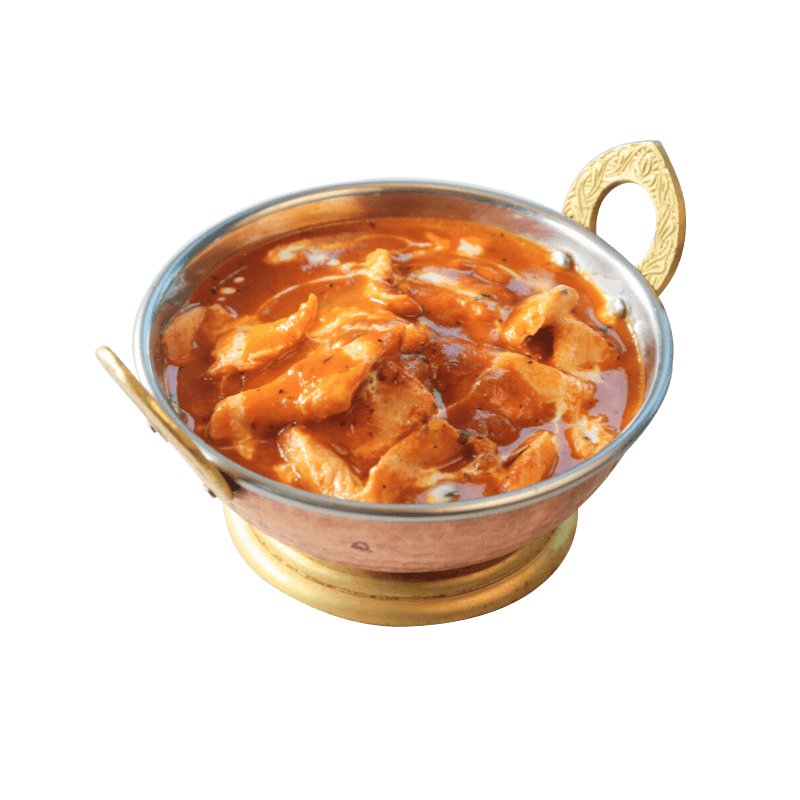
A dish from a foreign kitchen, loved anyway.
Butter Chicken — a Punjabi original, adopted with respect. Marinated overnight and finished in a velvety tomato-butter-cream sauce.
What Is Butter Chicken?
Butter Chicken — known in Hindi as murgh makhani, literally butter chicken — is the dish that introduced half the world to Indian cuisine. Tender pieces of chicken, marinated overnight in yoghurt and spices, charred at searing heat in a clay tandoor oven, then simmered in a velvety sauce of slow-cooked tomatoes, cashew paste, butter, cream, and a careful constellation of warm spices — fenugreek leaves, cardamom, clove, cinnamon, a whisper of sugar to balance the acidity of the tomatoes. The sauce is silky rather than chunky, rust-orange rather than red, and so gentle in its spicing that it reads as comfort food even to palates that have never encountered a single Indian spice before. This is precisely why it conquered the world.
At THAMARAI in Heilbronn, we serve Butter Chicken because we believe an honest menu should tell the truth about where its dishes come from. This one does not come from Jaffna. It does not come from the Tamil kitchen. It comes from the Punjabi kitchen of northern India, from a very specific restaurant in Old Delhi, from a very specific moment in history — and its story is worth telling properly, because it is one of the great origin stories in modern gastronomy.
A Confession — This Is Not Our Story
Anyone who has read our other dish pages — the Katharikkai Kari, the Jaffna Prawn Kari, the Paruppu Kari — will have noticed a pattern. There is always a kitchen in Jaffna. There is always a grandmother. There is always a memory carried across the Indian Ocean to a German city. Those stories are real, and they are ours.
This is not one of them.
If you expected us to tell you another tale from inside a Tamil home on the Jaffna peninsula — a mother roasting spices on a clay stove, a daughter learning by watching — you will be gently disappointed. Our mothers and fathers had never heard the words Butter Chicken growing up. Not in Urkavathurai, not in Manipay, not in Kopay, not in Chavakachcheri. It was not a phrase that existed in their vocabulary, because it was not a dish that existed in their world. They came across it only abroad, only after crossing an ocean, only in the Indian restaurants of Germany and Canada and the United Kingdom — restaurants that were, more often than not, run by Punjabis, not Tamils.
And if you are sitting there thinking, well, surely someone in Jaffna or Kilinochchi or Trincomalee or Batticaloa must have cooked something like Butter Chicken at some point — we must correct that assumption with a smile and a firm shake of the head. There is no Butter Chicken anywhere on the island. Not in Eelam, not in the south, not in the hill country. Not in the 1970s, not in the 1980s, and not today. The dish simply does not belong to the culinary tradition of that land, and pretending otherwise would be the kind of well-meaning dishonesty that we have spent a lifetime learning to avoid.
So this page is different. This is the story of someone else's kitchen — told with respect, with curiosity, and with the honest admission that we fell in love with a dish that was never ours, and decided to cook it anyway.
Why Butter Chicken Never Existed in Jaffna
To understand why Butter Chicken could not have emerged from a Tamil kitchen in the north of the island, you need to understand what that kitchen was built on — and what it was not.
The Jaffna Tamil kitchen is a coconut kitchen. Coconut oil for frying. Coconut milk for curries. Freshly grated coconut for sambols and poriyals. The fat that defines every dish, that gives Jaffna food its characteristic richness, is coconut — not butter, not cream, not ghee. Dairy played a minimal role in traditional Jaffna cooking. Cows were kept, certainly, but their milk went to curd and to the children's cups, not into the curry pot. The idea of finishing a sauce with a slab of butter and a pour of heavy cream would have struck Ammama — our grandmother — as not merely foreign but faintly absurd. Why would you add butter when you had coconut milk fresh from the shell?
Then there is the tomato question. Butter Chicken is, at its core, a tomato sauce. Without tomatoes, there is no Butter Chicken — full stop. And while tomatoes were not entirely absent from Jaffna gardens, they were never central. The peninsula's soil is sandy, calcium-rich coral limestone, excellent for palmyra palms and aubergines but not ideal for the heavy-feeding, water-hungry tomato plant. A few bushes might appear in a kitchen garden, staked to palmyra sticks, producing small, firm fruits used sparingly in a rasam or a quick curry. But the kind of tomato abundance that North Indian cooking demands — kilos of ripe, fleshy tomatoes, cooked down for hours into a thick, concentrated sauce — was simply not part of the Jaffna landscape. The acid backbone of Tamil cooking was tamarind, not tomato. The sourness came from the tamarind pod, the raw mango, the lime — never from a pile of crushed tomatoes.
And then there is the deepest reason of all: culinary tradition. The Jaffna Tamil kitchen evolved over centuries within a Hindu agricultural community. Vegetarianism was the cultural centre of gravity. Meat, when it appeared, was prepared in the Tamil way — roasted spice pastes, curry powders individually dry-roasted until almost black, the fierce heat of Jaffna chilli, the sourness of tamarind, the silk of coconut milk. The Mughal-influenced cuisine of northern India — with its tandoors, its cream-laden gravies, its liberal use of ghee and butter, its gentle spicing designed for royal courts — existed in an entirely different culinary universe. These two traditions developed independently, separated by two thousand kilometres of geography and several centuries of divergent cultural history. They are both extraordinary. They are not the same.
The Tandoor, the Refugee, and the Sauce
The story of Butter Chicken begins not with a recipe but with a catastrophe.
In 1947, the British partitioned the Indian subcontinent into two nations: India and Pakistan. The line drawn through Punjab — the ancient land of five rivers — split communities, families, and livelihoods overnight. Millions of people were displaced. Hindus and Sikhs fled westward from what became Pakistan; Muslims fled eastward from what became India. It was one of the largest and most violent mass migrations in human history, and it reshaped the culinary map of the subcontinent in ways that are still being felt today.
Among the millions who crossed the new border was a man named Kundan Lal Gujral. He had been running a small restaurant called Moti Mahal — Palace of Pearls — in the Gora Bazaar district of Peshawar, in what was now Pakistan. Gujral was a Punjabi Hindu, a cook by trade and by temperament, and he had spent decades perfecting his craft in Peshawar's bustling food scene. His speciality was tandoori cooking — chicken marinated in yoghurt and spices, then roasted in a blisteringly hot clay tandoor oven until the exterior was charred and smoky and the interior remained juicy. The tandoor itself was ancient technology — archaeological remains of clay ovens have been found in the Indus Valley dating to 2600 BCE — but Gujral had turned it into an art form.
When Partition came, Gujral lost everything. He arrived in Delhi as a refugee, with his skills and his reputation but without his restaurant, his equipment, or his savings. He was allocated a small space in Daryaganj, in the lanes of Old Delhi, through a government rehabilitation scheme. There, in 1947 or 1948 — the exact date is disputed, like everything else in this story — he reopened Moti Mahal.
The tandoori chicken was an immediate success. Delhi had not seen anything quite like it. Tandoori cooking was a North-Western Frontier tradition — common in Peshawar, Rawalpindi, and the Punjab — but it was relatively unknown in Delhi before the great wave of Partition refugees brought it south. Gujral's chicken, with its lurid red-orange marinade and its smoky, charred exterior, was a revelation. Within months, it had caught the attention of Delhi's political elite. Jawaharlal Nehru, India's first Prime Minister, became a regular patron. He brought foreign dignitaries to Moti Mahal — the Shah of Iran, Richard Nixon, Jacqueline Kennedy, Soviet leaders — and tandoori chicken became, almost by accident, a dish of state.
But tandoori chicken had a problem. It dried out. A freshly roasted bird, pulled from the tandoor at the peak of its juiciness, was magnificent. The same bird, sitting under a heat lamp for an hour while waiting for a late table, was tough, stringy, and unforgiving. And in a busy restaurant serving hundreds of covers a night, there were always leftovers — perfectly good pieces of tandoori chicken that had lost their magic to time and heat.
This is where the story turns. Gujral — or someone in his kitchen, depending on which family member you ask — began experimenting with a sauce. The idea was simple: take the dried-out tandoori chicken, simmer it in a rich, buttery gravy, and bring it back to life. Tomatoes were crushed and cooked down until they collapsed into a thick paste. Butter — not ghee, but actual butter, a nod perhaps to the British officers who had frequented the original Moti Mahal in Peshawar's garrison district — was added generously. Cream softened the acidity. A handful of cashews, ground to a paste, gave the sauce body and a faint sweetness. Fenugreek leaves, dried and crumbled, provided an earthy, bittersweet undertone that became the dish's secret signature. The spicing was deliberately gentle — garam masala, a touch of chilli, cardamom, cinnamon — because the point was not to overpower the chicken but to cradle it.
The result was murgh makhani — butter chicken. And it was, by any measure, a masterpiece of pragmatism. A dish born not from inspiration but from necessity. Not from abundance but from scarcity. A refugee's solution to the problem of waste, transformed into one of the most ordered dishes on the planet.
The Legal Battle over a Gravy
There is a footnote to this origin story that is too good — and too instructive — to leave out.
In January 2024, Monish Gujral, the grandson of Kundan Lal Gujral, filed a 2,752-page lawsuit in the Delhi High Court against the owners of a restaurant called Daryaganj. The defendants were the descendants of another man: Kundan Lal Jaggi, who had been Gujral's business partner in the original post-Partition Moti Mahal. Both families claimed that their respective grandfather had invented Butter Chicken. Both claimed that the other was fraudulently appropriating culinary history. The case — which the Indian press gleefully dubbed the Battle of Butter Chicken — went to hearings, with both sides presenting decades-old photographs, family testimonies, and restaurant menus as evidence.
Food historian Pushpesh Pant, asked to weigh in, offered a characteristically dry observation: tandoor-cooked meat had been around for millennia, and butter-based sauces were hardly an invention. The idea that a single individual could claim ownership of a dish that evolved through collaboration, improvisation, and the shared labour of an entire kitchen was, he suggested, somewhat beside the point.
We tend to agree. The genius of Butter Chicken was never the work of one hand. It was the product of a kitchen culture — the Punjabi Muslim and Hindu cooking traditions of the North-Western Frontier, transplanted to Delhi by Partition, adapted to new circumstances, and refined by the collective intelligence of cooks who understood that a good sauce can redeem almost anything. Arguing over who stirred the pot first is a bit like arguing over who planted the first tomato seed. The answer is: nobody remembers, and everybody deserves credit.
The Mughal Thread — Cream, Butter, and Empire
To understand why Butter Chicken tastes the way it does — rich, creamy, heavy with dairy, gently spiced rather than fiercely hot — you need to look further back than 1947. You need to look at the Mughal Empire.
The Mughals ruled most of the Indian subcontinent from 1526 to the mid-eighteenth century, and they brought with them a culinary tradition rooted in the Persian and Central Asian courts. This was a cuisine of extravagance. During the reign of Emperor Akbar, the imperial kitchen — the matbakh — was run by a minister-level official called the Mir Baqawal, who commanded a staff of hundreds. Ghee came from Hissar. Sheep and goats were fed aromatic herbs to perfume their flesh. Vegetable beds were watered with rose water. The Ain-i-Akbari, the administrative chronicle of Akbar's court written by Abu'l-Fazl, records dozens of recipes in which meat was slow-cooked with yoghurt, cream, ground almonds, saffron, and spices so gentle they were intended to complement rather than challenge.
The Mughal kitchen was, above all, a dairy kitchen. Butter, cream, and ghee were used with a lavishness that would have been unthinkable in the coconut-based cuisines of the south. This was not accidental — it was geographical. Northern India's great plains, watered by the Ganges, the Yamuna, and the five rivers of Punjab, supported vast herds of cattle. Dairy was abundant, cheap, and central to the culture. In the south and in the island's north, where coconut palms outnumbered cattle by orders of magnitude, the culinary logic ran in the opposite direction entirely.
Butter Chicken is a direct descendant of this Mughal dairy tradition, filtered through the Punjabi cooking of the North-Western Frontier and adapted to the twentieth century by a man with a tandoor and a problem. The cream in the sauce, the butter that gives the dish its name, the gentle spicing that flatters rather than fights — all of this is Mughal DNA, carried through centuries of cooking and centuries of eating, from the courts of Delhi to the kitchens of Peshawar to a refugee's restaurant in Daryaganj.
How Butter Chicken Conquered the German Palate
Germany's love affair with Indian cuisine — indische Küche, as it appears on every restaurant sign and every Google search — is one of the quieter culinary revolutions of the late twentieth century. Indian restaurants began appearing in German cities in the 1960s and 1970s, initially serving the small but growing community of Indian students, engineers, and diplomats. By the 1980s, they had expanded beyond their original audience. By the 2000s, indisch essen — eating Indian — had become a mainstream option in every mid-sized German city.
And the gateway dish, the one that converted the sceptics and turned the curious into regulars, was almost always Butter Chicken.
Why? Because the German palate — shaped by centuries of cream sauces, butter-enriched gravies, and mild seasoning — found in Butter Chicken something immediately familiar. The sauce has the consistency of a good Rahmsosse. The butter and cream provide the richness that German cooking has always prized. The spicing is present but never aggressive — no searing chilli heat, no overwhelming tartness, just a warm, rounded, almost sweet complexity that flatters rather than challenges. For a culture that grew up on Rahmsauce and Sahnesosse, Butter Chicken was not a leap into the unknown. It was a gentle bridge between two traditions that shared, without knowing it, a deep affection for cream.
Today, if you search for indisches Restaurant Heilbronn or Inder Heilbronn or simply indisch essen Heilbronn, you will find us — and you will find Butter Chicken on our menu. It is, consistently, one of our most ordered dishes. It is the dish that first-time guests choose when they are not yet sure how far they want to travel. And it is the dish that, more than any other, opens the door to everything else on the menu — to the Jaffna Prawn Kari, the Katharikkai Kari, the Paruppu Kari, and all the dishes that come from our own kitchen, our own history, our own memory.
Why We Serve It
The honest answer is: because our mother cannot stop cooking other people's food.
Gowari — the woman behind THAMARAI's kitchen, the girl who once rode a bicycle through the red-earth lanes of Urkavathurai — has an obsession. She loves India. Not in the abstract, not as a tourist destination, but as a continent of kitchens that she has spent decades exploring, first in person and then, increasingly, through the endless library of YouTube.
Her own homeland — Eelam, the Tamil-speaking north and east of the island that the political maps now call by another name — was a place she could not return to for decades. The war that began in the 1980s closed the door, and fear kept it shut long after the fighting ended in 2009. She craved something familiar, something that felt like home without being home, and India — with its Tamil-speaking south, its shared Hindu traditions, its proximity to everything she had lost — became that place. Over the years, our family visited India again and again, each trip a pilgrimage to a different regional kitchen: Kerala, Tamil Nadu, Karnataka, Rajasthan, Punjab, Delhi.
Back in Germany, Amma would not leave YouTube alone. She built an inner circle of cooks from other cuisines — Punjabi grandmothers demonstrating makhani sauce in their home kitchens, Hyderabadi aunties layering biryani, Gujarati women rolling out thepla on wooden boards. She watched, she learned, she tried, she adjusted. Her own kitchen remained rooted in Jaffna — the Katharikkai Kari, the Prawn Kari, the Paruppu, those never changed — but alongside them, a second repertoire began to grow. Dishes from other kitchens, cooked with the same rigour and the same respect she applied to her own.
And one that the entire family loved, for its sheer contrast to our own cooking, was the tomato base that forms the heart of Butter Chicken. Where our food was built on coconut milk and tamarind, this was built on tomato and cream. Where our spicing was fierce and smoky, this was gentle and warm. Where our curries were thin and brothy or thick with ground spice paste, this was velvety smooth, almost silken, the kind of sauce you wanted to mop up with naan until the plate was clean and then ask for more naan to mop up the memory.
It was the opposite of our kitchen. And that was precisely the point.
The Proud Moment — When North Indians Tasted It
There is a moment that Amma talks about with quiet pride. A family from Punjab — living in Stuttgart, visiting Heilbronn for the day — came to THAMARAI. They ordered Butter Chicken. They tasted it. And the woman at the table looked up and said, in Hindi: Yeh toh bilkul ghar jaisa hai — this tastes exactly like home.
Amma does not speak Hindi. She understood the sentence because one of the children translated. But she understood the look on the woman's face before anyone said a word, because it was the same look she had seen on Tamil guests who tasted her Katharikkai Kari and went silent for a moment, caught between the plate in front of them and a kitchen three thousand miles away. It is the look that says: you cooked this the way my mother cooks it.
Food connects. That is a truth so obvious it barely needs stating. But it connects in a specific way — not by erasing differences but by honouring them. The Punjabi woman did not say, this tastes like Tamil food. She said it tasted like her food. That distinction matters. It means that Amma had cooked a Punjabi dish well enough to be recognised as Punjabi — not as a Tamil interpretation of Punjabi, not as a fusion experiment, but as the real thing, cooked with the kind of attentiveness that only comes from years of watching, learning, and caring enough to get it right.
Kitchens, Borders, and the Words We Use
We need to talk about something that has been on our minds for a long time, and Butter Chicken — a dish from someone else's kitchen that we chose to adopt — is the right place to say it.
People use the phrase Indian cuisine as though it describes a single thing. It does not. India is a continent masquerading as a country, and its kitchens are as varied as Europe's. There is no single Indian cuisine any more than there is a single European cuisine. The food of Punjab has as much in common with the food of Kerala as the food of Bavaria has in common with the food of Portugal — which is to say, they share a landmass and very little else. What we call indische Küche in German is not one kitchen but dozens: Punjabi, Bengali, Gujarati, Rajasthani, Hyderabadi, Keralan, Chettinad, Konkani, Kashmiri — each with its own spice logic, its own base ingredients, its own history stretching back centuries or millennia.
The same is true for the island where our family comes from. We sometimes encounter people who speak of Sri Lankan cuisine as though it were a unified tradition. It is not. There is a Sinhalese kitchen and there is an Eelam Tamil kitchen, and while they share an island and a few ingredients, they are distinct traditions with distinct histories, distinct spice palettes, and distinct identities. Calling our food Sri Lankan is like calling Schwäbische Küche baden-württembergisch. Technically you could, but something real and important gets lost in the generalisation — and we are fairly certain that the people of Schwaben would object, just as we do.
Kitchens are not defined by political borders. Political borders are, in the grand sweep of history, recent and arbitrary lines drawn by colonial administrators, wartime negotiations, and post-independence bureaucracies. The Punjabi kitchen does not stop at the India-Pakistan border — it flows across it, because the people who cook that food live on both sides of a line that did not exist before 1947. The Eelam Tamil kitchen does not belong to the political construct that has governed the island for less than fifty years — it belongs to the homes, the villages, the families who have been cooking it for centuries, long before the name on the map changed and long after it may change again. Kitchens are defined by homes. By mothers. By the specific things that specific people cook in specific places for the people they love. Those are the true borders — not the ones drawn on paper, but the ones drawn in the taste of a particular curry, the smell of a particular spice, the memory of a particular kitchen.
This is why we refuse to flatten everything into a single label. When we say Eelam Tamil cuisine, we are not being difficult. We are being precise. We are giving credit to a kitchen that developed by its own logic over its own centuries in its own place, just as the Sinhalese kitchen developed by its own, just as the Punjabi kitchen that gave us Butter Chicken developed by its own. Calling them all the same thing is not inclusivity. It is the beginning of erasure — the slow deletion of the specific in favour of the generic, the individual in favour of the institutional. If anything, we should be moving in the opposite direction: towards more precision, more specificity, more respect for the terms that have prevailed over millennia and will prevail long after us.
Butter Chicken is Punjabi. Our Katharikkai Kari is Eelam Tamil. They sit on the same menu at THAMARAI because we believe it is possible to value, cherish, and respect each other's kitchens without merging them or talking them out of existence. We do not claim Butter Chicken as ours. We give credit where credit is due — to the kitchens of Punjab, to the legacy of the Mughal court, to the refugee cook in Daryaganj who turned leftovers into legend. And in doing so, we ask our guests to extend the same courtesy to our own food: call it what it is, learn its name, and respect the tradition it comes from.
The Tomato Sauce — A Closer Look
The sauce of Butter Chicken deserves its own chapter, because it is the sauce that distinguishes this dish from every other chicken curry on the subcontinent, and it is the sauce that the German palate has fallen so deeply in love with.
It starts with tomatoes — a mountain of them. Ripe, fleshy, sweet tomatoes, cooked low and slow until they break down into a thick, concentrated paste. This is not a quick sauce. It is a patient one. The tomatoes must surrender completely — their skins, their seeds, their structure — until nothing remains but a deep, rust-coloured purée that tastes of concentrated summer.
To this base, cashew nuts are added — soaked, blended to a fine paste, and stirred in to give the sauce its characteristic body and a subtle, almost imperceptible sweetness. The cashew paste is what makes the sauce feel luxurious without being heavy, silky without being thin. It is the secret structural element that most home cooks miss and most restaurants get wrong.
Then: butter. Not ghee — butter. This is one of the curious details of the dish's history. In traditional Mughlai cooking, ghee was the fat of choice. But Butter Chicken, born in a restaurant that had originally served British garrison officers in Peshawar, used butter — possibly because the British preferred it, possibly because Gujral simply liked the way it tasted in this particular sauce. Whatever the reason, it stuck. The butter goes in twice: once during cooking, to enrich the sauce, and once at the end, a cold pat stirred in just before serving, so it melts slowly on the surface and gives the dish its glossy, golden finish.
Cream follows. Just enough to round the edges, to mute the acidity of the tomatoes, to create that characteristic mellow warmth. And finally, the spices — garam masala, ground coriander, a touch of chilli powder for colour and gentle heat, and the crucial ingredient that separates a great Butter Chicken from a merely good one: dried fenugreek leaves, kasuri methi, crumbled between the palms and added at the very end. The fenugreek provides a bittersweet, herbaceous note that lifts the entire dish, preventing the richness from becoming cloying and giving the sauce a depth that lingers long after the last bite.
A Table for Everyone
Butter Chicken sits on our menu at the opposite end of the spectrum from our Jaffna dishes. Where the Prawn Kari is dark, fierce, and unapologetically hot, Butter Chicken is gentle, creamy, and forgiving. Where the Katharikkai Kari is a study in smoky minimalism — aubergine, coconut milk, mustard seeds, nothing more — Butter Chicken is a symphony of richness, layer upon layer of tomato, cream, butter, and spice.
We need both. A menu that offered only Jaffna food would be honest but incomplete, because it would exclude the guests who are not yet ready for the full intensity of a three-chilli prawn curry. And a menu that offered only Butter Chicken would be popular but hollow, because it would tell none of the stories that make THAMARAI what it is. The two traditions sit side by side on our table the way they should sit side by side in the world: distinct, respected, and enriching each other by their contrast.
Come for the Butter Chicken if that is where you want to start. Stay for the Katharikkai Kari once you are ready to travel further. And know that at this table, every dish comes with its own story, its own origin, and its own name — honestly given, honestly earned.
Frequently Asked Questions
Cycle to Us Along the Neckar
THAMARAI sits directly along the Neckartal-Radweg — the 370-kilometre cycling route that follows the Neckar from its source in the Schwenninger Moos all the way to Mannheim, where the river meets the Rhine. The route passes right through Heilbronn-Sontheim, and our restaurant is just steps from the path.
If you are coming from Bad Wimpfen or Neckarsulm, you are practically neighbours — seventeen kilometres, barely an hour along the river. From Lauffen am Neckar, it is roughly thirty-six kilometres through the vineyards of the Württemberg wine country, a comfortable ride you can do after lunch and still arrive in time for dinner.
For those with a full day ahead: from Ludwigsburg, count on about seventy-five kilometres and a solid half-day in the saddle. From Stuttgart-Bad Cannstatt, it is around ninety-six kilometres downstream — a ride where the river does most of the work for you. And from Heidelberg, cycling upstream through the castle-lined Odenwald gorge, you can reach us in a long day of about a hundred and ten kilometres.
There is something fitting about arriving by bicycle. In the north of the island where our family comes from, the bicycle was not a weekend hobby — it was the heartbeat of daily life. Our mother cycled the red-earth lanes of Urkavathurai as a girl, to school, to the temple, to the market. Our father cycled through Jaffna town. Everyone did. The bicycle was how you moved, how you carried things, how you stayed connected. It was so central to life in Jaffna that during the war, when movement was restricted, losing your bicycle meant losing your freedom in the most literal sense.
So when someone rolls up after an hour along the Neckar — a little warm, a little hungry, ready for a plate of something honest — it feels right. We have a dedicated cycle stand right outside, visible from the main dining area, so you can keep an eye on your bike while you eat. It feels like the kind of arrival our parents would understand.
Nutrition at a Glance
Per serving, based on a standard portion size.

