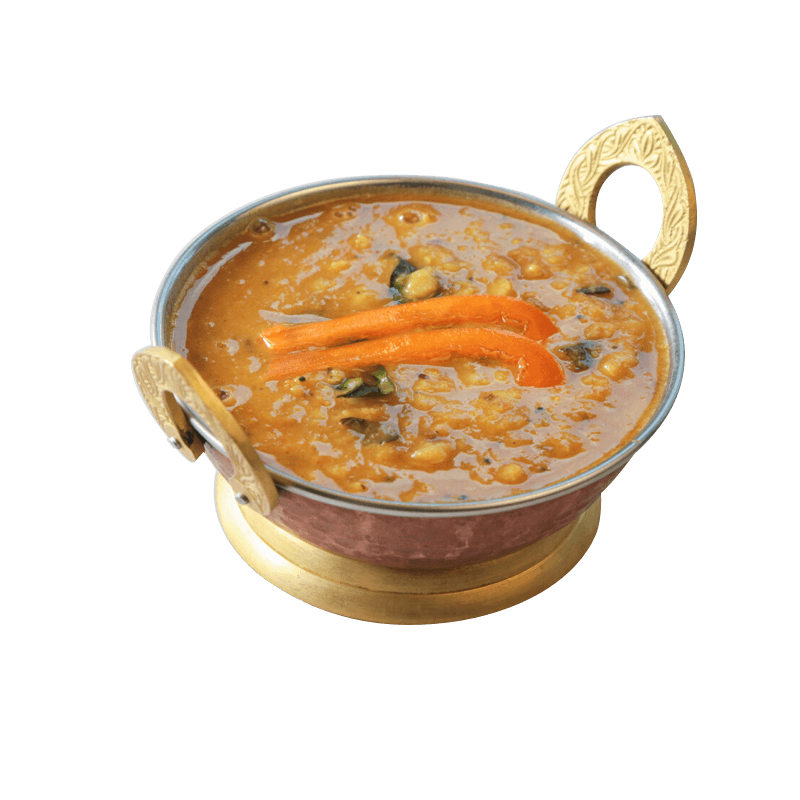
The most authentic Paruppu Kari in Heilbronn.
Tamil lentil curry. Vegan. Simmered in fresh coconut milk with Jaffna spices — still cooked the way Amma's recipe demands.
What Is Paruppu Kari?
Paruppu Kari is the heartbeat of Jaffna Tamil cuisine — a lentil curry so fundamental to the culture of northern Sri Lanka that a meal without it feels incomplete. Two Tamil words, one iconic dish: paruppu — split lentils — and kari — a spiced, simmered preparation. What sounds simple on paper is, in practice, a slow-simmered alchemy of split red lentils, fresh turmeric, and rich coconut milk, finished with a crackling tempering of mustard seeds, cumin, and curry leaves in coconut oil.
Unlike the generic "dhal" you might find at other restaurants across Europe, Jaffna Paruppu Kari follows a specific tradition refined over centuries on the northern peninsula of Sri Lanka. The lentils dissolve completely into a velvety, golden cream. The coconut milk — pressed fresh from whole coconuts, not poured from a tin — gives the curry its signature richness. And the tempering, that final theatrical pour of spice-infused oil, is what lifts the dish from humble sustenance to something that lingers in memory.
At THAMARAI in Heilbronn, we serve Paruppu Kari exactly as it has been prepared in Jaffna homes for generations. No shortcuts, no substitutions — just honest Tamil cooking, carried from the kitchens of our family to yours.
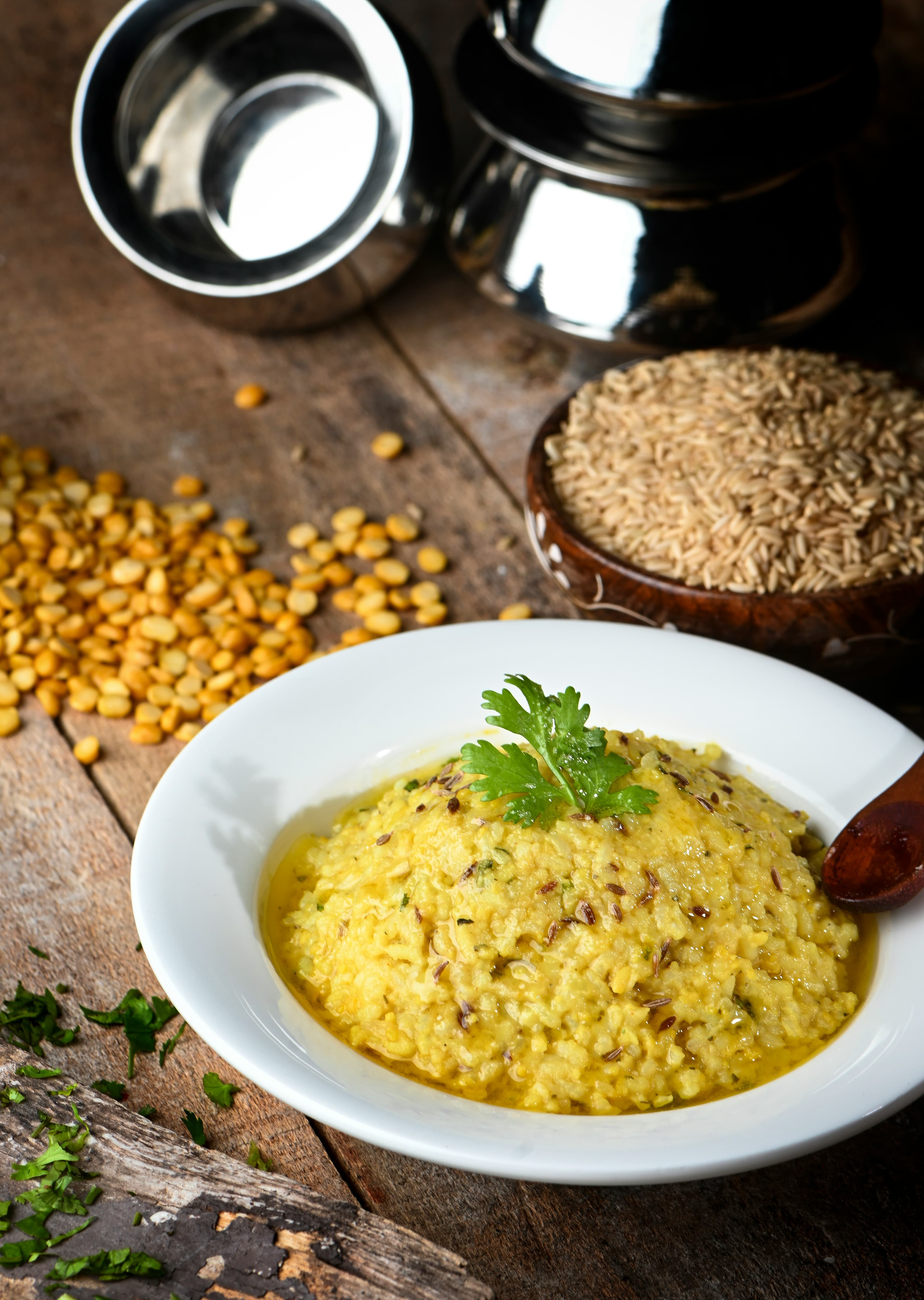
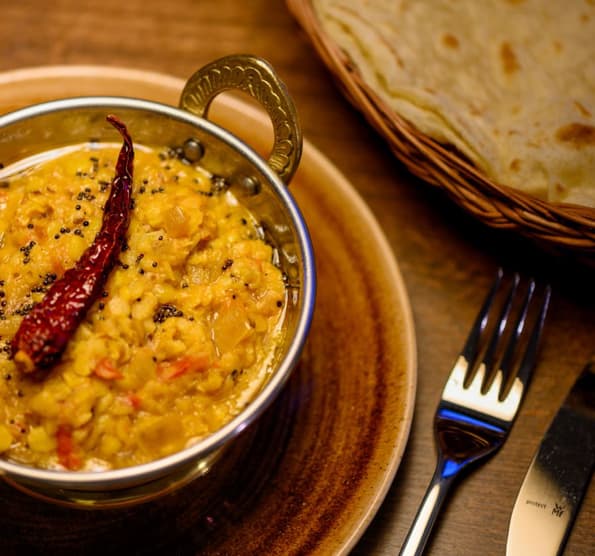
When Amma Calls for Dinner
If you grew up in a Jaffna Tamil household, the sound that meant the world was Amma's voice calling from the kitchen: "Saappaadu ready!" — food is ready. You didn't need to ask what was being served. You already knew. The warm, earthy aroma of turmeric-stained lentils had been drifting through the house for the past half hour. The sharp crack of mustard seeds hitting hot coconut oil — that unmistakable pop-pop-pop — had already told you everything: Paruppu Kari was on the table.
In our family, like in most Jaffna homes, Paruppu Kari was not a special occasion dish. It was the opposite — it was the everyday constant, the one curry that appeared at lunch and dinner without fail. Rice was scooped onto the plate first, then a generous ladle of Paruppu Kari poured right over the centre. It pooled around the rice, golden and thick, and you mixed it in with your fingers until every grain was coated. The first bite was always the best — warm, creamy, faintly peppery, deeply comforting.
There was a beautiful democracy to Paruppu Kari. It didn't matter whether the family had money that month or not. Whether there was fish curry on the table or just a simple coconut sambol alongside — Paruppu Kari was always there. It cost almost nothing to make, yet it tasted like everything. For children growing up during the war years in Jaffna, when fresh vegetables were scarce and meat was a luxury, Paruppu Kari was often the primary source of protein. It kept families going. It kept us going.
From Seed to Plate. The Lentil Plant.
The lentil plant, Lens culinaris, is a slender, bushy annual that grows 30 to 80 centimetres tall in open fields — not on trees, not on climbing vines, but as a modest field crop that hugs the ground. Its leaves are small and pinnate, ending in delicate tendrils. The flowers are tiny, white to pale purple, almost forgettable. But inside the flat, smooth pods that follow, each containing just one or two seeds, lies one of the most nutritionally complete foods on the planet.
The name itself is telling: the Latin word lens, from which we derive the word for optical lenses, comes from the lentil seed — because its shape resembles a tiny convex lens. The plant prefers cool, semi-arid conditions with moderate rainfall between 300 and 450 millimetres per year. It thrives in the Canadian prairies, the Australian drylands, the Turkish highlands, and the fertile plains of India — but notably, not in the hot, humid tropics of Sri Lanka. This single botanical fact shapes the entire economic story of paruppu on the island.
Lentils are a legume, which means they possess a remarkable ability that most crops lack: they fix atmospheric nitrogen into the soil through symbiotic bacteria in their root nodules. A lentil field doesn't just produce food — it enriches the earth for whatever crop follows. Ancient farmers understood this intuitively. They rotated lentils with cereals for millennia, long before anyone understood the chemistry of nitrogen fixation.
The harvest is straightforward but labour-intensive in traditional settings. When the pods turn yellow-brown after 80 to 130 days of growth, the plants are cut to ground level, left to dry in the sun for about ten days, then threshed and winnowed. A small family farm of one hectare might yield between 800 and 1,200 kilograms of lentils — enough to feed the family and sell the surplus at market. Today, the world produces roughly 6.6 million tonnes of lentils annually. Canada alone accounts for over a third of that, followed by India and Australia.
The variety used in Jaffna Paruppu Kari is masoor dal — split red lentils. These small, salmon-coloured seeds cook faster than any other lentil variety and dissolve completely into a smooth, creamy mass. This is precisely the quality that makes them ideal for paruppu kari: the lentils are not meant to hold their shape, but to become the sauce itself.
A Nation That Loves What It Cannot Grow
Here is the great paradox of Sri Lankan food culture: the nation's most essential, most consumed, most culturally important everyday food is one it produces virtually none of. Sri Lanka grows almost no lentils. The tropical climate — hot, humid, and monsoonal — is simply wrong for Lens culinaris, which demands the cool, dry conditions of continental interiors.
Sri Lanka is the eighth-largest lentil importer in the world, spending roughly 123 million US dollars on dried lentil imports in 2024 alone. Approximately 198,000 tonnes of lentils arrive on the island each year, predominantly from Australia, which supplies a staggering 82 per cent of Sri Lanka's lentil needs. Canada and India make up most of the remainder. Domestic pulse production covers a mere 2.5 kilograms per person per year — just 14 per cent of the recommended 18 kilograms. For lentils specifically, import dependency is effectively 100 per cent.
This dependency is not ancient — it is largely a legacy of colonialism. The Portuguese, Dutch, and British who controlled Sri Lanka in succession from 1505 were not interested in humble lentils. They restructured the island's agriculture around cash crops for export: cinnamon first, then tea, rubber, and coconut. The British plantation economy gradually displaced the domestic cultivation of staple pulses, creating the import dependency that persists to this day. The colonial powers did not take lentils back to Europe — Europe had its own ancient lentil traditions. Instead, they took Sri Lanka's agricultural capacity away from feeding its own people and directed it toward feeding European markets.
The 2022 Crisis. When Paruppu Became Unaffordable.
The fragility of this import dependency was brutally exposed during Sri Lanka's 2022 economic crisis — the worst since independence in 1948. When the country's foreign exchange reserves collapsed and the rupee lost half its value, import channels seized up. Lentil prices tripled almost overnight: from approximately 168 rupees per kilogram in October 2021 to 500 rupees by April 2022 — with open market prices peaking near 595 rupees. Food inflation reached a staggering 94 per cent year-on-year.
For a minimum-wage worker earning roughly 700 to 840 rupees per day, a single kilogram of dhal at crisis prices consumed 60 to 85 per cent of the entire daily wage. An estimated 6.26 million Sri Lankans — nearly one in three households — became food insecure. Three-quarters of surveyed households reduced their consumption of dhal, the single most important protein source in the Sri Lankan diet. The World Food Programme distributed emergency rations of rice and lentils.
The crisis hit with particular cruelty because paruppu is not a luxury in Sri Lanka — it is the absolute baseline of nutrition. When its price triples, the poorest families are forced to eat meals without any protein source at all. The price of paruppu is quite literally a barometer of national wellbeing. Sri Lanka does not export lentils in any meaningful quantity — the roughly two million dollars' worth that leaves the country annually is negligible next to 123 million in imports. This is a nation of lentil consumers, not lentil producers.
The Soul of a Jaffna Meal
To understand why Paruppu Kari matters so much, you need to understand its place within the architecture of a Jaffna Tamil meal. In Tamil food philosophy, a proper meal should embody arusuvai — the six tastes: sweet, sour, salty, bitter, pungent, and astringent. No single dish can achieve this balance. It takes an ensemble — and Paruppu Kari is the anchor of that ensemble, the creamy, protein-rich base that ties everything together. Without it, the meal feels structurally incomplete — like a building without its foundation.
The Full Jaffna Dinner Experience
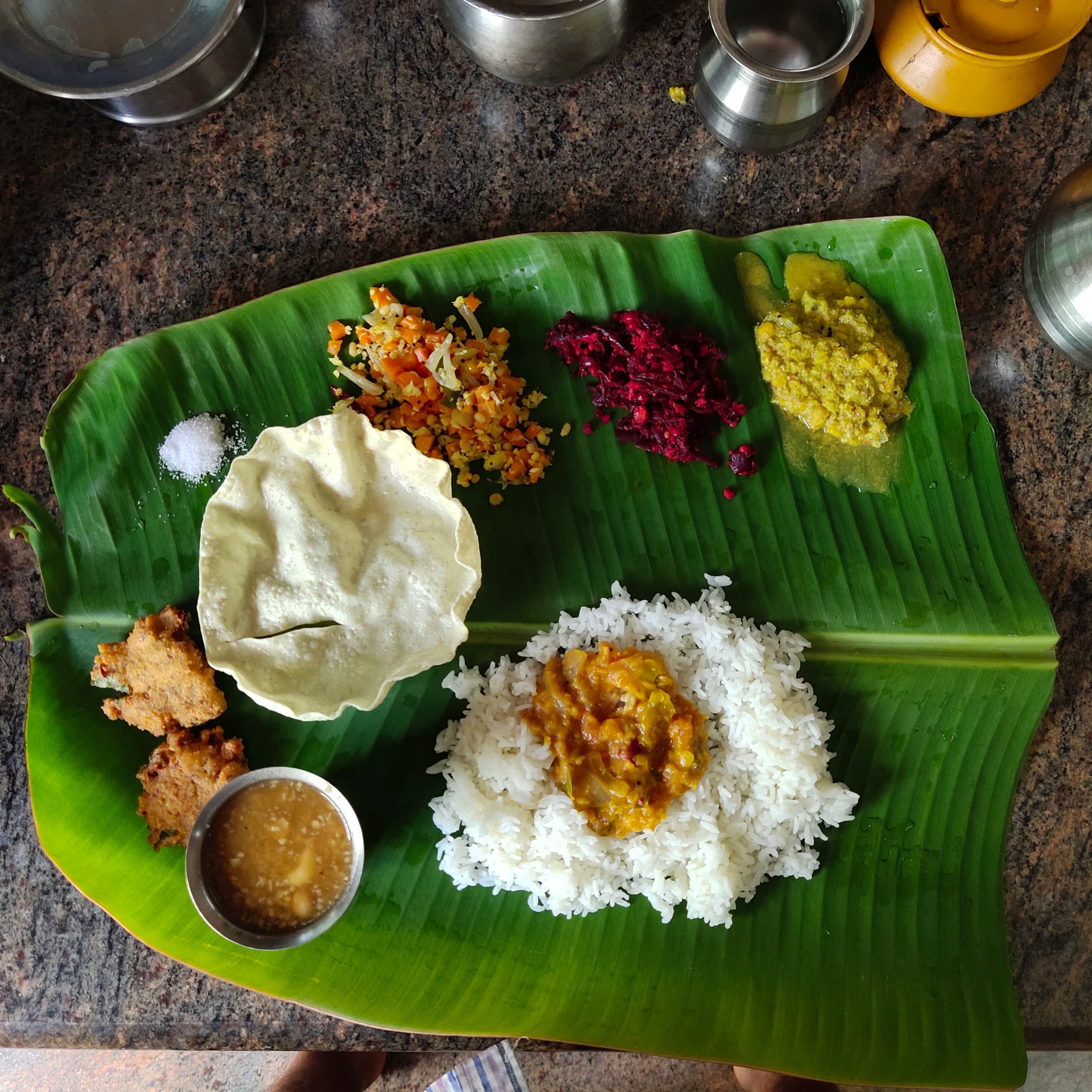
A traditional Jaffna rice and curry meal, often served on a fresh banana leaf, is not a single dish but a carefully composed spread of complementary flavours and textures:
- Saadam (steamed rice) — the foundation upon which everything rests
- Paruppu Kari — the lentil curry, mixed into the rice first as the protein base
- Rasam — a thin, peppery, tamarind-based broth with medicinal qualities, sipped between courses or poured over rice as a second course
- Kuzhambu — a thick, tamarind-based vegetable gravy, often with brinjal or drumstick
- Poriyal — a dry-fried vegetable dish, perhaps beans with freshly grated coconut, or cabbage with mustard seeds
- Keerai — cooked greens, rich in iron and flavoured simply with garlic and dried chillies
- Meen Kari (fish curry) — Jaffna sits on the coast, so fresh fish in a fiery red gravy is common in non-vegetarian homes
- Thengai Chutney — fresh coconut chutney, cool and mildly sweet
- Appalam — crispy papadam, shattered over the rice for textural contrast
- Oorukai — pickles, sharp and intensely flavoured, eaten in tiny amounts
- Thayir — curd or buttermilk, mixed into the rice at the very end of the meal to cool the palate
The meal follows a specific sequence. You begin with rice and Paruppu Kari — always. Then you work through the vegetable curries and fish curry. Rasam comes next, poured generously over fresh rice. And you finish with thayir — curd rice — as a digestive cooldown. The meal is eaten with the right hand, the rice and curries mixed together with the fingers. There is an intimacy to this way of eating that cutlery cannot replicate.
Within this ensemble, Paruppu Kari is the one dish that never changes, never rotates, never gets replaced. The kuzhambu might vary — tamarind one day, tomato the next. The fish curry depends on the catch. The poriyal depends on which vegetables are in season. But Paruppu Kari is always there. Always. It is the culinary equivalent of a steady heartbeat.
Why Paruppu, Not Dhal?
Walk into a restaurant in North India and you'll order "dal." In Tamil Nadu, you'll hear "paruppu" — the Tamil word for split pulses. In Jaffna, it is always "paruppu kari." The linguistic difference is not trivial. It reflects a broader cultural divide between the Hindi-speaking north of India, where "dal" derives from the Sanskrit root dal- meaning "to split," and the Dravidian south, where Tamil, Malayalam, and related languages have their own ancient vocabulary for the same concept.
But the difference between Jaffna paruppu kari and what most of the world calls "dhal" goes far beyond vocabulary. In much of North India, dal is a relatively thin, soupy preparation — often seasoned with cumin, asafoetida, and tomatoes, finished with ghee. In Jaffna, paruppu kari is thick, coconut-rich, and tempered with mustard seeds and curry leaves in coconut oil. The flavour profiles are so different that calling both "dhal" is like calling both Bordeaux and Riesling simply "wine."
| Aspect | Paruppu Kari (Jaffna) | Dal (North India) | Sambar (Tamil Nadu) |
|---|---|---|---|
| Primary lentil | Masoor dal (red lentils) | Toor, chana, moong, masoor | Toor dal (pigeon pea) |
| Coconut milk | Essential — defines the dish | Rarely or never used | Not typically used |
| Cooking fat | Coconut oil | Ghee or mustard oil | Sesame oil |
| Tempering | Mustard seeds, cumin, curry leaves, dried chillies | Cumin, garlic, asafoetida, dried chillies | Mustard seeds, fenugreek, curry leaves, asafoetida |
| Tamarind | Not used | Not typically used | Core ingredient |
| Vegetables | None — pure lentils | None or minimal | Essential — drumstick, brinjal, okra |
| Texture | Thick, velvety, creamy | Thin to medium, soupy | Medium, brothy with vegetable pieces |
Jaffna and Kerala. Culinary Cousins.
If you travel from Jaffna southward across the Palk Strait to the coast of India, the cuisine that most closely resembles Jaffna's cooking is not that of Tamil Nadu — it is Kerala's. This surprises many people, since Jaffna is a Tamil-speaking region while Kerala speaks Malayalam. But the culinary evidence is compelling.
Kerala's parippu curry shares the same fundamental architecture as Jaffna's Paruppu Kari: lentils cooked to a creamy consistency, enriched with coconut (either freshly ground coconut paste or coconut milk), and finished with a tempering of mustard seeds, curry leaves, and dried red chillies in coconut oil. The simplicity is the same. The coconut-forward flavour profile is the same. The tempering technique is virtually identical.
In Tamil Nadu, by contrast, the primary lentil dish is sambar — a fundamentally different preparation built on toor dal (pigeon pea), tamarind, a complex spice powder, and vegetables cooked into the stew. There is no coconut milk. The cooking fat is typically sesame oil, not coconut oil. The flavour profile is tangy, complex, and vegetable-heavy — nothing like the clean, coconut-rich simplicity of Jaffna paruppu kari or Kerala parippu.
The similarity between Jaffna and Kerala is no coincidence. Historians believe that a significant portion of Jaffna's Tamil population migrated from the ancient Chera kingdom — roughly corresponding to modern Kerala — rather than from the Pandya or Chola kingdoms of modern Tamil Nadu. Linguistic evidence supports this: the Jaffna Tamil dialect contains features closer to Malayalam than to mainland Tamil. Maritime trade between Jaffna and Kerala flourished for centuries — the great traveller Ibn Battuta recorded 100 ships belonging to the King of Jaffna sailing off the Kerala coast in 1344. This shared history of migration, trade, and cultural exchange produced shared food traditions.
The main culinary difference lies in the lentil variety: Kerala favours moong dal (split green gram), while Jaffna uses masoor dal (split red lentils). But the cooking method — coconut-enriched, minimally spiced, tempering-finished — is fundamentally the same approach, evolved independently on two sides of the same strait over centuries of cultural exchange.
Two Worlds. One Legume.
Here in Baden-Württemberg, lentils need no introduction. Linsen mit Spätzle und Saitenwürstchen — lentils with Swabian egg noodles and thin sausages — is the regional soul food, the dish that every Schwabe claims their grandmother made best. And the parallels with Jaffna Paruppu Kari are striking, not in flavour but in cultural meaning.
Both dishes are born from poverty. On the rocky, nutrient-poor soils of the Schwäbische Alb, lentils were one of the few protein crops that would grow. In the war-scarred, economically strained villages of the Jaffna peninsula, lentils were the cheapest reliable source of protein. In both cultures, lentils became what they are today — not despite being poor people's food, but because of it. The most deeply loved dishes are rarely the extravagant ones. They are the ones that kept families fed when nothing else would.
The Swabian lentil story contains a chapter that feels almost novelistic. Lentil cultivation dominated the Schwäbische Alb for centuries, but by 1985, the original Alb lentil varieties had completely vanished from Germany — not a single seed remained. Then in 2006, the original varieties were accidentally discovered in the Vavilov Institute gene bank in St. Petersburg, Russia, stored under accession number 2106 with the incorrect label "SPATS ALPENLINSE." These were the varieties bred by Fritz Späth from Haigerloch: Späths Alb-Leisa I, Späths Alb-Leisa II, and Späths Heller-Leisa. They were brought back to Germany, and cultivation resumed on the Swabian Alb. A heritage nearly lost was recovered from the other side of the continent.
The botanical differences between the two traditions reflect their different culinary purposes. German Alb-Leisa are medium-sized, firm-cooking lentils that hold their shape in a vinegar-seasoned stew. South Asian masoor dal are small, quickly dissolving lentils that break down completely into a smooth, creamy curry. Same species — Lens culinaris — but selected over generations for entirely different textures and culinary outcomes. Swabian lentils are simmered with vinegar and a touch of sugar for that tangy-sweet flavour, then served with Spätzle and Saitenwürstchen. Jaffna lentils dissolve into coconut milk and are seasoned with turmeric, mustard seeds, and curry leaves. The technique could hardly be more different, yet the underlying story is the same: humble ingredients, elevated by generations of home cooks into something irreplaceable.
Both dishes are served as the centrepiece of a working family's meal. Both are comfort food in the deepest sense — the first dish you crave when you are homesick. And both are virtually never served in fine dining restaurants, because their power lies in their humility. No chef can improve on what generations of grandmothers perfected.
The Science of Why It Tastes So Good
For a dish with so few ingredients, Paruppu Kari delivers a remarkable depth of flavour. The science explains why.
Lentils are naturally rich in glutamic acid — the amino acid responsible for umami, the savoury "fifth taste" identified by Japanese chemist Kikunae Ikeda in 1908. Glutamic acid is the single most abundant amino acid in lentil protein. When lentils are cooked and their proteins break down, free glutamate is released into the liquid, activating the same umami taste receptors that make Parmesan cheese, soy sauce, and aged meat so deeply satisfying. This is why a bowl of well-made paruppu kari tastes so much richer and more complex than its simple ingredient list would suggest.
The tempering — that dramatic final step where whole spices hit hot oil — is where flavour chemistry reaches its peak. Most spice flavour compounds are fat-soluble, not water-soluble. When mustard seeds hit coconut oil at approximately 180°C, their cell walls rupture, releasing isothiocyanates — the sharp, pungent compounds that give mustard its bite. When cumin seeds crackle, they release cuminaldehyde, the warm, earthy compound that defines cumin's character. When curry leaves sizzle in the oil, they release volatile aromatic oils that would never fully emerge in water-based cooking. The oil captures all these compounds and carries them uniformly through the dish.
The onion base undergoes the Maillard reaction — the same chemical reaction that browns bread crusts, sears steaks, and gives roasted coffee its depth. At temperatures between 140 and 165°C, amino acids in the onion react with its reducing sugars to produce melanoidins: complex molecules responsible for the deep brown colour, nutty aroma, and rich savoury flavour of properly cooked onions.
Finally, the coconut milk acts as both a flavour carrier and a flavour contributor. Its fat content — approximately 17 to 20 per cent, primarily medium-chain triglycerides — dissolves and distributes the fat-soluble spice compounds across the entire dish. Its own flavour profile, dominated by esters and lactones, adds sweet, tropical, and subtly floral notes that balance the earthy lentils and pungent spices. The result is a dish that hits umami, fat, aromatics, and subtle sweetness simultaneously — a complexity that belies the simplicity of the ingredients.
A Tiny Seed. A Nutritional Powerhouse.
Lentils have been called "poor man's meat" for centuries, and the nutritional data confirms the title. Per 100 grams of cooked lentils: 9 grams of protein, 8 grams of dietary fibre, 3.3 milligrams of iron (42 per cent of the daily recommended intake), 181 micrograms of folate (45 per cent of daily needs), and just 116 calories. Lentils contain the most folate of any plant-based food. The glycaemic index is low at 29, making lentils one of the most blood-sugar-friendly foods available.
But here is the truly elegant part: lentils alone are not a complete protein. They are rich in lysine but limiting in the sulphur-containing amino acids methionine and cysteine. Rice, conversely, is low in lysine but relatively high in methionine. When you eat Paruppu Kari over rice — as every Jaffna Tamil does at every meal — the amino acid profiles complement each other perfectly. A 2022 study published in the Journal of Nutrition confirmed that consuming lentils and rice together resulted in measurably increased protein synthesis in healthy adults — approaching the quality of animal protein.
This is not a modern nutritional discovery. It is ancient wisdom, validated by science. The rice-and-lentil combination that has sustained South Asian civilisations for millennia turns out to be biochemically optimised for human nutrition. Generations of Jaffna grandmothers, ladling Paruppu Kari over rice, were practising precision nutrition long before the term existed.
Frequently Asked Questions
Visit THAMARAI in Heilbronn
Ready to taste authentic Jaffna Paruppu Kari? Visit us at THAMARAI Restaurant in Heilbronn. We serve lunch and dinner daily.
Whether you grew up eating Paruppu Kari and are searching for the taste of home, or whether you're discovering one of the world's great lentil dishes for the first time — we'd love to welcome you to our table.
Nutrition at a Glance
Per serving, based on a standard portion size.

