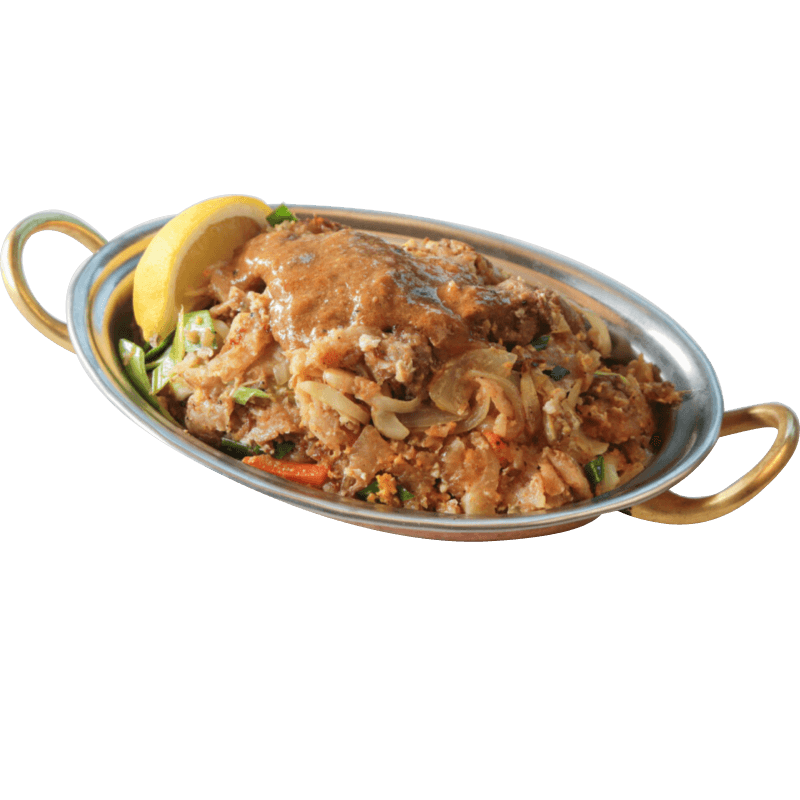
Two blades, one rhythm. The loudest dish on the menu.
Sri Lankan street-food classic. Shredded roti, slow-cooked lamb kari, eggs, and aromatic spices, tossed on a hot griddle.
What Is Lamb Kothu?
Lamb Kothu — kothu roti — is Sri Lanka's most beloved street food: a loud, theatrical, rhythmic stir-fry of shredded godhamba roti, tender slow-cooked lamb curry, eggs, onions, green chillies, and leeks, chopped and tossed on a scorching iron griddle with two blunt metal blades. The percussive clang of those blades on metal — kothu-kothu-kothu — is the sound that gives the dish its name, the sound that echoes through every night market on the island, and the sound that a million Tamil children in the diaspora hear when they close their eyes and think of home.
There is no other dish in Sri Lanka with a soundtrack. There is no other dish where the cooking itself is a performance — half kitchen, half drum solo. And there is no other dish that has travelled as far, crossed as many borders, and fed as many people who needed feeding, as kothu roti.
At THAMARAI in Heilbronn, we build our Lamb Kothu on the foundation of our slow-cooked Lamb Kari — the same three-hour braise, the same hand-roasted Jaffna curry powder, the same bone-in New Zealand lamb — and then we chop it into something entirely new. If our Lamb Kari is the Sunday centrepiece, the dish that asks you to sit and stay, then Lamb Kothu is its restless younger sibling: the one that wants to be eaten standing up, late at night, with your hands, surrounded by noise and friends and the smell of a hot griddle.
This is the story of that younger sibling. It is a story about youth, about invention, about people who work in kitchens that are not their own, and about a dish that belongs to everyone.
Where It All Began
The origin story of kothu roti does not begin in Jaffna. It does not begin in Colombo. It begins on the eastern coast of Sri Lanka, in a quiet town called Batticaloa — மட்டக்களப்பு (Mattakkalappu) in Tamil, known colloquially as Batti — sometime in the 1960s or early 1970s.
Batticaloa in that era was an agrarian coastal town with a Tamil majority and a significant Muslim minority. The Sri Lankan Moors — Tamil-speaking Muslims whose ancestors were Arab and Persian merchants who had married into local Tamil and Sinhalese families from the seventh century onward — had been part of the eastern coast's fabric for over a thousand years. Many of them ran small roadside eateries, the kind that Sri Lankans call hotels even though they have no rooms. These hotels served rice and curry during the day, and at night, they sold godhamba roti — thin, stretchy, oil-enriched wheat flatbreads cooked on a hot griddle.
The problem was the leftovers. Godhamba roti does not keep well. By the next morning, yesterday's unsold rotis were stale, tough, and unsellable. Throwing them away was not an option — not in a town where money was tight and waste was a sin. So an enterprising cook — nobody knows exactly who, nobody wrote it down, nobody thought it was the kind of moment that deserved a name — took those day-old rotis, threw them onto the hot griddle, and began chopping them up with whatever was to hand: a bit of leftover curry, an egg, some onions, green chillies, a handful of leeks. The two metal blades came out. The chopping began. The sound began.
And something remarkable happened. The dish was not just edible — it was extraordinary. The stale roti, which had lost its softness overnight, now had exactly the right texture for stir-frying: firm enough to hold its shape against the blades, porous enough to absorb the curry gravy, and chewy enough to give the finished dish a satisfying bite that fresh roti could never achieve. The egg bound everything together. The chillies and leeks lifted it. The curry gave it soul. A dish born from poverty and leftover bread turned out to be one of the most satisfying things anyone in Batticaloa had ever eaten.
From those Tamil-Muslim kitchens on the eastern coast, kothu roti spread — first to Trincomalee, then to Colombo, then to every corner of the island. By the 1980s, it had become the national street food of Sri Lanka. By the 2000s, it had followed the Tamil diaspora across the ocean to Toronto, London, Paris, Berlin, Zurich, and Heilbronn. A dish invented to save stale bread ended up conquering the world.
A Young Man on Galle Road
It is ten o'clock at night on Galle Road in Colombo, and Farhan is already sweating. He is twenty-three years old. He has been standing behind this griddle since six in the evening, and he will not leave until two in the morning, sometimes three. The griddle is a flat rectangle of cast iron, blackened by years of oil and heat, and it radiates warmth like a living thing. The two metal blades — rectangular, heavy, with wooden handles worn smooth by his grip — are extensions of his arms. He does not think about them any more than a drummer thinks about his sticks.
Farhan is a Sri Lankan Moor. His family is from the eastern coast — Kattankudy, near Batticaloa, the very stretch of coastline where kothu roti was born. His grandfather ran a small hotel there. His father moved to Colombo for work in the 1990s and found a job in a restaurant kitchen. Farhan followed him into the trade. He has been making kothu since he was fifteen. He is very, very good at it.
A customer approaches the counter. "Mutton kothu, extra egg, extra spicy." Farhan nods without looking up. His hands are already moving. Oil goes onto the griddle — a quick pour from a battered steel jug. Then the aromatics: sliced onions, crushed ginger, garlic, a fistful of curry leaves that hiss and crackle on contact. Green chillies, split lengthwise. A handful of julienned leeks — the vegetable that makes kothu kothu, the one ingredient that appears in every version on the island.
While the aromatics sizzle, Farhan reaches for the protein. The mutton curry has been simmering in a pot behind him since the afternoon — slow-cooked goat meat in a dark, thick gravy, the kind that has been reduced until the sauce clings to every piece. He ladles a generous portion onto the griddle. The gravy hits the hot metal and erupts into a cloud of fragrant steam. Then two eggs, cracked one-handed, dropped directly onto the iron surface and scrambled into the mix with a few quick strokes of the blade.
Now the roti. A stack of godhamba rotis — cooked that morning, cooled, and rolled into loose cylinders — sits in a steel container to his left. He takes two, unfurls them across the griddle, and pauses for exactly one second. This is the moment the audience has been waiting for.
Both blades come down. The chopping begins.
The sound is immediate, rhythmic, and impossibly fast — a staccato burst of metal on metal that carries halfway down the street. Tak-tak-tak-tak-tak. Farhan's wrists move in alternating strokes, each blade striking the griddle a fraction of a second after the other, shredding the roti into ribbons, folding the meat and egg and vegetables into the bread, turning six separate ingredients into one unified dish. He works the mixture across the griddle in wide sweeps, scraping, flipping, chopping again. The rhythm shifts — faster now, a triplet pattern, then a hard double strike that sends a shower of sparks off the iron. Every kothu master has a signature beat. Farhan's sounds like the opening of a Baila song.
Two minutes. Maybe three. The kothu is done. The roti pieces are golden-edged and slightly charred in places, soaked through with curry gravy, threaded with egg and leeks and chilli. Farhan sweeps it onto a plate in one practised motion, taps the blades together twice — a full stop, a signature — and the plate goes across the counter.
The next customer is already ordering.
The Moors and the Griddle
The Sri Lankan Moors deserve a chapter in this story that they have rarely been given. They are approximately ten per cent of Sri Lanka's population — roughly two million people — and they are the descendants of Arab and Persian traders who established settlements along the island's coast from the seventh century onward, married local women, and stayed. The Portuguese, who arrived in the sixteenth century, called them Mouros after the Muslim Moors of Iberia. The name stuck. The identity they built is entirely their own.
The Moors speak Tamil. Their dialect — Sri Lankan Muslim Tamil — carries traces of Arabic in its vocabulary and a distinctive rhythm in its cadence, but it is Tamil, and it has been Tamil for centuries. They share wedding customs with their Hindu Tamil neighbours: the thaali, the wedding necklace, crosses the religious divide. They eat kiribath, the Sinhalese milk rice, at celebrations. They are, in every meaningful sense, a bridge people — Tamil-speaking, Arab-descended, Sri Lankan to the bone, belonging to every tradition and exclusively to none.
And they have been feeding the island for as long as anyone can remember. The small roadside hotels that dot every main road in Sri Lanka — the ones that serve rice and curry at lunchtime and short eats and roti at night — have historically been a Moor enterprise. The food trade, from street stalls to wholesale spice markets, has been woven into the community's economic life for generations. When kothu roti emerged from a Batticaloa kitchen in the 1960s, it emerged from this tradition: a Tamil-Muslim tradition of feeding people well, cheaply, and without fuss.
This is not to say that kothu roti belongs to the Moors. It does not belong to anyone. It belongs to everyone — to the Hindu Tamil grandmother in Jaffna who makes vegetable kothu for her grandchildren, to the Sinhalese university student in Kandy who orders cheese kothu at midnight, to the Tamil diaspora family in Scarborough who cooks it on a Saturday when the whole extended family is over. Kothu roti is Sri Lanka's most democratic dish. But its origin story runs through Batticaloa, through Tamil-Muslim kitchens, through the hands of people like Farhan's grandfather — and that is a story worth telling.
Cousins Across the Palk Strait
No honest account of kothu roti can ignore the elephant in the room — or rather, the cousin across the water. In the southern Indian state of Tamil Nadu, there exists a dish called kothu parotta: shredded Malabar parotta, stir-fried with egg, vegetables, and a spiced curry on a hot griddle, chopped with the same two-blade technique, producing the same rhythmic clanging, and eaten with the same late-night enthusiasm. The resemblance is unmistakable.
Did kothu roti inspire kothu parotta, or the other way around? The honest answer is: nobody knows for certain. The Palk Strait between Sri Lanka and Tamil Nadu is only thirty-five kilometres wide at its narrowest point, and for centuries, people, recipes, and ideas have flowed freely across it. The godhamba roti itself is related to the Malabar parotta of Kerala and the roti canai of Malaysia — all descendants of the same family of layered, oil-enriched flatbreads that Arab and Indian Ocean traders carried along maritime trade routes. The technique of chopping cooked flatbread with two blades on a griddle could have been invented independently in both places, or it could have crossed the strait in either direction. What is documented is that the Sri Lankan version — using godhamba roti specifically, with the distinctive leek-and-curry-leaf flavour profile — crystallised in Batticaloa in the 1960s, while kothu parotta became widespread in Chennai and Madurai from the 1980s onward.
The connection matters because it places kothu roti within a larger South Asian tradition of resourceful cooking — of taking yesterday's bread and transforming it into today's feast. In North India, leftover chapati becomes choor choor paratha. In Kerala, leftover puttu is crumbled and fried. In the Middle East, stale flatbread becomes fatteh. Kothu roti belongs to this global family of dishes born from the refusal to waste food, and its kinship with South Indian kothu parotta is part of what makes it so deeply rooted in the shared culinary logic of the region.
At THAMARAI, we serve the version that was born in Batticaloa and conquered the island — the Sri Lankan kothu roti, with godhamba roti, curry leaves, leeks, and the two-blade technique that men have been perfecting at hot griddles from Colombo to Jaffna for over half a century. It shares DNA with its South Indian cousin, but it is its own dish, shaped by its own island, carried across the ocean by its own diaspora.
The Sound of the Night
In Jaffna, kothu roti is not a daytime food. It is a creature of the night — the dish that appears when the sun goes down and the streets come alive with a different kind of energy. The kothu stalls open at dusk. The griddles heat up. The sound begins. And the young people come.
This has been true for decades. In the 1970s, before the war, Jaffna's night food culture was a world of its own: the stalls along Hospital Road and Stanley Road, the small hotels near the Jaffna Fort, the roadside vendors on KKS Road where students from the University of Jaffna gathered after evening lectures. Kothu was the food of those gatherings — cheap, filling, shareable, and above all, social. You did not eat kothu alone. You ate it with friends, standing around a stall, arguing about cricket or politics or who owed whom a kothu from last week.
The war changed everything and nothing. During the worst years — the 1990s, the long sieges, the curfews that fell like curtains across the peninsula — kothu stalls closed, reopened, closed again, moved underground, moved to different streets. The sound of the blades became a marker of normalcy: if you could hear kothu being made, the night was still yours. If the stalls were dark, something was wrong. One Jaffna businessman told journalist Marwaan Macan-Markar that the sound of kothu told him "how late we can be out on the street." The dish became a barometer of freedom.
After the war ended in 2009, Jaffna's night food culture came roaring back. Today, every major hotel and restaurant in Jaffna town — from the establishments on KKS Road to the stalls along Hospital Road — serves kothu roti as a standard evening item. Hotel New Selva is known for its mutton kothu. Steamboat Restaurant on Hospital Road advertises kothu roti in both vegetarian and non-vegetarian versions. The night markets have returned, louder than before, and the sound of the blades is once again the sound of a Jaffna evening.
But the protagonists of the Jaffna kothu scene are not the hotels. They are the young people — the university students, the shop workers finishing their shifts, the groups of friends on motorbikes who pull up to a stall at ten o'clock and order five kothus and argue about who is paying. Kothu roti is, above all else, young people's food. It is the food you eat when you are twenty and broke and happy and surrounded by people who understand you. It is the food that tastes best when it is loud, when it is late, when someone is telling a story that keeps getting interrupted by the sound of the blades. It is the opposite of the formal family meal. It is the anti-Sunday-lunch. And that is exactly why the youth of Jaffna have made it their own.
Every Kothu Has a Story
One of the remarkable things about kothu roti is how many versions exist. The base concept — shredded flatbread, stir-fried with protein and vegetables on a hot griddle — is a canvas that accommodates almost anything. Across Sri Lanka and the diaspora, the variations have multiplied into an entire family of dishes.
Chicken Kothu is the most popular and widely available — tender chicken from a spiced curry, mixed with chopped roti, egg, and vegetables. It is the universal entry point, the one that every stall offers and every newcomer orders first.
Mutton Kothu — which in Sri Lanka means goat, not sheep — is the prestige version. The slow-cooked goat curry produces a rich, dark gravy that permeates every shred of roti, and the fall-apart meat adds a depth that lighter proteins cannot match. In the diaspora, where goat gives way to lamb, this becomes Lamb Kothu — the version we serve at THAMARAI, built on our own three-hour Lamb Kari.
Egg Kothu is the vegetarian-friendly classic — scrambled eggs, vegetables, and roti, nothing more, nothing less. It is the cheapest option and, for many students, the one they eat five nights a week.
Vegetable Kothu expands the plant-based palette: cabbage, beans, potatoes, chickpeas, whatever the kitchen has, stir-fried with spices and chopped roti. In Jaffna, where many Hindu families are vegetarian, this is not a compromise — it is a tradition in its own right.
Seafood Kothu appears along the coast — in Galle, Negombo, Trincomalee, and the fishing villages of the Jaffna lagoon — where fresh prawns, fish, or cuttlefish replace the meat. The tangy seafood curry sauce gives it a character entirely different from the inland versions.
Idiyappam Kothu — known to Western tourists as string hopper kothu, though no Tamil or Sinhalese person uses the colonial British term — replaces the godhamba roti with shredded idiyappam, steamed rice-flour noodle nests, producing a lighter, more delicate dish with a completely different texture.
Cheese Kothu is the modern invention — a Colombo creation that exploded among younger diners. Generous slabs of processed cheese are melted into a classic chicken or mutton kothu, creating something gooey, decadent, and utterly unapologetic. The older generation shakes their heads. The younger generation orders a double portion.
And then there is Dolphin Kothu — named not after the animal but after the Dolphin brand of paratha, a popular commercial flatbread in Sri Lanka — which uses paratha instead of godhamba roti; Nasi Goreng Kothu, a Southeast Asian fusion with sweet soy sauce; and a hundred other local inventions that exist in a single stall in a single town and have never been written down. Kothu roti is a living tradition, and like all living traditions, it refuses to stand still.
Three Hours Before the Chopping Begins
The secret of our Lamb Kothu at THAMARAI is that it begins long before the blades touch the griddle. It begins with our Lamb Kari — the same slow-cooked Jaffna lamb curry that we describe in its own article, the one that takes three hours of patient simmering to bring bone-in New Zealand lamb to the point where it falls apart at the touch of a spoon.
We will not repeat the full story here — you can read it on our Lamb Kari page, where we describe the Sunday mornings, the hand-roasted Jaffna curry powder, the two milks from one coconut, the science of collagen dissolving into gelatine. What matters for the kothu is the result: meat that is intensely tender, saturated with dark roasted spice, and surrounded by a thick, concentrated gravy that has been reducing all morning.
That lamb kari is the soul of our Lamb Kothu. When we chop it into the roti on the griddle, the gravy soaks into every shred of bread, the spices from three hours of simmering distribute themselves through the entire dish, and the tender lamb — already falling apart — integrates into the kothu in a way that a quick-cooked protein never could. This is what separates a great Lamb Kothu from an ordinary one: the quality of the curry that goes into it. You cannot make exceptional kothu from mediocre kari. The equation does not work.
The Godhamba Roti. The Forgotten Foundation.
The other half of kothu roti — the half that rarely gets the attention it deserves — is the roti itself. Godhamba roti (also spelled godamba) is a thin, stretchy, oil-enriched wheat flatbread that is the essential base of every kothu. Without it, there is no dish. And making it well is harder than it looks.
The ingredients are deceptively simple: flour, salt, oil, and lukewarm water. The dough is kneaded for approximately ten minutes until it becomes smooth and elastic, divided into balls, coated in oil, and rested for at least an hour. Then each ball is stretched — by hand, on an oiled surface — into a sheet so thin it is almost translucent. This stretching is the skill that takes years to learn. Too much force and the dough tears. Too little and it stays thick and doughy. The perfect godhamba roti is paper-thin, slightly blistered from the griddle, and layered with pockets of air and oil that give it its characteristic flaky texture.
For kothu, the rotis are typically made the day before and allowed to rest overnight. This is not laziness — it is engineering. The overnight rest firms the texture, making the roti easier to chop without disintegrating and giving it the slightly chewy bite that is essential to a good kothu. Fresh roti is too soft. It turns to mush under the blades. Day-old roti fights back just enough. The dish that was invented to use up yesterday's leftovers turns out to require yesterday's leftovers to work properly. There is a poetry in that.
The Street Food Festival That Changed Everything
In 2019, a few months before THAMARAI opened its doors in Heilbronn, we made a decision that turned out to be one of the most important of our early history. There was a street food festival in Heilbronn — three days of outdoor stalls, food from around the world, thousands of visitors. We signed up. We decided to test whether the food we were preparing for our restaurant would resonate with a German audience that had never encountered Jaffna Tamil cooking before.
We brought our Kothu. We brought our Lamb Kari. We brought the griddle, the blades, and the sound.
The first day was insane. The queue at our stall did not stop. People who had never heard of kothu roti watched the chopping, heard the rhythm, smelled the lamb and spices, and ordered. Then they came back and ordered again. By the end of the first day, we were sold out — completely, entirely, nothing left. Not a single portion of kothu, not a single serving of kari.
Gowari went home that night to produce more. But here is the truth about Jaffna cooking, the truth that our Lamb Kari article explains in detail: you cannot rush a three-hour braise. You cannot shortcut the slow simmer that turns tough lamb into tender, falling-apart meat. Gowari cooked through the night, but the mathematics of slow food are unforgiving. We managed to produce enough for the second day, but not enough for the third. By the end of day two, we had to close our stall. And then we did what any family would do with an unexpected day off and no kari left: we rented a car and drove to Venice. The whole family, our first trip to Italy ever — born from a sold-out street food festival in Heilbronn.
The good news was the validation. The people of Heilbronn loved our food — not politely, not tentatively, but with the kind of enthusiasm that tells you something real is happening. They loved the kothu. They loved the theatre of the preparation. They loved the sound of the blades. And they could not wait for the grand opening of the restaurant, which was lined up for September that year.
That street food festival taught us two things. First, that kothu roti is a perfect street food — perhaps the perfect street food. It is fast to assemble (once the kari is ready), dramatic to watch, easy to eat standing up, and so flavourful that a single plate turns a sceptic into a convert. Second, that the foundation of great kothu is time — hours of slow cooking that happen long before the blades ever touch the griddle. The spectacle takes three minutes. The preparation takes three hours. Both are essential.
From Tellerwäscher to Inhaber
There is a story that plays out in every country where the Tamil diaspora has settled — in Germany, in Switzerland, in Canada, in France, in the United Kingdom, in Australia — and it is always, at its core, the same story. A man arrives. He does not speak the local language. He has no recognised qualifications. He has left behind a war, or the aftermath of a war, or the economic devastation that a war leaves in its wake. He needs work. He finds the one industry that will take him without a CV, without fluent German or French or English, without connections: the restaurant kitchen.
He starts washing dishes. He is good at it — fast, thorough, uncomplaining. He arrives early. He stays late. He does not call in sick. After a few months, the chef notices. After a year, he is peeling vegetables, then chopping onions, then working the line. After three years, he is cooking. After five, the regular customers know his name. After ten, the owner — who is getting older, whose children do not want the business, who has been looking for someone reliable — offers him a deal.
In Toronto, this story has a name: Siva Sathasivam, who saw a sign calling for a dishwasher at a restaurant on Bloor Street, worked his way up over fifteen years, and ended up co-owning the business. Or Kugendran Perampalam, who arrived from Punkudutivu — a tiny island off the Jaffna coast — in 2002 as a refugee, began by washing dishes in his cousin's restaurant, and now owns eleven restaurant brands across the Greater Toronto Area, including one featured in the Michelin Guide. Or Kokulan Saravanapavananthan, who started as a dishwasher at Jump Restaurant in Toronto's financial district in 1999 and rose to sous chef over twenty-five years, introducing Jaffna fish curry and mutton curry to an upscale Canadian menu.
In Zurich, Tamil immigrants built a reputation as reliable workers in the hotel and catering industry from the 1980s onward. Switzerland's Tamil community — over forty thousand strong, ninety per cent of them ethnic Tamils from the north and east of Sri Lanka — found the restaurant sector to be one of the few doors that opened. They walked through it, and they kept walking.
In Paris, the story took a turn that nobody expected. In 2023, an Eelam Tamil baker named Tharshan Selvarajah — self-taught, no formal training, arrived in France in 2006 — won the Grand Prix de la Baguette de Tradition Française de la Ville de Paris, defeating 176 competitors to produce the best traditional baguette in the city. His prize: four thousand euros and the honour of supplying fresh baguettes to the Élysée Palace for a year. "I cried," he said, "because we are foreigners and came here to learn how to make traditional French bread." The following year, he was selected as a torchbearer for the 2024 Paris Olympic Games — the first Eelam Tamil to carry the Olympic torch. And in 2026, a second Tamil baker, Sithamparappillai Jegatheepan, won the same competition on his first attempt, defeating 142 competitors. Two Eelam Tamils, both self-taught, both winning France's most prestigious baguette prize within three years. The best bread in Paris, baked by hands that learned to cook in kitchens far from France.
These are all versions of the same story. Vom Tellerwäscher zum Inhaber — from dishwasher to owner — is not a metaphor for the Tamil diaspora. It is a literal description. And kothu roti, more than any other dish, was the gate-opener. It was the dish that Tamil cooks made in the kitchens of other people's restaurants — after hours, for the staff meal, from whatever was in the fridge — and the dish that made the owner stop, taste, and say: what is this? The dish that earned respect. The dish that got the cook out of the dishpit and onto the line. The dish that, eventually, went on the menu.
In Zurich, in Düsseldorf, in Toronto, in Paris — Tamil dishes have found their way onto the menus of established European and Canadian restaurants because the owners learned to trust the people who cooked them. The magic that came across the ocean, in the hands of people who arrived with nothing, turned out to be too good to keep in the back of the kitchen. Kothu roti, with its sound and its spectacle and its irresistible flavour, was often the first Tamil dish to make that journey from the staff meal to the menu. It was, and remains, the ambassador.
The Bridge to Home
Ask a Tamil family in the diaspora what they cook when the whole extended family comes over — for a birthday, for a Tamil New Year gathering, for a housewarming, for a Saturday night that has turned into an occasion simply because enough people showed up — and the answer, more often than not, is kothu.
Not Lamb Kari, which is the formal dish, the Sunday dish, the dish that requires planning and preparation and a pot that simmers for hours. Not Prawn Kari, which is the coastal dish, the special-occasion dish, the one reserved for the most honoured guest. Kothu is the dish for the moment when formality breaks down and joy takes over. It is the dish for the crowd — the ten, fifteen, twenty people crammed into a kitchen in Scarborough or Croydon or Villeurbanne, everyone talking at once, children running between legs, someone's uncle telling a story he has told forty times before.
Kothu is perfect for this because it scales. You can make kothu for five or for fifty — the technique is the same, and all you need is a bigger griddle and more roti. It is fast to assemble. It is endlessly customisable — chicken for those who eat chicken, vegetable for the vegetarians, extra chilli for the uncle who claims nothing is ever spicy enough. And it is, above all, communal. Kothu is served in the centre of the table, or on a large tray, and everyone takes from the same pile. There is no portion control. There is no individual plating. There is just a mountain of steaming, fragrant, spice-soaked roti, and everyone digs in.
For the young Tamils of the diaspora — the generation born in Germany, in Canada, in the UK, in Switzerland — kothu roti is often the strongest edible link to a homeland they may never have visited. They did not grow up in Jaffna. They did not hear the sound of the blades on Hospital Road at ten o'clock at night. But they grew up with the smell of their parents' kothu in the kitchen, with the taste of lamb curry folded into shredded roti, with the sound of someone chopping on a flat pan and the memory of a Saturday night when the whole family was together and the food was hot and the world, for one evening, felt exactly right.
That is what kothu carries. It carries the bridge. It is the single most unifying food in the Tamil diaspora — not the grandest, not the most elaborate, not the most expensive, but the one that everyone, without exception, recognises as theirs.
Kothu at THAMARAI
When we serve Lamb Kothu at THAMARAI in Heilbronn, we are serving all of this — the Batticaloa origin, the Jaffna nights, the diaspora kitchens, the bridge to home. We are serving the three-hour lamb kari that our family has been cooking for generations, chopped and folded into roti with the same technique that a twenty-three-year-old on Galle Road uses at ten o'clock at night.
Our Lamb Kothu is also one of our most requested catering items. For weddings, birthdays, corporate events, and private gatherings in the Heilbronn region, the theatrical preparation and the communal eating style make it a centrepiece that doubles as entertainment. The sound of the blades, the smell of the spices, the sight of a mountain of steaming kothu being assembled in front of your guests — it is a performance and a meal in one. If you are planning an event and want something that will start conversations and end with empty plates, contact us to discuss catering.
Not Just Lamb. Not Just Meat.
We want to be clear about something: kothu roti is not exclusively a meat dish. It never has been. From its earliest days in Batticaloa to the night stalls of Jaffna to the diaspora kitchens of the world, vegetable kothu and egg kothu have existed alongside the meat versions — equal in technique, equal in flavour, equal in the satisfaction of a plate eaten standing up at eleven o'clock at night.
At THAMARAI, we offer vegetarian kothu alongside our Lamb Kothu. The technique is the same. The theatre is the same. The roti is the same. The only difference is the filling — and in the hands of a cook who knows what they are doing, a well-made vegetable kothu is every bit as satisfying as its meaty counterpart. If you are vegetarian, if you are hosting guests with mixed dietary preferences, or if you simply want to try the lighter version, the vegetarian kothu is not a compromise. It is a tradition.
Frequently Asked Questions
Visit THAMARAI in Heilbronn
If you are searching for authentic Sri Lankan street food in Heilbronn — a real Jaffna Lamb Kothu, built on a three-hour slow-cooked lamb kari, chopped to order on a hot griddle with the same technique and the same sound that echoes through the night markets of Colombo and the streets of Jaffna — you will find it at THAMARAI.
Many of our guests arrive expecting what they know from Indian restaurants across Germany. What they discover is something else entirely — a cuisine that is darker, bolder, more coconut-rich, and more rooted in a specific place than the familiar curries of the North Indian tradition. Eelam Tamil food is not Indian food. It is its own world, and Lamb Kothu is one of its loudest, most joyful ambassadors.
Whether you are a Tamil far from home, looking for the kothu that your parents used to make on Saturday nights in a kitchen that smelled like home — or whether you have never heard the sound of the blades and are ready to hear it for the first time — come and sit down. Or stand up. Kothu does not mind either way.
This article is dedicated to the people who work in kitchens that are not their own. To the dishwashers, the line cooks, the prep cooks, the night-shift kothu masters. To the people who arrived with nothing and built something. To the people who are invisible and who do the heavy lifting. To the Farhans and the Sivas and the Tharshans. This one is for them.
Nutrition at a Glance
Per serving, based on a standard portion size.

