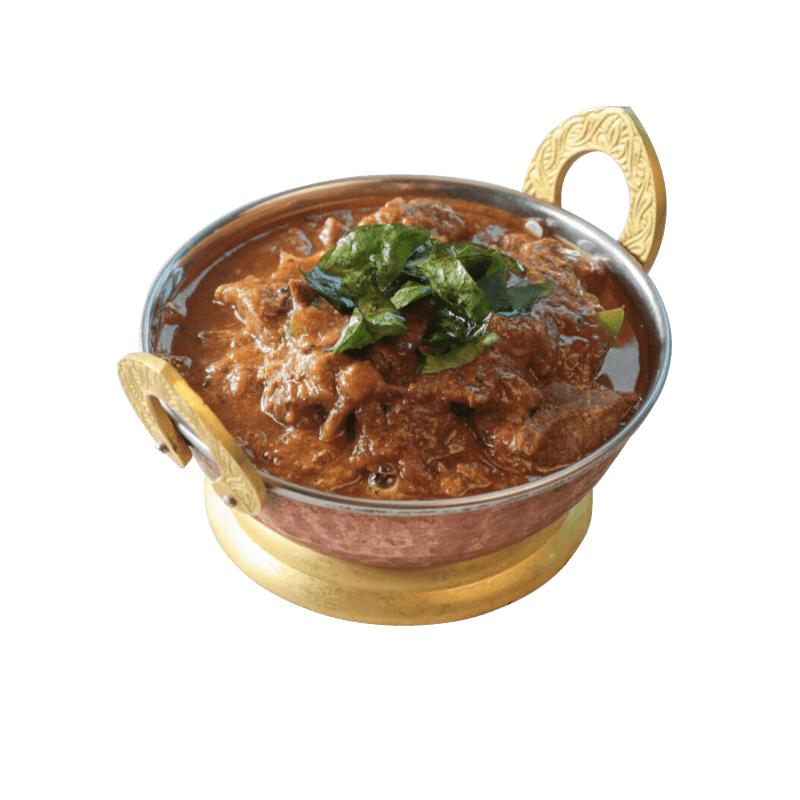
The Jaffna dish that turns Sunday into a feast.
Bone-in lamb, three hours on the fire, hand-roasted Jaffna masala and coconut milk. The curry our grandmothers cooked for weddings, Pongal and Sundays that mattered — now cooked the same way in Heilbronn.
What Is Lamb Kari?
Lamb Kari is the Sunday centrepiece of the Jaffna Tamil kitchen — a slow-simmered, deeply spiced lamb curry that turns an ordinary afternoon into a celebration. Bone-in pieces of lamb are marinated in turmeric and lime, pressed into a thick masala of roasted coriander, cumin, fennel, fenugreek and pepper, and braised for hours in coconut milk until the meat surrenders off the bone and the gravy darkens into a glossy, mahogany sauce. There is nothing quick about it. There is no shortcut that any Jaffna grandmother would ever accept.
Where Paruppu Kari — the humble lentil curry — is the everyday heartbeat of a Jaffna home, Lamb Kari is its opposite. It is the dish that announces, without words, that today is different. Today is a festival, a wedding, a baptism, a birthday, the first Sunday of a visit from relatives abroad. In most Jaffna households, Lamb Kari is not cooked daily. It is cooked when the occasion deserves it, and when the pot goes on the stove, everyone in the house knows.
At THAMARAI in Heilbronn, we prepare Lamb Kari the way it has been cooked in Jaffna kitchens for generations — bone-in lamb, hand-ground Jaffna curry powder roasted fresh each week, a long gentle simmer that cannot be rushed. It is our most-ordered weekend dish, and the reason is simple: once you have tasted real Jaffna Lamb Kari, the memory does not leave you.
A Sunday Like No Other
If you want to understand what Lamb Kari means to a Jaffna Tamil family, step into a Jaffna home on a Sunday morning. The air in the kitchen is different on Sunday. There is a focused, unhurried purpose in the way Amma moves. She is not rushing — she is pacing herself for a day of cooking that will not end until the first guest is seated at the table.
It begins around eight. The lamb has been washed, trimmed and patted dry. A small bowl of turmeric sits on the counter, a pinch of salt beside it, and the juice of half a lime. Amma rubs the turmeric into the meat by hand — not with a spoon, never with a spoon — and leaves it to rest in a clay bowl while she tackles the spice tray. Coriander seeds. Cumin. Fennel. Black peppercorns. Fenugreek. Dried red chillies bought in bulk from the Tamil grocer when a cousin visited last month. Each spice is roasted separately in a flat iron pan until it darkens and releases its oil. The smell rolls out of the kitchen and down the corridor, and by the time the spices are ground — first on the old grinding stone, these days in a small electric grinder — the whole house has woken up.
Grandmother has been peeling garlic for forty minutes on a low wooden stool in the corner. She does not hurry. There is nothing to hurry for. The first lesson of Lamb Kari is that speed ruins it. The second is that flavour cannot be added at the end — it has to be built in from the start.
At half past nine, the onions go into coconut oil in a heavy clay uruli — a round-bottomed pot worn smooth by three generations of stirring. Then come curry leaves, pandan, a bruised stalk of lemongrass, a stick of cinnamon, two green cardamom pods, three cloves. The kitchen is full of smoke and music. Amma is humming now. The lamb goes in, hissing violently as it hits the hot oil, and for a few minutes there is nothing to do but stir and watch the outside of each piece seal and colour. Then the ground spice powder — three heaped tablespoons, sometimes four — is added with a splash of water. The masala catches onto the meat. Salt goes in. Tamarind pulp. Just enough thin coconut milk to cover. The lid goes on.
Now the waiting begins. The whole house smells of roasted spice and gently simmering lamb for the next two hours. Children drift in from the garden, ask how long until lunch, and are sent back out. Uncles arrive with newspapers folded under their arms. The aunties take over the rice and the side dishes. At noon the lid comes off, the thick coconut milk is stirred in, and the final ten minutes happen fast — the oil rising to the surface, the gravy darkening, the meat falling apart at the touch of a spoon. Someone tastes it from the ladle and nods. That nod is the only permission that matters.
And when the plates are finally on the table — rice steaming in the middle, iddiyappam coiled on a tray, roast paan from the Jaffna bakery, coconut sambol, boiled egg halves, thin curd to cool the mouth — everyone sits down at once. The elders first. Then the men. Then the women. Then the children who have been waiting for three hours. No one begins to eat until Grandfather has taken his first bite and nodded. And then, for the first thirty seconds, there is nothing but the sound of spoons meeting plates. That is the sound of Sunday in a Jaffna home.
Not Every Day. Not Every Family.
Lamb Kari was never an everyday dish in Jaffna — and understanding why requires understanding the economics and religion of northern Sri Lanka. Jaffna is, culturally, a Hindu Tamil society. The dominant caste group, the Vellalar, is traditionally vegetarian. For centuries, the most devout Hindu households cooked no meat at all, and those that did reserved it for the rarest of occasions. Mutton — which in Sri Lanka almost always means goat, not sheep — was a once-a-month luxury at best, and in many households much rarer than that.
The families who cooked meat most often were the Jaffna Tamil Catholics and Christians — communities concentrated in Karampon, Mannar, the small islands of the Jaffna lagoon, and pockets of the peninsula converted during the Portuguese and Dutch eras. For these households, the Sunday mutton curry became a weekly ritual, cooked after church in large clay pots, shared among extended family. It is no accident that many of the most celebrated Jaffna Lamb Kari recipes in the diaspora come from Catholic grandmothers. They had three hundred years of Sundays to perfect the dish.
But even in non-vegetarian households, meat was not cheap. A single goat had to feed an extended family, and a kilo of fresh mutton could cost more than a day's wages for many workers. For this reason, Lamb Kari became tightly bound to festive occasions: weddings, baptisms, first birthdays, Pongal, Deepavali, Christmas Eve, the return of a relative from overseas. To serve Lamb Kari was to say, without words, you are worth the expense. It is this social weight, more than any single ingredient, that gives the dish its flavour.
The war years between 1983 and 2009 made meat even rarer in Jaffna. Embargoes, displacement, and collapsing supply chains meant that for many families, a pot of Lamb Kari was something to remember rather than to cook. Children who grew up during the war often first tasted real Jaffna Lamb Kari as adults in the diaspora — in a Tamil uncle's kitchen in Toronto, in a temple canteen in Paris, in a small restaurant in a German town called Heilbronn. The dish carries that history with it. It is a curry that remembers where it has been.
The Jaffna Curry Powder. A Blend Like No Other.
The single ingredient that separates Jaffna Lamb Kari from every other curry in South Asia is the spice blend — and specifically, the way that blend is roasted. Jaffna curry powder is not generic "curry powder". It is a regional formula that evolved on the northern peninsula of Sri Lanka over centuries, shaped by the dry climate, the coastal trade routes, and the particular palate of Tamil Hindus and Christians who demanded heat, depth, and aroma in equal measure.
A proper Jaffna curry powder contains, at minimum, six ingredients. Coriander seeds provide the citrus-and-nut backbone. Cumin contributes earthy warmth. Fennel gives the characteristic sweet-liquorice lift. Fenugreek adds a faintly bitter, maple-syrup undertone that is unmistakably Jaffna. Black peppercorns provide the clean, nose-tingling heat that does not burn the tongue. Dried red chillies — preferably the long, deep-red varieties from Kandy or Murunkan — bring colour and a slow-building fire. Some cooks add raw rice or green gram as a thickener. Others include a small measure of cinnamon, cloves, or cardamom for fragrance. Every family has its own ratio. Every grandmother swears hers is the right one.
The order of roasting matters almost as much as the ingredients. Coriander first, because it takes the longest. Cumin next, roasted until it darkens and pops. Fennel third — a quick roast only, or it turns bitter. Fenugreek fourth, watched constantly, because fenugreek burns in seconds and a single scorched seed can ruin an entire batch. Peppercorns fifth. Chillies last, roasted in their own pan because they release capsaicin vapour that will have the whole household coughing for an hour. Once all the spices are roasted and cooled, they are ground together — traditionally on a flat grinding stone, today in an electric grinder — into a coarse, fragrant powder the colour of dark chocolate.
That colour is not an accident. It is the signature of Jaffna cooking. A properly roasted Jaffna curry powder is noticeably darker than a North Indian garam masala, darker than a Malaysian meat curry powder, darker even than a Sri Lankan Sinhala curry powder. The deeper the roast, the more intense the flavour — and the more distinctively Jaffna the curry tastes.
Why Jaffna Curries Are Darker
If you have ever ordered a Jaffna-style lamb curry and a North Indian rogan josh side by side, the first thing you notice is the colour. The rogan josh is bright red, almost lipstick-coloured, tinted by Kashmiri chillies and finished with a pour of ghee. The Jaffna curry is dark — mahogany, nearly black where the masala has clung to the meat. There is a reason for this, and it is chemistry rather than accident.
When spices are roasted beyond the point where most Indian cuisines stop, they undergo what food scientists call pyrolysis — a controlled, just-before-burning breakdown of plant compounds that releases a second wave of flavour molecules not present in the raw or lightly roasted spice. Fennel roasted this deeply loses its floral sweetness and gains a smoky, almost caramelised note. Coriander develops toasted-wheat and cocoa undertones. Cumin picks up a bitter-coffee edge. Fenugreek crosses the line from maple syrup into something closer to roasted chicory. The resulting powder is darker, more bitter, more complex — and, crucially, it stands up to meat in a way that a lighter blend never can.
Lamb is a strong-flavoured meat. Its fat carries a distinctive gamey edge that thinner spice blends cannot tame. The deep-roasted Jaffna masala matches the lamb molecule for molecule: the toasted notes wrap around the meat, the bitter edges cut through the fat, and the slow simmer gives everything time to merge into something much larger than the sum of its parts. It is the culinary equivalent of bass and drums locking into a rhythm. This is why Jaffna Lamb Kari tastes the way it does, and why it cannot be faked with a spoonful of off-the-shelf curry powder from the supermarket.
Not Your Average Indian Restaurant Curry
When most Europeans think of lamb curry, they picture the dishes served at a typical Indian restaurant: rogan josh from Kashmir, bhuna gosht from the north, mutton korma, or a Hyderabadi dum gosht. These are all magnificent dishes with deep histories of their own — and they are all significantly different from Jaffna Lamb Kari. Understanding the differences is the best way to understand what makes our cooking ours.
Kashmiri Rogan Josh is built on yogurt, Kashmiri chilli, and ghee. It has no coconut. It is enriched with a spice bouquet of fennel, dry ginger, cinnamon, and asafoetida, and the meat is simmered in its own juices with a little water until the fat separates into glossy red pools on the surface. The flavour is aromatic, tangy, and relatively mild by Sri Lankan standards — the Kashmiri chilli provides colour without much heat.
Bhuna Gosht from the Gangetic plains is a slow-cooked, onion-heavy lamb curry where the meat is fried with masala and onions until the oil separates and the gravy reduces to a thick coating. It uses mustard oil, garam masala, tomatoes, and sometimes yogurt. There is no coconut milk, no curry leaves, no fenugreek roast. The texture is dry and clinging rather than saucy.
Hyderabadi Mutton Curry carries the Mughal and Persian influences of the Deccan courts: saffron, ghee, fried onions, yogurt, and a finishing flourish of mint and coriander leaves. It is often served alongside biryani. The spice profile is fragrant and layered rather than dark and fiery.
Chettinad Mutton from southern Tamil Nadu is the Indian curry closest in intensity to Jaffna cooking. It leans heavily on roasted coriander, black pepper, star anise, fennel and kalpasi (black stone flower), and it uses fiery dried chillies with confident hands. But Chettinad curries are typically drier, more pepper-forward, and built on sesame oil rather than coconut oil. They are cousins to Jaffna Lamb Kari, not siblings.
Kerala Erachi Curry, just across the Palk Strait from Jaffna, is the closest Indian relative of all. It uses coconut oil, curry leaves, coconut milk, roasted spices, and slow braising. The differences are subtle: Kerala favours more black pepper and less fenugreek, uses thin slivers of fresh coconut alongside coconut milk, and tends to be lighter in colour because the spices are less deeply roasted. If you enjoy Kerala mutton curry, you will love Jaffna Lamb Kari. They are first cousins, separated by a narrow sea and centuries of parallel evolution.
| Curry | Region | Base Fat | Signature Spice | Coconut Milk | Heat Level |
|---|---|---|---|---|---|
| Jaffna Lamb Kari | Northern Sri Lanka | Coconut oil | Dark-roasted Jaffna curry powder | Essential | Medium-high |
| Kerala Erachi | Southern India (Kerala) | Coconut oil | Roasted coriander, pepper | Essential | Medium |
| Chettinad Mutton | Tamil Nadu | Sesame oil | Kalpasi, star anise | Minimal | High |
| Hyderabadi Mutton | Deccan, India | Ghee | Saffron, fried onions | None | Medium |
| Bhuna Gosht | North India | Mustard oil | Garam masala | None | Medium |
| Kashmiri Rogan Josh | Kashmir | Ghee | Fennel, Kashmiri chilli | None | Mild-medium |
All of these curries are wonderful in their own right. None of them is Jaffna Lamb Kari. If you have been eating Indian restaurant food in Germany for years and have never tasted a real Jaffna curry, you are in for a surprise — the depth is different, the roasting is different, the balance of heat and fat and aromatic sweetness is different. It is not better or worse than the great North Indian traditions. It is simply another country on the map of South Asian cooking, and one that very few Europeans have yet been lucky enough to visit.
How Jaffna Cooks It. How the Rest of the Island Does.
Even within Sri Lanka, Lamb Kari is not one dish. The Jaffna style in the north is noticeably different from the Sinhalese style cooked in the south and central highlands. Sinhalese mutton curry tends to be lighter in colour, uses more cinnamon and pandan, leans harder on lemongrass, and often includes a generous hand of tamarind or goraka — a sour dried fruit native to Sri Lanka that gives southern curries their distinctive tang. The spice blend used in the south, known broadly as "Ceylon curry powder," is lighter than Jaffna's, sometimes even unroasted, which gives Sinhalese curries a fresher, more herbal profile.
The Jaffna version is darker, more intensely roasted, and more pepper-driven. The heat comes more from black pepper and less from chillies, giving a slower, deeper burn rather than a sharp bite. Fenugreek plays a much larger role in the north. Coconut milk is used in greater quantity. The meat is simmered for longer, until the gravy reduces to a thick, glossy sauce that coats every piece. A Sinhalese mutton curry might be ready in an hour. A Jaffna Lamb Kari will almost always take two or three — and most of that time is gentle, lid-on simmering that no cook can rush.
From Jaffna to the World
The Tamil diaspora is one of the largest in South Asia. An estimated eight hundred thousand to one million Sri Lankan Tamils live outside the island — in Canada, the United Kingdom, France, Germany, Switzerland, Norway, Australia, and beyond — most of them displaced by the civil war that raged from 1983 to 2009. Wherever they went, they carried their recipes with them. And of all those recipes, Lamb Kari was the one that travelled furthest and became the most recognisable marker of Tamil identity abroad.
In Toronto, Sunday Lamb Kari is cooked in Scarborough kitchens and served at Hindu temple canteens. In London, it appears on the menus of the Tamil restaurants along Tooting and East Ham. In Paris, it is cooked in the apartments of La Chapelle after the children have come home from Tamil school. In Berlin, Hamburg, Frankfurt and now Heilbronn, it has become the dish that tells the story of Jaffna to a European audience that often still confuses Sri Lankan food with Indian food. Every bowl is a conversation. Every plate is a small ambassador for a cuisine that, outside of the Tamil world, is still barely known.
In Germany, where the line between "Indian" and "Tamil" cooking is rarely drawn in casual conversation, Tamil restaurants have had to work twice as hard to explain what they cook. For many of our guests at THAMARAI, Jaffna Lamb Kari is the first introduction to the idea that South Asian cooking is not one cuisine but dozens — each region, each island, each community cooking differently, with its own spices and its own stories. "Sri Lankan" as a culinary label is a recent, post-colonial shorthand; the Jaffna Tamil kitchen is much older than the country it now sits inside, and it deserves its own name on the map. Once you have tasted the difference, you cannot un-taste it.
From New Zealand Pasture to Jaffna Pot
There is a small, beautiful irony at the heart of Jaffna Lamb Kari in Germany. In Jaffna itself, the dish was traditionally made with goat, not sheep — sheep do not thrive in the tropical heat of the Jaffna peninsula, and the small numbers of goats raised on the dry scrubland behind the villages were the main source of red meat for generations. When the recipe travelled to Europe, Tamil cooks discovered something wonderful: lamb raised on cool-climate pastures is more tender, sweeter, and more consistently available than the goat they grew up with. The dish adapted, as every great dish eventually does, to the ingredients of its new home.
At THAMARAI in Heilbronn, we source our lamb from New Zealand — from the grass-fed flocks that have grazed the long, wet pastures of the North and South Islands for well over a century. There is a particular reason we made this choice. New Zealand lamb is consistently young, tender and well-marbled, raised almost entirely outdoors on pasture rather than in feedlots, and the cold-chain supply into Europe is reliable enough that we can cook with the same quality of meat every week of the year. For a dish where the meat is the entire point, consistency is not a luxury — it is the dish itself.
There is a pleasing geography to it too. The lentils for our Paruppu Kari come from a dal tradition a thousand years old. The lamb for our Lamb Kari travels from the southernmost grasslands of the Pacific to the heart of Heilbronn, where we cook it in a roasted Jaffna masala our grandmothers ground by hand on the northern tip of Sri Lanka. Three places, three traditions, one pot on a Sunday morning. Jaffna Lamb Kari forgives very little: if the lamb is not good, the curry cannot be good. We take this part of our kitchen more seriously than any other.
The Science of Slow
Lamb Kari is, at its heart, an exercise in patient chemistry. Three things happen when tough cuts of lamb are simmered gently for hours, and together they are what makes the dish work.
First, collagen — the tough, rubbery connective tissue that runs through lamb shoulder, neck, and shank — slowly dissolves into gelatine at temperatures between 70 and 90 degrees Celsius. This is why the meat falls off the bone in a well-cooked Lamb Kari, and why the sauce thickens naturally without any flour or cornflour. The gelatine gives the gravy its glossy, lip-coating quality. You cannot fake this with quick cooking. Collagen takes its time, or it takes nothing at all.
Second, the Maillard reaction — the same chemical reaction that browns bread crusts and sears steaks — builds flavour in the early searing stages, when the lamb hits hot coconut oil. At around 140 to 165 degrees Celsius, amino acids in the meat react with reducing sugars to produce melanoidins: the deep brown, savoury compounds responsible for roasted aromas and umami depth. Skipping this step gives you boiled lamb in sauce. Doing it properly gives you Lamb Kari.
Third, fat rendering: lamb fat is richer in branched-chain fatty acids than beef or pork, which is what gives the meat its distinctive aroma. When the fat slowly melts into the coconut milk and spice oil, it carries fat-soluble flavour compounds throughout the gravy — capsaicin from the chillies, curcumin from the turmeric, aromatic terpenes from the curry leaves and pandan. By the end of three hours, every ingredient has dissolved into every other. There are no discrete flavours left. There is only Lamb Kari.
A Dish That Remembers
Ask any Tamil child of the diaspora what they miss most when they are homesick, and the answer is almost never a famous landmark or a piece of music. It is a food. And for most of them, that food is their grandmother's Lamb Kari — the Sunday curry that smelled through the whole house, the lamb on the bone, the hours of waiting, the nod from Grandfather before the first spoonful. Food is memory, and Lamb Kari is one of the strongest memories Jaffna has to offer.
We have guests who come to THAMARAI in Heilbronn and go very quiet at the first taste of our Lamb Kari. We have grandfathers who have not eaten a proper Jaffna curry since they left Sri Lanka in 1985 and who need a long moment before they can speak. We have German guests who discover Tamil cooking for the first time and spend the rest of the meal asking questions. Every plate is a story. Every ladle remembers something that happened in a kitchen forty years ago in a corner of the world most of our guests will never see.
It is worth being precise about this. Many of our German guests have been to Sri Lanka — to the beaches of the south coast, to Kandy and the tea plantations, to the rock fortress at Sigiriya, to the old Dutch walls of Galle. They have seen a beautiful country. But very few of them have been to the North — to Jaffna itself, to Karampon, to Kayts, to Mannar, to the islands in the lagoon where this recipe was born. The North is still, for most European travellers, a blank spot on the map: too far from Colombo, too slow to reach, too quiet for the guidebooks. And yet that is exactly where Jaffna Lamb Kari comes from. When you taste this curry in Heilbronn, you are tasting a place most visitors to Sri Lanka never quite reach — the kitchens of a Tamil peninsula that has been cooking this way for longer than anyone can remember.
This is the thing about Jaffna Lamb Kari. It is not just a dish. It is a carrier. It carries Sundays, weddings, temples, losses, returns, migrations, and quiet afternoons on verandas under mango trees. When we serve it to you in Heilbronn, we are serving all of that with it. That is what we mean when we say the food at THAMARAI is authentic. We do not mean that we followed a recipe from a cookbook. We mean that the recipe was carried here in our family's hands.
Frequently Asked Questions
Catering for Your Celebration
Jaffna Lamb Kari is, by tradition, a celebration dish. It was cooked for weddings, for Pongal, for Christmas Eve, for the homecoming of a relative from overseas. If you are planning a celebration of your own — a wedding, a birthday, a baptism, a family gathering, a company dinner — we would love to cook it for you. At THAMARAI in Heilbronn, we offer catering for private events with the same care we bring to the dishes on our daily menu. Lamb Kari travels well, reheats beautifully, and has the remarkable quality of tasting even better the next day, as the spices settle into the meat overnight.
Contact us to discuss your event. We can cater for small gatherings in the restaurant itself, or deliver prepared dishes to your venue. Every Tamil family already knows the truth: the best meals are the ones cooked by someone who loves the recipe as much as you love the occasion.
Visit THAMARAI in Heilbronn
Ready to taste real Jaffna Lamb Kari? Come and find us at THAMARAI Restaurant in Heilbronn. We serve Lamb Kari daily, freshly cooked each morning from bone-in lamb and our own hand-roasted Jaffna curry powder. Whether you grew up eating Tamil food and are searching for the taste of home, or whether you are stepping into a Sri Lankan kitchen for the first time — whether you thought you knew Indian food and are about to discover how much wider South Asian cooking really is — we would love to welcome you to our table.
Nutrition at a Glance
Per serving, based on a standard portion size.

