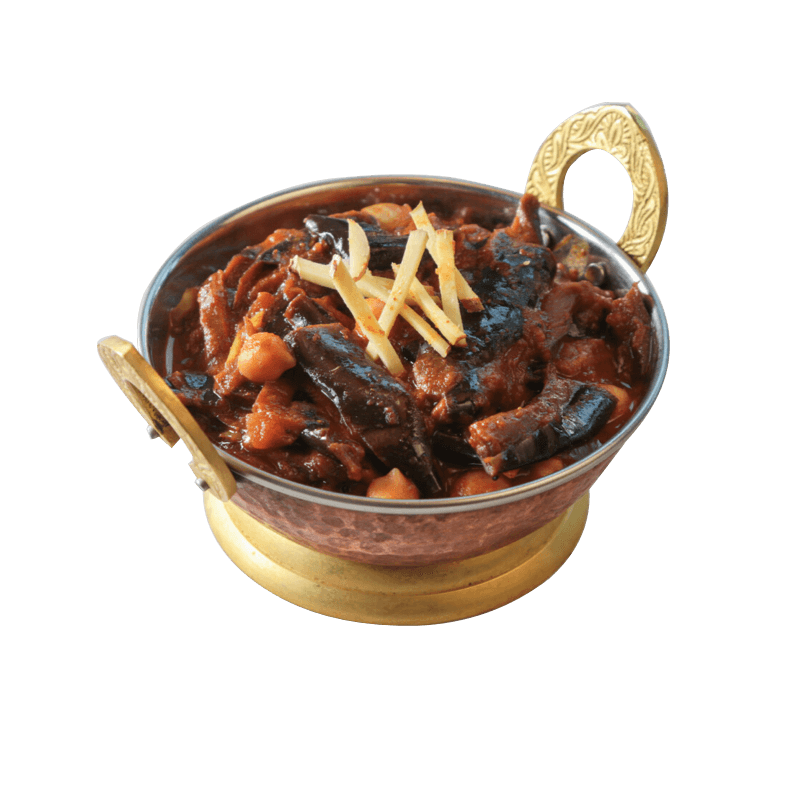
From Ammama's clay pot — the queen of the vegetarian kitchen.
Traditional Tamil aubergine curry. Flame-charred, tempered with mustard seeds, curry leaves, and coconut milk — the queen of the Jaffna vegetarian table.
What Is Katharikkai Kari?
Katharikkai Kari (pronounced kath-tha-rik-kai kari in Tamil; katharikkai means aubergine) is the smoky, silken vegetable curry that sits at the very heart of Jaffna Tamil home cooking. It is the dish that appears when there is no meat in the house and nobody minds, because katharikkai kari does not apologise for being vegetarian — it celebrates it. Small, tender aubergines are charred over an open flame until their skins blister and blacken, then simmered with freshly tempered mustard seeds, curry leaves, green chillies, a squeeze of tamarind, and a generous pour of coconut milk. The flesh collapses into the sauce and absorbs every flavour around it, until the boundary between vegetable and gravy dissolves entirely.
Ask ten Tamil grandmothers for their katharikkai kari and you will receive ten recipes, each one presented as the only correct version. One swears by roasting the aubergines whole over coconut husks. Another insists on splitting them lengthwise and frying in sesame oil first. A third adds a single dried Maldive fish chip for depth — and a fourth considers that addition a heresy punishable by exclusion from the kitchen. Nobody is wrong. Nobody will ever admit that. But beneath every argument, every family secret, every firmly held opinion about the correct amount of tamarind, one thing remains undisputed: katharikkai is the queen of the Jaffna vegetarian table — the dish that Hindu farming families have cooked with more pride, more frequency, and more love than any other vegetable on the peninsula.
At THAMARAI in Heilbronn, we char our aubergines over an open flame before they ever meet the pan. We temper them with mustard seeds that pop like tiny firecrackers in coconut oil, add hand-stripped curry leaves from the stem, and finish with freshly pressed coconut milk — not from a tin, not from a carton, but squeezed through cloth the way it has been done in Jaffna kitchens for longer than anyone can remember. This is the dish our vegetarian guests order first, and the one our Tamil guests nod quietly at when they taste it, because it reminds them of a kitchen they have not stood in for a very long time.
A Morning in Urkavathurai, 1973
Imagine a morning in 1973. Not the Sri Lanka of political speeches or tourist brochures, but the Sri Lanka that smells of red earth after overnight rain, of cow dung drying on a wall, of jasmine strung through a woman's braid before the sun has fully risen. The village is Urkavathurai — known to the British maps as Kayts — a small settlement on Velanai Island, one of the flat, wind-scrubbed islands connected to the Jaffna peninsula by a narrow causeway and a faith in bridges that have been rebuilt more times than anyone can count.
Velanai is not the Jaffna of postcards. There is no dramatic coastline here, no crashing surf. The island is low and level, barely above sea level, fringed by shallow lagoons where herons stand motionless at dawn. The soil is sandy and calcium-rich — coral limestone ground down over millennia — and it drains fast after rain, which means that the plants that thrive here must be tough, deep-rooted, and patient. Palmyra palms line every road, their fan-shaped crowns silhouetted against a sky that is white with heat by ten in the morning. Between the palms, there are houses — low, tile-roofed, with thick walls of coral stone or plastered brick — and behind every house, without exception, there is a garden.
The house we are entering belongs to a Hindu farming family. The father — whom the children address with quiet respect and the neighbours address by his land — runs a small but productive farm on the edge of the village. He grows tobacco, onions, chillies, and groundnuts on his fields, and he employs a handful of workers during planting and harvest seasons. His wife — whom everyone calls Amma, the Tamil word for mother that has expanded, as it always does, to mean the woman who holds the entire household in her hands — rises before anyone else in the house. By the time the first rooster announces itself from behind the coconut-frond fence, she has already swept the front yard with a coconut-rib broom, drawn a fresh kolam — a geometric pattern of rice flour — at the threshold, lit the brass kuthuvilakku lamp in the prayer alcove, and set water to boil on the firewood stove in the outdoor kitchen.
The house has six children. Five girls and one boy — the youngest, the long-awaited son, whom the whole family calls Thamby, which simply means younger brother in Tamil and is, in practice, a name that will follow him for the rest of his life. The girls, from eldest to youngest: Malar, Kala, Kumari, Gowari, and Kalyani. In 1973, Malar is eighteen and already thinking about what comes next. Kala is sixteen, quiet and meticulous, the one who keeps the household accounts in a ruled exercise book. Kumari is fourteen, the fastest talker in the family and the one most likely to start an argument at the dinner table and win it. Gowari is twelve — born in August 1961 — and she is the one we will follow most closely, because she is the one who will one day leave this island, cross an ocean, and open a restaurant in a German city called Heilbronn. But in 1973, she does not know any of that. She knows the bicycle, the red-earth lanes, the weight of a message pouch slung across her shoulder, and the taste of her mother's katharikkai kari on a Tuesday afternoon.
Kalyani is ten, still young enough to play in the backyard with Thamby, who is seven and interested primarily in two things: climbing the mango tree and chasing the neighbour's goats. Together they form the tail end of the family, the two who are not yet old enough to be useful in the kitchen or the fields, and who are therefore granted the one luxury that childhood on Velanai Island offers in abundance: time.
I never called her Amma. To me she was always Ammama — my grandmother. My mother, Gowari, told me these stories so many times that I sometimes forget I was not there myself. But I was not. I came later. What follows is her world, as she remembers it and as I have tried to set it down.
The Errand to Jaffna Town
On the Monday morning of that week, the harvest day was approaching. Eight workers would be in the fields the next morning, and Ammama was already planning the midday meal in her head — rice, rasam, paruppu and, as the centrepiece, her katharikkai kari. The aubergines hung from their bushes in the backyard, and she would press the coconut milk fresh in the morning. But three things were missing that could not be had on the island: a block of asafoetida from the spice merchant on Hospital Road, a pound of tamarind from the mainland, and — most importantly — Jaffna curry powder from the dealer at the old market, the only man in town whose spice blend Ammama would accept. The village shopkeeper on Velanai had curry powder, certainly. Ammama had tried it once and concluded that the man was stretching his stock with rice bran. Since then, she bought only in Jaffna Town.
She sent three girls on the morning bus: Kala, sixteen and meticulous, who carried the note with the exact quantities in her pocket and was the only one Ammama trusted to test tamarind for freshness by pressing it between her fingers. Kumari, fourteen and fierce, who could haggle at the market as though she had twenty years' experience. And Gowari, twelve, the family's messenger, who knew every dealer and every shortcut in Jaffna Town because she had been running errands by bicycle and occasionally by bus since she was ten.
The Ceylon Transport Board bus — painted red and cream, wooden seats, open windows — took forty minutes from Kayts to Jaffna on a good day and over an hour on a bad one. Ammama calculated generously: one hour there, one hour at the market, one hour back, one hour's buffer. You will be home by two o'clock. The girls nodded. Four hours for an errand that took one. Each of them knew what that meant.
In Jaffna Town, after Kala had tested the tamarind, Kumari had bargained the price of the asafoetida down by twenty cents, and Gowari had collected the curry powder from the dealer at the market, they stood with three full cloth bags at the crossroads near the clock tower. It was half past ten. The return bus left at one. Kumari said what all three were thinking: The MGR matinee starts at eleven.
Ulagam Sutrum Valiban — The Youth Who Circled the World — had been playing in every cinema in the Tamil world for months, and the girls of Urkavathurai had not yet seen it. Tickets cost seventy-five cents each. Kumari had counted the change from the market. It was enough. The cinema was five minutes' walk away. Kala hesitated — she was the eldest, the responsible one. Gowari said nothing, but her eyes said everything. Kumari argued with the logic of a fourteen-year-old who knows she is going to win: We take the two o'clock bus instead of the one o'clock bus. One hour. Ammama won't notice.
They did not take the two o'clock bus. The film was longer than expected, and the two o'clock bus was full. They took the three o'clock bus. When they stood at the garden gate at four — one hour late, with three cloth bags full of spices and the afterglow of MGR in their heads — Ammama was waiting on the veranda. She said nothing. She held out her hand. Kala gave her the note with the dealer's receipt. Ammama unwrapped the asafoetida, smelled it, scraped the surface with her thumbnail. She opened the tamarind, pressed it with her thumb. She opened the curry powder and rubbed a pinch between her fingers.
Kumari had her explanation ready. The bus broke down at Punnalaikadduvan, she said, and her tone was so convincing that she almost believed it herself.
Ammama looked at her — one long, quiet look that caught all three girls at once. Then she said: The asafoetida is fresh. The bus company should be ashamed of itself. She turned and walked into the kitchen. Not another word. No question about why Gowari's hair ribbon smelled of cinema popcorn. No remark about the fact that the three o'clock bus from Punnalaikadduvan ran on schedule — Ammama knew this because she herself had been taking that bus for twenty years.
The next morning, when the workers were in the fields and Ammama was preparing the katharikkai kari in her heavy clay pot, it tasted especially good. Perhaps it was the curry powder from the dealer in Jaffna Town. Perhaps it was something else — the small secret that hung in the kitchen like the smoke from the firewood, unspoken and smelled by everyone. The girls ate in silence. Ammama pretended not to notice. The katharikkai kari was excellent. Some things are better left unexplained.
When Ammama Cooked for Forty
To understand katharikkai kari, you have to understand the scale at which Ammama cooked. She was not preparing meals for six children and a husband. She was feeding an economy.
During the planting and harvesting seasons, eight to twelve farm workers came to the fields each morning. They were local men from Urkavathurai and the neighbouring villages — Mankumpan, Saravanai, Allaipiddy — and they arrived at dawn, worked through the morning, and expected a full meal at midday. That meal was not a sandwich and a flask of tea. It was rice — a mountain of rice, steamed in the large aluminium pot that lived permanently on the back burner — accompanied by three or four curries, a sambol, a rasam, and curd. The curries rotated, but one appeared more often than any other: katharikkai kari.
The reason was partly practical. Aubergines grew in the backyard. They did not need to be bought, carried, or bargained for. They were simply there — hanging from their bushes in the kitchen garden behind the house, purple-black and glossy, ready to be picked before breakfast and cooked before noon. But the reason was also culinary. Katharikkai kari, when cooked properly, stretches. A single kilo of aubergines, charred and simmered in a generous gravy, could accompany ten plates of rice without anyone feeling shortchanged. The flesh absorbs the sauce, expands, becomes more than itself. It is the most generous vegetable in the Tamil kitchen — the one that gives back more than you put in.
Ammama cooked it in a heavy clay pot on the outdoor firewood stove. The aubergines were sliced lengthwise — small ones halved, larger ones quartered — and dropped into a bowl of tamarind water to prevent browning. Coconut oil went into the pot first, then a pinch of fenugreek seeds, then mustard seeds that crackled and jumped in the hot oil like rain on a tin roof. Curry leaves followed — a generous fistful, still on the stem, stripped with one sharp pull. Then dried red chillies, broken in half so the seeds scattered into the oil. Then sliced shallots, translucent and sweet. Then turmeric, just a pinch, for colour. Then the aubergines themselves, drained of their tamarind bath and tumbled into the pot. A splash of the tamarind water. The Jaffna curry powder — two tablespoons, dark and smoky, ground that morning on the stone. A pinch of salt. The lid went on.
Twenty minutes later, when the aubergines had softened into the sauce and the kitchen smelled of smoke and tamarind and roasted spice, Ammama would lift the lid, pour in a ladle of thick coconut milk, stir gently — never roughly, because katharikkai breaks apart if you handle it without respect — and taste from the wooden spoon. A small nod. More salt. Another small nod. Done.
This is the version we cook at THAMARAI. Not a restaurant invention. Not a chef's reinterpretation. A farm wife's katharikkai kari, made the way it was made when there were twelve hungry mouths to feed and the aubergines were picked that morning from the bush outside the kitchen window.
The Queen of Vegetarian Dishes
In the Hindu farming communities of Jaffna — the agricultural families who had worked the red soil of the peninsula for centuries — vegetarian cooking was not a limitation. It was a tradition, a discipline, and, for the most devout families, a source of quiet pride. Not every household was strictly vegetarian, but the cultural centre of gravity leaned unmistakably toward a plant-based kitchen.
Within that kitchen, katharikkai occupied a position of unrivalled prestige. If paruppu — lentils — was the everyday staple, the humble foundation of every meal, then katharikkai was the star. It was the dish that elevated a weekday dinner to something worth talking about. A plate of rice with paruppu kari and a simple sambol was sustenance. The same plate with katharikkai kari added to it was a meal worth sitting down slowly for.
The reasons are partly flavour — no other vegetable can match the smoky, silken, deeply savoury character of a well-made katharikkai kari. But they are also cultural. In a Hindu household where meat was rare or absent, the ability to produce a vegetable dish of such depth and complexity was a measure of the cook's skill. A woman who could transform a handful of aubergines, a spoonful of mustard seeds, and a cup of coconut milk into something that made the whole table fall silent at the first bite — that woman was respected. Not for her piety, though piety mattered. For her craft.
Ammama was that woman. Her katharikkai kari was famous within three villages. Not because she advertised it — advertising was unthinkable — but because anyone who had eaten at her table mentioned it to anyone who had not. The farm workers talked about it to their wives. Their wives talked about it to the women at the temple. The women at the temple talked about it to their daughters. And so the reputation of a single dish, cooked in a clay pot on a firewood stove behind a farmhouse in Urkavathurai, rippled outward through the community in the way that only food can — not through boasting, but through memory.
The Mango Tree and the Backyard
Every Jaffna house had a backyard garden. This was not a decorative choice — it was survival infrastructure. In a community where the nearest market might be a bicycle ride away and the nearest town a bus journey, the backyard provided the daily foundation of the kitchen: moringa leaves, drumstick pods, curry leaves, green chillies, bitter gourd, snake gourd, long beans, a few tomato plants staked to palmyra sticks, and, invariably, a row of aubergine bushes.
The aubergine was the most reliable producer. Once established, a single bush would fruit continuously for months, yielding a handful of glossy purple fruits every few days — enough for a curry, enough for a side dish, enough for a quick vathakkal when there was nothing else in the kitchen and the workers would arrive in an hour. It tolerated the peninsula's heat, survived the salt-laden winds from the lagoon, and responded gratefully to the most basic care: water, a handful of cow dung, and the shade of larger plants nearby.
The largest plant in most Jaffna backyards was the mango tree. It served as shade for the kitchen garden, as a climbing frame for children, as a source of fruit in season and pickles out of season, and as the gathering point for the family in the hot hours of the afternoon. Ammama's mango tree was an old Jaffna variety — tall, broad-canopied, with small, fibrous, intensely sweet mangoes that ripened in May and June and drew every child and every crow in the neighbourhood. Beneath its shade, the aubergine bushes grew in the dappled light, their purple fruit visible against the dark green leaves, ready for picking. It was, in the most practical sense, a food system — the tree providing shade and mulch, the bushes providing fruit, and the kitchen providing the fire that turned both into something worth remembering.
Gowari's earliest memories of katharikkai kari are not of the cooking but of the picking. Ammama would send her to the backyard before breakfast with a small aluminium bowl. Pick the ones that are firm and shiny. Leave the dull ones — they are too old. Gowari learned, at seven or eight, the difference between a katharikkai that would char beautifully and one that would turn to mush. She learned that the stem should snap cleanly. She learned that the best ones had a slight give when pressed — not hard, not soft, but exactly between. This knowledge, acquired before she could read fluently, would travel with her across the Indian Ocean and resurface, decades later, when she stood in a German wholesale market selecting aubergines for a restaurant that did not yet exist.
Not One Katharikkai but Many
One of the great misunderstandings about Tamil vegetarian cooking is that it is simple. It is not. It is, in fact, among the most technically sophisticated vegetarian cuisines on earth, and katharikkai is the proof.
A single aubergine, in a Jaffna kitchen, can become half a dozen completely different dishes depending on how it is cut, how it is cooked, and what it is cooked with. Katharikkai kari — the thick coconut-milk curry — is the most celebrated, but it is only one voice in a much larger conversation.
Ennai katharikkai is the oil-rich version: baby aubergines are slit crosswise, stuffed with a paste of ground roasted spices, sesame, and coconut, and slow-fried in sesame oil until the skin blisters and the flesh turns creamy. It is richer, darker, and more intense than the coconut-milk version — a dish for small portions and strong flavours. Katharikkai vathakkal is the dry stir-fry: sliced aubergine tossed in a hot pan with mustard seeds, urad dal, curry leaves, and red chilli, cooked fast and served as a side dish with rice and sambar. Katharikkai poriyal is the tempered version: cubed aubergine steamed until soft, then mixed with freshly grated coconut and a quick tempering of mustard, curry leaves, and dried chilli. And katharikkai chutney — the roasted version, where the whole aubergine is placed directly in the embers of the firewood stove, charred until the skin is black and the flesh inside is smoky and molten, then mashed with shallots, green chilli, lime juice, and a pinch of salt — is the simplest and arguably the most addictive preparation of all.
At Ammama's table, the preparation changed with the day, the season, and the number of mouths. Katharikkai kari with coconut milk was for the big cooking days — workers' lunches, festival meals, days when the pot had to stretch. Ennai katharikkai was for special occasions — a temple festival, a visiting relative, a day when Ammama wanted to show what she could do. Vathakkal and poriyal were for weekday dinners, quick and satisfying. And the fire-roasted chutney was for the evenings when Ammama was tired, the children were hungry, and all it took was one aubergine, a bed of coals, and five minutes of patience.
Katharikkai Around the World
The aubergine is one of a handful of vegetables that has been independently adopted by almost every major culinary tradition on earth. It left South Asia two thousand years ago and never stopped travelling. Wherever it arrived, it was embraced, adapted, and claimed as a local treasure — which means that a Jaffna grandmother and a Turkish grandmother and a Sicilian grandmother, separated by thousands of kilometres, are all cooking the same plant with the same conviction that their version is the original.
| Dish | Origin | Preparation | Primary Fat | Key Flavour |
|---|---|---|---|---|
| Katharikkai Kari | Jaffna, Sri Lanka | Charred, simmered in coconut milk curry | Coconut oil | Smoky, tamarind, mustard seed |
| Baingan Bharta | North India | Fire-roasted, mashed with onion and tomato | Mustard oil / Ghee | Smoky, tomato, cumin |
| Baba Ganoush | Levant | Fire-roasted, blended with tahini and lemon | Olive oil / Tahini | Smoky, sesame, citrus |
| Imam Bayildi | Turkey | Stuffed, braised in olive oil with tomato | Olive oil | Sweet, tomato, garlic |
| Melanzane alla Parmigiana | Southern Italy | Sliced, fried, layered with cheese and tomato | Olive oil | Tomato, mozzarella, basil |
| Moussaka | Greece | Sliced, layered with meat sauce and bechamel | Olive oil / Butter | Cinnamon, nutmeg, cream |
What unites all these dishes — despite their vastly different spice profiles, fats, and cultural contexts — is an understanding of the aubergine's essential nature: it is a sponge. It absorbs whatever you give it. Olive oil, coconut milk, tahini, tomato sauce, spice paste — the aubergine takes it in, makes it part of itself, and gives back a texture that no other vegetable can replicate. This is why the aubergine has conquered every kitchen it has entered. It does not compete with local flavours. It amplifies them.
The Science of the Sponge
The aubergine's extraordinary ability to absorb flavour is not a metaphor — it is a measurable physical property rooted in the vegetable's cellular structure. Raw aubergine flesh is roughly sixty per cent air by volume. The cells are large, thin-walled, and riddled with intercellular air pockets, creating a foam-like matrix that behaves less like solid plant tissue and more like a dry sponge. When heat is applied — particularly the intense, direct heat of charring over flame — the cell walls collapse, the air is expelled, and the flesh compresses into a dense, velvety mass that is now hungry for liquid. Submerge that mass in a flavoured sauce — coconut milk spiked with roasted spices, say — and it absorbs the liquid the way a sponge absorbs water, pulling flavour into its very structure rather than merely sitting in it.
This is why Ammama charred her aubergines before adding them to the curry. The charring was not decorative. It was functional: it collapsed the cellular structure, created the Maillard compounds that give charred aubergine its distinctive smoky flavour — the same browning reaction that sears a steak or crusts a loaf of bread — and prepared the flesh to absorb the maximum amount of sauce during the subsequent simmering. A katharikkai kari made with uncharred aubergines is a different dish entirely — softer, blander, without the smoky backbone that holds the whole preparation together.
The tempering — thaalithal in Tamil, the technique of frying whole spices in hot oil at the start of cooking — is equally grounded in chemistry. When mustard seeds hit hot coconut oil, the heat causes the seed coat to rupture, releasing volatile isothiocyanate compounds (the same family of molecules that gives wasabi its bite). These compounds are oil-soluble, meaning they dissolve into the coconut oil and distribute evenly through the dish. Curry leaves release their essential oils — including linalool and pinene — into the fat within seconds of contact. The dried red chillies contribute capsaicin, which is also fat-soluble. The result is an infused oil that carries flavour compounds that water alone could never dissolve.
The coconut milk that finishes the dish serves a dual purpose. First, it provides fat — roughly seventeen per cent in fresh first-pressing coconut milk — which acts as a solvent for the fat-soluble flavour compounds in the spices. Curcumin, the active compound in turmeric, is virtually insoluble in water but highly soluble in fat; cooking it in coconut oil increases its bioavailability by a factor of roughly twenty. Second, the coconut milk provides a creamy, slightly sweet counterbalance to the sharpness of the tamarind and the heat of the chilli, creating the rounded, complex flavour profile that distinguishes Jaffna curries from the thinner, more astringent curries of South India.
The purple skin of the aubergine contributes its own chemistry. It contains nasunin, a potent anthocyanin antioxidant that gives the skin its colour and has been shown in laboratory studies to protect cell membranes from lipid peroxidation. Ammama did not know the word nasunin. She knew that you never peeled a katharikkai before cooking it, because the skin held the flavour and the colour. She was, as so often, right for reasons she never needed to name.
What Happened to the Islands
In July 1983, the violence that had been building for years on the island of Sri Lanka erupted into what is now known as Black July — a series of anti-Tamil pogroms that killed between one thousand and three thousand people and displaced over one hundred and fifty thousand. The Jaffna peninsula, home to the largest concentration of Tamil civilians in the country, became the frontline of a civil war that would last twenty-six years.
The islands suffered disproportionately. Velanai, Kayts, Karampon, Mandaitivu — small, exposed, difficult to defend, impossible to flee from quickly — became some of the most dangerous places in northern Sri Lanka. The fighting came in waves: army operations, resistance, aerial bombardments, naval blockades. The causeway — the same causeway the girls had crossed on the bus to see MGR in Jaffna Town — was intermittently closed, mined, or destroyed. The gardens went untended. The mango trees still fruited, but there was no one to pick the mangoes. The aubergine bushes, left to themselves, grew wild for a season and then died.
By the late 1980s, most families had left the village. Malar and Kala went to Toronto. The rest to Baden-Württemberg — the German economic miracle had built a thriving metal industry in the region, and the factories needed workers. Kumari went to Sindelfingen, Kalyani and Thamby to Heilbronn, and Gowari — now nineteen, the same girl who had ridden a BSA bicycle along the red-earth lanes with a message pouch across her shoulder — to Wüstenrot, where her husband Thilagam found work as a machine operator. Ammama eventually came to Germany too, and lived with Kumari in Sindelfingen.
The war ended in May 2009. Some families returned. Some did not. The house in Urkavathurai still stands, though the roof has been repaired twice and the backyard garden is smaller than it was. The mango tree, incredibly, survived — its roots too deep, its trunk too thick, for even two decades of neglect to kill it. New aubergine bushes have been planted where the old ones grew. The soil is the same. The climate is the same. Whether the katharikkai kari cooked in that kitchen today tastes the same as Ammama's is a question that only Ammama could answer, and Ammama is no longer here to ask.
What remains is the recipe — not written, never written, carried in the hands and the instincts of the daughters who watched and learned and carried it across oceans. When Gowari cooks katharikkai kari in the kitchen of THAMARAI, she does not consult a recipe book. She listens for the pop of the mustard seeds. She watches the colour of the oil. She tastes from the spoon and adjusts by feel — more tamarind, less salt, a touch more coconut milk — the way her mother taught her without ever saying a single word of instruction.
Frequently Asked Questions
Visit Us in Heilbronn-Sontheim
THAMARAI is in the Heilbronn district of Sontheim. By public transport, bus lines 31 and 41 run every ten to fifteen minutes — step off between the Ackermann and Lutzstrasse stops, and you are at our door.
By car from Heilbronn city centre, follow the B27 south toward Sontheim — the drive takes less than ten minutes, and parking is available directly in front of the restaurant. From Stuttgart, take the A81 toward Heilbronn/Würzburg, then merge onto the A6 in the direction of Nürnberg. Exit at Heilbronn/Untergruppenbach and follow the signs toward Sontheim — the restaurant sits just minutes from the motorway exit, making it one of the most accessible Sri Lankan restaurants in the region for guests arriving from across Baden-Württemberg.
If you are looking for authentic Sri Lankan Tamil vegetarian food in Heilbronn — the kind that was shaped in a farm kitchen on Velanai Island before it ever saw the inside of a restaurant — this is the table. Katharikkai kari, charred over flame, tempered with mustard seeds, finished in coconut milk pressed that morning. Ammama would recognise every step. She would also, we think, approve.
In Tamil, there is a phrase: Thirumba vaanga — come again. We say it after every meal, because no single visit can hold everything we want to share. The first plate is an introduction. The second is a conversation. The third is family.
Nutrition at a Glance
Per serving, based on a standard portion size.

