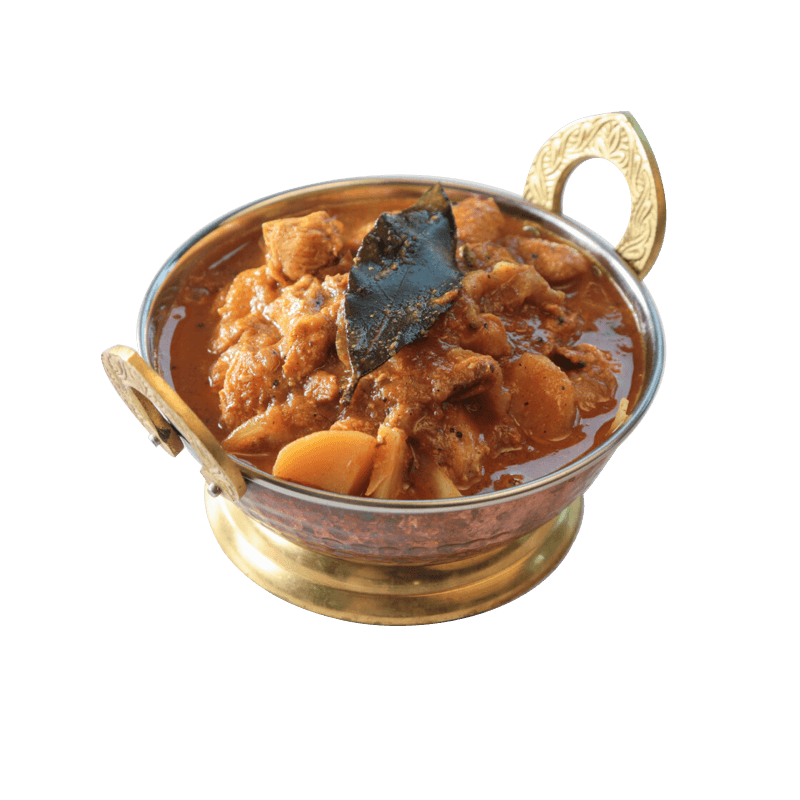
The Jaffna chicken curry that enchants Heilbronn.
Hand-roasted Jaffna masala, fresh coconut milk, slow-simmered the way Tamil grandmothers have done it for generations. Cooked by mother and daughter at THAMARAI in Heilbronn-Sontheim.
What Is Kozhi Kari?
Kozhi kari (pronounced kol-i kari, the zh sounds like a soft L; kozhi means chicken) is the fragrant, coconut-rich, deeply spiced chicken curry that defines Jaffna Tamil home cooking. It is not a single fixed recipe but a quiet family institution. Every Jaffna household will argue, politely, that its own version is the real one.
What all Jaffna versions share is a dark, hand-roasted curry powder — coriander, cumin, fennel, fenugreek, dried red chillies, black pepper, cinnamon, cloves, cardamom — browned in a heavy pan over a low flame until the kitchen smells the way only a Jaffna kitchen can smell. That powder meets freshly pressed coconut milk, curry leaves, pandan, a knot of ginger, a handful of shallots, and a good farm chicken. The rest is patience.
At THAMARAI in Heilbronn-Sontheim, we cook kozhi kari the Jaffna way — roasting and grinding our own curry powder in small batches, pressing our coconut milk fresh, and simmering the curry gently until the sauce turns glossy and the chicken falls off the bone at the touch of a fork. No tins. No shortcuts. No factory masala.
The Day the Chicken Was on the Table
You knew it before you even opened the front door. The scent of roasted coriander and coconut milk drifted all the way to the street, and in that moment every child in the neighbourhood knew: today there is kozhi kari.
In the Jaffna of an earlier generation, a chicken curry was not a weekday afterthought. It was an event. Chicken was something you planned for — a birthday, a baptism, an uncle coming home from work in the Gulf region and finally being back with the family, Thai Pongal, Tamil New Year, or the day a son had finished his A-Levels and the whole street was going to know about it by evening.
The day would usually begin early. The smallest boy in the household — nephew, cousin, or youngest son — would be sent to the morning market with coins folded into his fist and strict instructions. Nalla kozhi vaangi vaa da. Bring back a good bird. Not too fat. Not too old. One that had been running around a village yard that morning, not sitting in a crate all week.
He would come back with it still warm, the shopkeeper having done the difficult part. In the kitchen, Amma was already ahead of him. The brass ammikkal — the grinding stone that every Jaffna household owned the way every Swabian household owns a good knife — would already be out. Shallots were being peeled into a steel plate. Somebody's aunt, who had walked over from two houses down because she heard kozhi kari was happening, was pulling curry leaves off the stem one by one and scolding the children who tried to steal them.
The grandmother, whom everyone called Paati, would take charge of the spice roasting. She did not measure. She never measured. She would toss coriander seeds into the hot pan, wait for the first wave of fragrance, add cumin, then fennel, then fenugreek, then the dried chillies last so they did not burn. The children were allowed into the kitchen only if they stood still and breathed quietly. This was not a moment to interrupt.
The roasted spices went onto the ammikkal. Thunk. Thunk. Thunk. The stone pestle against the stone base, slow and rhythmic, until the kitchen smelled of something the tin masala packets in the supermarket have never once produced and will never produce.
Meanwhile, somebody was cracking a coconut. Somebody was grating it. Somebody was pressing the first milk — the thick, rich thirattu pāl — through a cotton cloth. A second pressing gave the thinner milk for the body of the curry. The thick first milk was saved for the very end, for the moment just before serving, when the curry would be kissed with cream and allowed to bloom one last time.
By the time the chicken went into the pot, half the neighbourhood seemed to have drifted into the kitchen under various pretexts — Paati, do you have a little salt? Amma, can I borrow your good ladle? — and nobody, absolutely nobody, was in a hurry. A Jaffna kozhi kari was not rushed. It was attended to.
This is the part of the story we most want to preserve at THAMARAI. The dish on your plate in Heilbronn was shaped, generations ago, by a kitchen full of people who loved each other and had nowhere else to be.
Who Grew Up Eating Kozhi Kari
Here is something that surprises people who only know South Asian cooking from cookbooks: kozhi kari is the most universally beloved meat dish in Jaffna. More than lamb, more than goat, more than fish. If any single dish is common ground across Jaffna Tamil families, it is this one.
That does not mean every Jaffna household eats it every week, or every month, or at all. Some Tamil families are lifelong vegetarians for reasons of faith, family tradition, or simple personal choice, and they will quietly skip the chicken day and eat paruppu kari with extra pride. Other families eat kozhi kari on Sundays, on festival days, or whenever there is something to celebrate. Frequency varies. Affection does not.
The real picture is softer and more human than any simple formula allows. Kozhi kari was never an everyday meal in any Jaffna family — it was something special, whether Hindu, Christian or Muslim. During religious fasting periods and on certain days of the week, it would not appear on the table in many households. But when the right occasion arrived, a festival, a celebration, a special Sunday, it was cooked with devotion and everyone looked forward to it. Hindu Tamils, Christian Tamils, Muslim Tamils, Sinhalese Buddhists — all have, in their own ways, grown up with a chicken curry that belongs to their kitchen. The spice profiles shift. The coconut milk is thicker here, thinner there. Somebody adds tamarind. Somebody adds a cinnamon stick. Somebody swears by a pinch of roasted rice powder at the end. But the gesture — I am cooking you a chicken curry today because you matter to me — is shared.
Kozhi kari, in other words, is the dish where Jaffna agrees with itself. And on a good day, it is the dish where Jaffna Tamils and Sinhalese neighbours quietly agree with each other too — in their own kitchens, over their own pots, without needing to say so out loud.
Jaffna Curry Powder — The Dark, Roasted Heart of the Dish
If you ever want to explain, in one sentence, why a Jaffna kozhi kari tastes different from a North Indian chicken curry, a Thai green curry or a supermarket jar of "curry sauce," the answer is this: Jaffna curry powder is roasted dark.
Most Indian curry powders are barely toasted — the spices are warmed briefly to wake them up, then ground. Jaffna curry powder is taken much further. The coriander seeds are allowed to turn the colour of dark tea. The cumin goes almost chocolate-brown. The fenugreek hovers right at the edge of bitterness, where the nutty aroma is strongest but the bitterness has not yet taken over. This is a high-wire act, and the appammas and ammamas of Jaffna — Tamil has two words for grandmother, one for the father's side, one for the mother's — have been performing it without timers for a very long time.
Why so dark? Partly climate — the Jaffna peninsula is hot, coastal, and historically used heat and preservation creatively. Partly geography — Jaffna sits at an old crossroads of Arab, Portuguese, Dutch and British spice trade, and the local palate learned to push roasting further than its neighbours. And partly the curry leaves, pandan and coconut milk that the powder was destined to meet: a dark, assertive powder can hold its own against all that richness without disappearing into it.
At THAMARAI we grind our Jaffna masala in small batches every week. When a jar gets more than a few days old, it stops tasting like itself. This is one of those places where shortcuts would be easy to take, and nobody would notice from the outside — until they tasted the difference.
From Ceylon to London — How a Jaffna Curry Became British
The story of how "chicken curry" became one of the most popular dishes in Britain is, in large part, a Ceylon story.
During the long colonial period on the island — first as Dutch Ceylon, then as British Ceylon from 1815 — British officers, planters, civil servants and their families lived for decades on Sri Lankan food, cooked in Sri Lankan kitchens, by Sri Lankan cooks. They went home with suitcases full of memories and, eventually, with cookbooks. Early British "curry powder" — the mustard-yellow tin that would one day sit in every English pantry — was essentially a simplified, shelf-stable imitation of the Ceylon masala the cooks back in Colombo and Jaffna had been grinding fresh every week.
Ceylon Chicken Curry entered the British culinary imagination through that door. It appeared in Victorian cookbooks. It appeared on P&O passenger ships sailing between Southampton and Colombo. It appeared on the Sunday tables of retired colonial families in Surrey who missed the island more than they were willing to admit. By the time the word "curry" had become fully domesticated in English, a Ceylon-shaped idea of what a chicken curry should taste like — coconut, curry leaves, roasted spices, a warm depth rather than a sharp heat — had quietly embedded itself in the British palate.
Which means that when a guest walks into THAMARAI and tells us, "I know chicken curry, I've had it in England a hundred times," we smile, because in a sense they are right. The chicken curry they grew up with owes a great deal to Jaffna. We are simply serving them the original — without the tin, without the shortcut, and without a hundred years of compromise in between.
Ceylon Chicken Kari vs. The Thirty Chicken Curries on Every Indian Menu
You know that moment when you open the menu at an Indian restaurant and there are thirty different chicken dishes staring back at you? Chicken Tikka Masala. Chicken Butter Masala. Chicken Makhani. Chicken Korma. Chicken Jalfrezi. Chicken Madras. Chicken Vindaloo. Chicken Karahi. Chicken Handi. Chicken Bhuna. Chicken Do Pyaza. Chicken Saag. Chicken Palak. Chicken Lababdar. Chicken Kadai. Chicken Dopiaza. Chicken Rezala. You feel slightly overwhelmed, pick something more or less at random, and hope for the best.
We know the feeling. And we have to confess: we tried it ourselves once. Early on, when THAMARAI was still young, we wanted a bit more variety on the menu and added Chicken Jalfrezi. Fresh colourful peppers tossed in, nicely plated — done. And then we noticed something.
First: it was remarkably close to our Ceylon Chicken Kari. The only real difference was the peppers. And second — this was the truly instructive part — many guests had expected a completely different base and a completely different flavour profile, not something they had already tasted in a slightly altered form. The disappointment on their faces was quiet but clear. It was embarrassing.
So we dropped it and went back to what we had always eaten at home: the classic kozhi kari. Because in a Jaffna home you rarely cook five meat dishes at once. You cook one properly.
For us, the decision was clear: a small menu, but a distinctive one. The chicken dishes we have established on our regular menu are all fundamentally different from each other — no gentle variations of the same thing. If a guest asks us what the difference is between two dishes, we can answer without lying. There is no right or wrong here. But if you have ever glanced through the kitchen hatch and seen one cook on a Tuesday evening with thirty different chicken curries on the menu — well, the maths does not quite add up. As for us: we would rather cook five things, each with its own soul.
If you are looking for Indian food in Heilbronn and your only criterion is a long menu, we may disappoint you. If your criterion is a short menu where every dish has been thought about, tasted, argued over and refined — you have come to the right door.
The Potato Question
Our Ceylon Chicken Kari at THAMARAI arrives at your table with golden, shallow-fried potato pieces tucked into the sauce. Some guests raise an eyebrow. Potatoes in a Sri Lankan curry?
Yes. Absolutely yes. And here is why.
Potatoes reached Sri Lanka relatively late in the island's food history — brought in via colonial trade routes, grown eventually in the cool hill country around Nuwara Eliya, and adopted enthusiastically by Jaffna kitchens because they did something wonderful. A potato, gently fried until the outside is golden and the inside is soft, soaks up chicken curry sauce the way bread soaks up soup. Each bite becomes a small, quiet celebration of the gravy.
But there is also a very practical reason why potatoes became a permanent part of the recipe: a single chicken had to feed everyone. The potatoes gave the kari more body, more weight, more substance — and, as it turned out, they tasted so good in the sauce that necessity became tradition. Economy and flavour, equally important.
In many Jaffna homes, a Sunday kozhi kari with potatoes is the version the children remember. The chicken was the main event, but the potatoes were the part that disappeared from the plate first. At THAMARAI we honour that childhood memory by frying the potato pieces separately so they keep their texture, then folding them in at the end so the sauce clings but does not turn them to mush.
A Dish That Crossed Oceans — The Heimweh Chapter
Tamil food, more than almost any other cuisine we know, is a cuisine of migration. Over the last forty years, Jaffna Tamils have scattered across the globe — to Chennai, to Colombo, to London, to Toronto, to Paris, to Zürich, to Oslo, to Sydney, and to a quiet number of German cities including Heilbronn. Many left very young. Many left with no intention of leaving forever. Many left with a small bag and a very large fear.
And nearly all of them, once the first months of exhaustion and paperwork and language classes were behind them, discovered the same strange grief. They missed the food. Not in an abstract, sentimental way. They missed it in a physical, bodily way. The smell of curry leaves hitting hot oil. The specific darkness of a properly roasted Jaffna masala. The sound of coconut being grated in the next room. The knowledge that somewhere, someone who loved you was cooking kozhi kari for a Sunday lunch that you would not be at.
German has a word for this that no other language quite matches — Heimweh. Home-ache. A pain that lives specifically in the place in your chest where home used to be. For a generation of Tamils who came to Europe in the 1980s and 1990s, kozhi kari became one of the main anchors of that Heimweh. You could learn a new language. You could learn a new city. You could learn winter. You could not, somehow, learn to be fine without a good chicken curry on a Sunday afternoon.
THAMARAI exists, in a real and unhidden way, because of that Heimweh.
Our story begins with a woman named Gowari. Gowari left Jaffna at the age of nineteen, during the long civil war that reshaped so many Sri Lankan Tamil lives. Nineteen is a particular age to leave a homeland — old enough to know exactly what you are losing, young enough to still believe you might one day get some of it back. She arrived in Germany with what nineteen-year-olds arrive with everywhere: a few clothes, a few documents, and a memory of her mother's kitchen that would not fade no matter how many winters she saw.
Kozhi kari was a dish Gowari knew, of course — you cannot grow up in Jaffna without knowing it. But she deepened into it over the years, as she began cooking for her own family and Sunday chicken curry became the anchor of the week. The techniques of her own mother's kitchen met the rhythms of her own household, and somewhere between the two, a kozhi kari began to exist that was entirely Gowari's own.
For years, she cooked it only for her family. For birthdays. For guests. For Pongal. For the days her daughter Rathika brought friends home from school and the friends quietly refused to leave until they had been fed. It was Rathika, watching her mother feed half of Heilbronn out of a home kitchen, who first said what both of them had been thinking for a long time: Amma, this should be a restaurant.
THAMARAI — the Tamil word for lotus — is what that conversation eventually became. Mother and daughter. One kitchen. One kozhi kari that has been travelling for forty years and is, at last, allowed to sit down.
When guests tell us, with tears they did not expect, that our Ceylon Chicken Kari tastes exactly like the one their grandmother used to make — we understand. We are not surprised. That is, in the end, the whole point of the restaurant.
Frequently Asked Questions
Visit Us in Heilbronn-Sontheim
You will find THAMARAI in the Sontheim district of Heilbronn. Take bus line 31 or 41, which run every ten to fifteen minutes, and get off between the Ackermann and Lutzstrasse stops — right in front of the restaurant.
If you are looking for authentic Sri Lankan Tamil food in Heilbronn, a real Jaffna kozhi kari cooked the way it has always been cooked, or simply a quiet Sunday lunch that tastes like somebody's mother meant it — come and sit down. We will save you a table, ladle the curry generously, and try very hard not to smile too widely when you tell us it reminds you of home.
Saapittiya? — Have you eaten? In every Tamil household, that is not a casual question — it is a hug. If you haven't — come by.
Nutrition at a Glance
Per serving, based on a standard portion size.

