Where Tamil meets Korea.
A fusion dish born from fifteen years of patience, two ancient spice traditions, and the courage to wait — only at THAMARAI Restaurant Heilbronn.
What Is Tamko? Our Signature Dish
Every dish on our menu carries a story, but Tamko carries an entire life. The name itself is a quiet declaration: TAM for Tamil, KO for Korea. Two syllables that bridge two ancient culinary traditions separated by thousands of miles, yet joined together in a single kitchen in southern Germany. It is not a name we arrived at through a branding exercise or a clever marketing session. It is simply what the dish is — the place where two worlds of spice, technique, and memory converge on one plate.
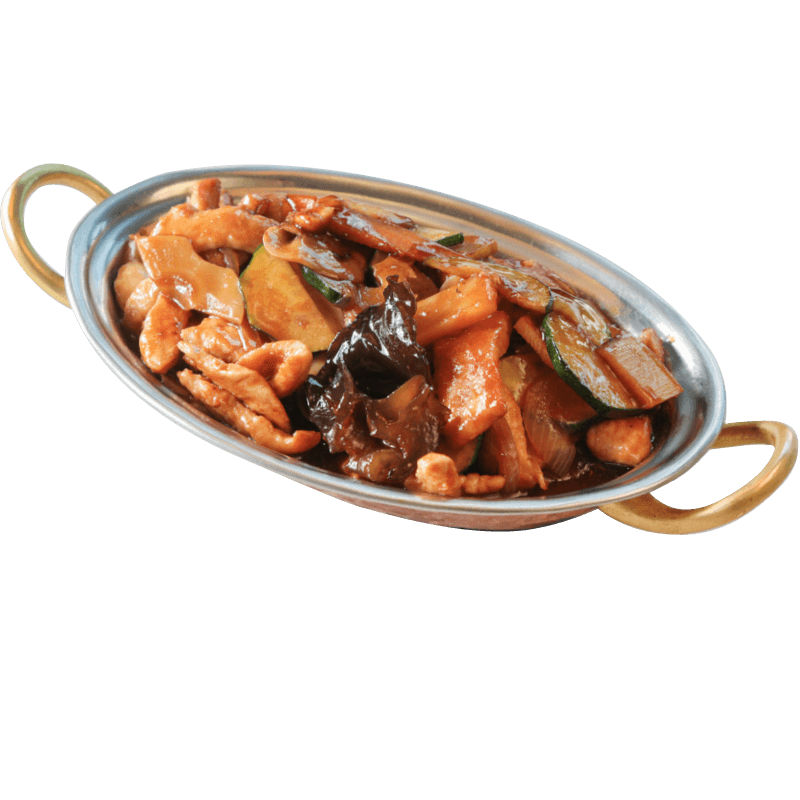
Tamko is a fusion dish built on a foundation of Korean cooking — soy sauce, sesame, fermented depth, clean vegetable work — layered with the bold, aromatic spice profiles of Jaffna Tamil cuisine. It is available as chicken or vegetarian, and it is unlike anything else on our menu, because it does not trace a straight line back to our mother's village in northern Sri Lanka. Instead, it takes a detour through a tiny village in the Swabian hills, through a Korean kitchen run by a woman named Mrs. Han, through fifteen years of patience and sacrifice, and finally arrives here, at THAMARAI in Heilbronn, where our mother Gowari serves it with the quiet pride of someone who has earned every gram of spice on that plate.
To understand Tamko, you cannot simply read an ingredient list. You must understand the journey. You must understand how a Tamil woman from Jaffna found herself in a Korean kitchen in rural Germany, how she learned to wield a knife with professional precision, how she carried that knowledge through years of factory work and child-rearing, and how — more than a decade later — her daughter stood beside her and said: we are ready now. This is that story.
A Kitchen in Wüstenrot Where It All Began
Wüstenrot is not the kind of place that appears on international food maps. It is a small municipality in the Löwenstein Hills of Baden-Württemberg, surrounded by forest and farmland, the sort of place where everyone knows everyone and a good restaurant becomes the heartbeat of the community. It was here, in this unassuming corner of Germany, that our mother Gowari first stepped into a professional kitchen — not a Tamil one, not a Sri Lankan one, but a Korean one.
She had arrived in Germany the way many Tamil families did in those years: carrying the weight of displacement, the uncertainty of starting over, the fierce determination to build something stable for her children. She spoke little German at first. She had no formal culinary training. What she had was a lifetime of cooking — the instinctive, deeply ingrained kitchen knowledge that Tamil mothers carry in their hands, knowledge passed down through generations of women who never wrote recipes because the measurements lived in their fingers and their memory.
The Korean restaurant in Wüstenrot was, by all accounts, one of the finest in the area. It was not a large establishment, but it had a reputation that drew people from surrounding villages and beyond. And it was run entirely by a Korean woman who had built it from nothing — a woman who understood, perhaps better than most, what it meant to cook the food of your homeland in a country that was not your own. When Gowari found work there, she found something she had not expected: a teacher.
For nearly fifteen years, our mother worked in that kitchen. Fifteen years. It is an extraordinary span of time to spend in a single kitchen, long enough to transform a home cook into a professional, long enough to absorb not just recipes but an entirely different culinary philosophy. She entered as someone who could cook Tamil food beautifully — and she emerged as someone who could cook Korean food with the same fluency, the same instinct, the same love.
Mrs. Han's Kitchen The Apprenticeship That Changed Everything
We call her Mrs. Han, though after all these years she feels less like a former employer and more like family — a woman whose influence runs so deep through our mother's cooking that you can taste it in dishes she prepares today, decades after they last worked side by side. Mrs. Han was a classically trained Korean cook, meticulous and exacting, the kind of chef who believed that the foundation of every great dish lay in the preparation that happened long before the flame was lit.
Under Mrs. Han's guidance, our mother learned the art of Korean knife work — the precise, efficient cuts that distinguish professional cooking from home cooking. She learned to julienne vegetables so finely they became translucent ribbons. She learned the rhythmic, confident chopping that Korean cuisine demands, where speed and uniformity are not merely aesthetic choices but essential to how a dish cooks, how it absorbs seasoning, how it presents itself to the eye before it reaches the tongue.
She learned to make kimchi — not the simplified version you find in supermarkets, but the real thing, the laborious, multi-day process of salting napa cabbage, preparing the paste of gochugaru, garlic, ginger, fish sauce, and fermented shrimp, massaging it leaf by leaf into the vegetable until every fold was coated, then sealing it away and waiting. Waiting for the fermentation to do its ancient work, for the lactic acid to develop that sour, funky, effervescent depth that makes great kimchi one of the most complex foods on earth. Our mother learned patience in that kitchen — a patience that would define the rest of her life.
She learned to fold mandu, Korean dumplings, with the precision and speed of someone who had been doing it since childhood, though she had not. She learned the bases — the anchovy broths, the dashima seaweed stocks, the doenjang-enriched soups that form the backbone of Korean home cooking. She learned to balance soy sauce, sesame oil, and rice vinegar in proportions so instinctive that she eventually stopped measuring altogether. She learned that Korean food, like Tamil food, is built on layers — that flavour is not something you add at the end but something you construct from the very first moment you heat your pan.
What makes this apprenticeship remarkable is not just its duration but its depth. Mrs. Han did not merely teach our mother to replicate Korean dishes. She taught her to understand them — to know why gochujang needs time to mellow in a stew, why sesame seeds must be toasted just so, why the temperature of the oil matters when you add garlic. She gave our mother the vocabulary of Korean cooking, and our mother, already fluent in the language of Tamil spice, became bilingual in a way that no formal education could have achieved.
There is a particular kind of trust that develops between two women working side by side in a hot kitchen, day after day, year after year. Mrs. Han saw something in our mother — a seriousness, a respect for the craft, a willingness to learn that went beyond mere employment. And our mother, in turn, saw in Mrs. Han a reflection of something she recognised from her own tradition: the belief that food is not just sustenance but an act of care, a form of love made tangible, a way of saying things that words cannot.
When Amma Brought Korean Food Home A Childhood Memory
I need to tell you about the evenings. The evenings when Amma came home from the restaurant carrying containers of food — Korean food, the kind we could never have imagined eating as Tamil children in a German village. Those evenings were events. They were celebrations disguised as ordinary weeknights.
There were four of us — four children waiting for our mother to walk through the door, and we always knew, somehow, when she was bringing food home. Perhaps it was the way she held her bag, slightly more carefully, or perhaps it was simply the hours: if she was later than usual, it often meant she had stayed to prepare something extra, something Mrs. Han had set aside for her to take home to her family. Whatever the signal, we would gather in the kitchen with a kind of breathless anticipation that I can still feel in my chest when I close my eyes and remember.
The containers would open and the kitchen would fill with aromas that were utterly foreign to our usual world of rasam, sambar, and coconut chutney. Soy sauce, dark and savoury. Sesame, warm and nutty. The sharp, bright funk of kimchi. The rich, meaty depth of braised Korean chicken. We would crowd around the table, reaching for everything at once, mixing it with rice the way we mixed everything with rice, and for those meals, our tiny kitchen in Wüstenrot became something extraordinary — a place where Tamil and Korean existed side by side on the same plate, in the same mouthful, in the same family.
We did not know, then, that we were eating the prototype of what would one day become Tamko. We did not know that our mother was quietly absorbing a culinary tradition that would merge with her own. We were just children, delighted by the novelty, by the strange new flavours, by the sheer excitement of food that came from somewhere else, somewhere unexpected. But looking back, I understand now that those evenings were the very first time Korean and Tamil cooking met in our family — not in a restaurant, not on a menu, but on a crowded kitchen table surrounded by four hungry children and a mother who had spent the day learning to cook in a language that was not her own.
Amma never made a fuss about it. She would set the containers down, change out of her work clothes, and join us at the table as if this were the most ordinary thing in the world — as if every Tamil family in Germany ate kimchi jjigae alongside their evening rice. But it was not ordinary. It was the quiet beginning of something that would take years to fully form, the first seeds of a fusion that would eventually define not just a dish but an entire restaurant.
The Offer She Could Not Accept A Mother's Sacrifice
There came a day — and our mother tells this story with a stillness that reveals how deeply it affected her — when Mrs. Han sat her down and told her she was planning to retire. She was growing older, she missed Korea, and she had decided it was time to close this chapter of her life and return home. But she did not want the restaurant to die. She had built it over many years, had poured her life into it, and she wanted it to continue. She wanted to offer it to someone she trusted.
She offered it to our mother.
Think about that for a moment. A Korean woman, offering her life's work — her restaurant, her recipes, her reputation — to a Tamil woman from Jaffna, because she believed in her that much. Because after fifteen years of working together, she had come to see our mother not as an employee but as a successor, someone who understood the food, who respected the tradition, who had the skill and the heart to carry it forward. It was, by any measure, an extraordinary act of trust and generosity.
And our mother said no.
We were too young. All four of us, still in school, still years away from standing on our own feet. Our mother looked at that offer — looked at the restaurant she knew intimately, the kitchen she could have run with her eyes closed, the opportunity to become her own boss and build something permanent — and she saw, with the clear-eyed pragmatism of a mother who has already sacrificed so much, what it would cost. She saw her children working in the restaurant after school instead of studying. She saw the financial pressure, the long hours, the risk of failure that could swallow not just her savings but her children's futures. She saw the weight of it falling on small shoulders that were not yet strong enough to bear it.
So she declined. She thanked Mrs. Han, she held the grief of that decision somewhere deep inside her, and she let the restaurant go. Mrs. Han returned to Korea. The kitchen in Wüstenrot closed. And our mother, who had just turned down the opportunity of a lifetime, went back to the daily work of raising four children in a country that was not her own, carrying inside her a dream that she could not yet afford to pursue.
I did not understand, as a child, what that decision cost her. Children rarely understand the shape of their parents' sacrifices — we see only the surface, the meals on the table, the packed lunches, the Christmas presents that appeared as if by magic. We do not see the things our parents gave up so that we could have those ordinary, precious things. It was only years later, when I was old enough to ask the right questions, that I began to understand what our mother had done. She had chosen us over herself. She had chosen our education, our freedom, our futures, over her own dream. And she had done it without hesitation, without resentment, without ever once making us feel that we owed her anything for it.
That is the kind of woman Gowari is. That is the kind of mother she has always been. And that is why Tamko, when it finally arrived on our menu nearly two decades later, carried so much more than flavour. It carried the weight of a dream deferred, a sacrifice made in silence, and the fierce, unwavering love of a mother who believed that her children's wings mattered more than her own.
The Painter's Workshop in Alt-Sontheim A Vision Takes Root
The family moved from Wüstenrot to Heilbronn-Sontheim, and it was there, on Horkheimer Straße in the old quarter known as Alt-Sontheim, that our mother found the building. It was a former Malermeisterwerkstatt — a master painter's workshop — with tall ceilings on the first floor, large windows that let in generous light, and the kind of solid, unpretentious architecture that spoke of craft and purpose. It sat on a well-trafficked road with ample parking, in a neighbourhood that had quietly become one of Heilbronn's most popular dining destinations — not the expensive, bustling city centre, but the kind of place where locals came to eat well without ceremony, where restaurants earned their reputation through food rather than postcode.
Our mother saw it and she knew. She knew it the way you know certain things in your body before your mind catches up — a tightening in the chest, a quickening of breath, a sudden clarity that cuts through all the noise of daily life. She could see the restaurant in that space. She could see the kitchen behind those tall walls, the tables arranged beneath those high ceilings, the customers walking in from the bright main road. She could see it all, fully formed, as if the building were already what she wanted it to become and was simply waiting for her to arrive.
But the children were still not old enough. The youngest was still in school. The financial risk was still too great. And so, once again, our mother did what she had done in Wüstenrot: she put the dream aside. She folded it carefully, tucked it into some quiet corner of her heart, and went to work in a metal factory — the same factory where our father worked, doing shift work, punching in and punching out, earning the steady, unglamorous income that kept the family afloat while her children grew.
She took on various part-time jobs alongside the factory work, saving money with the discipline of someone who has a purpose that extends beyond the present. Every euro set aside was a brick in the foundation of something that did not yet exist but that she could see with absolute clarity. She never spoke about it in grand terms. She never announced to us that she was saving for a restaurant. She simply worked, and saved, and waited, with a patience that I now recognise as one of the most extraordinary qualities a person can possess — the ability to hold a vision for years without losing faith in it, without allowing the daily grind to erode its edges, without giving in to the very reasonable voice that says: perhaps this is not meant to be.
Alt-Sontheim waited too. The building remained, the tall ceilings unchanged, Horkheimer Straße still busy with traffic, the neighbourhood still growing as a destination for people who valued good food. It was as if the space itself understood that it had been claimed, that someone had looked at it and seen its future, and that all it needed to do was stand there, solid and patient, until the right moment arrived.
A Daughter's Return When the Pieces Fell Into Place
I finished my undergraduate degree at the University of Hohenheim in Stuttgart. Hohenheim is one of Germany's oldest universities, known particularly for its agricultural and food sciences programmes, though I had studied business. During my years there, I had worked in service at various restaurants across Stuttgart — not because I was consciously preparing for a career in hospitality, but because restaurant work was the kind of flexible employment that fitted around university schedules, and because, if I am honest, there was something about the rhythm of a dining room that felt familiar, that felt like home.
It was only after I graduated, standing at that peculiar crossroads where university ends and the rest of your life begins, that the thought crystallised into something I could no longer ignore. I had spent years watching our mother cook. I had spent years working the floor of restaurants, learning how service operates, how a dining room breathes, how you read a table, how you manage the thousand small interactions that determine whether a guest leaves satisfied or disappointed. And I realised, with a force that surprised me, that between the two of us — between our mother's kitchen mastery and my understanding of business and service — we covered both sides of what a restaurant requires.
She had the food. I had the front of house. She had decades of professional kitchen experience under Mrs. Han and a lifetime of Tamil home cooking before that. I had a business degree and years of practical restaurant work. She had the recipes, the technique, the instinct. I had the spreadsheets, the customer awareness, the operational thinking. We were, without having planned it, the two halves of a complete restaurant operation.
By this time, all four children were old enough. The youngest had finished school. The burden that had kept our mother from accepting Mrs. Han's offer, the weight that had kept her from acting on the vision she saw in the painter's workshop — it had lifted. Her children were grown. Her responsibility had been fulfilled. She had given us our education, our independence, our freedom to choose our own paths. And now, at last, it was her turn.
I remember the conversation, though I cannot tell you the exact words. What I remember is the look on her face when I said it — when I told her that I thought we should do this, that we should open the restaurant, that she had waited long enough. There was a moment of absolute stillness, the kind that precedes something momentous, and then a light came into her eyes that I had never seen before. Not surprise, exactly — she had always known this day would come — but something deeper. Relief, perhaps. Vindication. The quiet, overwhelming joy of a woman who has carried a dream for more than fifteen years and is finally being told: it is time.
Building THAMARAI From Workshop to Restaurant
In 2018, we applied for permission to convert the former painter's workshop into a restaurant. The process was neither quick nor simple — German bureaucracy is thorough, meticulous, and unyielding in its requirements for commercial food establishments. There were inspections, plans, regulations, fire safety assessments, ventilation specifications, hygiene certifications. Every wall, every pipe, every electrical socket had to meet the exacting standards that Germany rightly demands of anyone who wishes to serve food to the public.
In February 2019, we received permission. I remember the letter arriving, the official stamp, the formal language that carried within it the fulfilment of a dream that had waited since before I was old enough to understand what dreaming meant. Our mother held that letter and I watched her read it twice, slowly, as if she needed to confirm that the words were real, that this was not another vision that would have to be folded away and stored for later.
Then the real work began. The conversion of a painter's workshop into a functioning restaurant is not a trivial undertaking. The tall ceilings that had drawn our mother's eye were beautiful but presented challenges for heating and ventilation. The open spaces that had once held easels and paint-splattered workbenches needed to be reconfigured for a kitchen, a dining room, storage, preparation areas, service stations. We were not simply decorating a space — we were building one, from the plumbing up, transforming a place that had served one craft into a place that would serve another.
Those months of construction were intense and exhausting and exhilarating in equal measure. Our mother was involved in every decision — the layout of the kitchen, the positioning of the stoves, the flow from preparation to plating to service. She designed the kitchen not from blueprints but from experience, from fifteen years of knowing where a chef needs things to be, how a cook moves through a space, where the bottlenecks form during a busy service. It was Mrs. Han's training manifesting in steel and tile, the professional instincts she had absorbed in Wüstenrot now shaping the physical space where she would cook for the rest of her career.
In September 2019, THAMARAI opened its doors. The name — a Tamil word for the lotus flower — was our mother's choice, and like everything she does, it carried layers of meaning: the lotus that grows from mud and blooms in beauty, the flower that represents purity and resilience, the plant that thrives precisely because it has roots in difficult ground. It was, in every sense, the perfect name for a restaurant built on decades of sacrifice, patience, and an unshakeable belief that good things come to those who wait — and work.
Two Spice Worlds Collide The Making of Tamko
Now let me tell you about the food itself, because Tamko is not merely a symbol or a story — it is a dish, and it must stand on its own merits at the table.
The Korean foundation is unmistakable. Soy sauce — not the thin, salty variety that dominates Western supermarkets, but the deep, aged Korean soy sauce that carries umami the way a river carries sediment: slowly, powerfully, in layers that reveal themselves over time. Sesame oil, toasted until it reaches that precise shade of amber that signals maximum flavour. Garlic and ginger, the twin pillars of Korean aromatics, minced finely and cooked until they release their fragrance into the oil. Vegetables prepared with the precision our mother learned from Mrs. Han — julienned, sliced, cut to exact specifications that ensure even cooking and maximum absorption of the sauce.
The chicken, when it is the chicken version, is cooked in the Korean style — marinated, seared, braised — until it reaches that state of tender, yielding softness where the meat separates from the bone with the gentlest pressure of a chopstick. The vegetable version, which is likely vegan by default given that it contains no eggs, is built on the same foundation of soy and sesame but lets the vegetables speak for themselves, each one cooked to its own ideal point of doneness, each one contributing its own texture and flavour to the ensemble.
And then come the Jaffna spices. This is where Tamko becomes something that Mrs. Han would recognise but could not have made, something that belongs to our mother and our mother alone. Fennel seeds, dry-roasted until they crack and release their anise sweetness. Coriander seeds, ground fresh, adding their citrusy warmth. Fenugreek, bitter and earthy, the unmistakable signature of Jaffna Tamil cooking — the spice that separates northern Sri Lankan cuisine from its southern Indian cousins. Black pepper, not the pre-ground dust that sits in shakers but whole peppercorns, cracked at the moment of use, delivering that sharp, clean heat that builds at the back of the throat.
Curry leaves — those small, impossously aromatic leaves that no Tamil kitchen is ever without — sizzled in oil until they crisp and perfume the entire dish with their unique, irreplaceable fragrance. And coconut, in one form or another: coconut milk for richness, coconut cream for body, freshly grated coconut for texture. The coconut is the bridge, the ingredient that exists in both traditions — Korean cooking uses it less frequently, but its presence in Tamko feels entirely natural, the element that allows the two spice worlds to communicate rather than compete.
The result is extraordinary. The soy sauce provides the deep, savoury base — the umami foundation upon which everything else is constructed. The sesame oil adds warmth and nuttiness. And then the Tamil spices arrive, not fighting the Korean flavours but dancing with them, adding dimensions that soy sauce alone cannot reach. The fennel sweetness plays against the soy salt. The fenugreek earthiness deepens the sesame warmth. The black pepper sharpens the edges that the coconut milk has softened. The curry leaves add a brightness, a lift, a green aromatic note that cuts through the richness and keeps the palate engaged, bite after bite.
It is a dish that should not work — that combination of Korean and Tamil should, by the conventional logic of fusion cooking, produce confusion rather than harmony. But it works because it was not designed in a test kitchen by a chef seeking novelty. It was born in a life, in the daily reality of a Tamil woman who cooked Korean food for fifteen years and whose hands eventually stopped distinguishing between the two traditions. When our mother makes Tamko, she is not consciously fusing two cuisines. She is simply cooking the way she cooks — with everything she knows, everything she has learned, everything she carries.
The Old Regulars A Drive Down Memory Lane
They come from Wüstenrot. They drive the forty-odd kilometres from the Löwenstein Hills down to Heilbronn-Sontheim, following the main road to our door, and when they walk in, something happens to their faces that never fails to move me. A softening. A recognition. A return to something they thought they had lost.
These are the people who ate at Mrs. Han's restaurant. The regulars, the loyal ones, the families who came every Friday evening, the couples who celebrated anniversaries over Korean chicken, the friends who gathered around those tables year after year until the restaurant became woven into the fabric of their lives. When Mrs. Han closed her doors and returned to Korea, they lost not just a restaurant but a ritual, a place, a taste that had become part of who they were.
And then they heard — through the grapevine, through friends of friends, through the quiet network of word-of-mouth that still outperforms any social media algorithm — that Gowari had opened her own restaurant in Heilbronn. That the woman who had cooked beside Mrs. Han for fifteen years was finally cooking under her own name. That the food they remembered, the food they had mourned, was alive again in a new kitchen, in a new city, in a building that used to be a painter's workshop.
So they come. They make the drive, sometimes on weeknights, sometimes on special occasions, always with that particular anticipation of returning to something familiar after a long absence. And when they taste Tamko — when the soy sauce and sesame hit their palate, followed by that unexpected warmth of Jaffna spice — I can see the memories moving behind their eyes. They are tasting Wüstenrot. They are tasting Mrs. Han's kitchen. They are tasting something that has evolved, that has grown, that has become more than what it was, but that still carries within it the essence of what they loved.
Some of them tell me stories. They tell me about dishes Mrs. Han used to make, about evenings at the restaurant that they remember with startling specificity — what they ordered, who they were with, what the weather was like that night. They tell me that our mother's cooking takes them back, and then they pause, because they realise that it also takes them forward, that Tamko is not a replica of what Mrs. Han served but something new, something that honours the Korean tradition while adding a dimension that did not exist before. They taste the Tamil spices and they understand, perhaps for the first time, that our mother was never just Mrs. Han's cook. She was always, quietly, becoming something of her own.
A Dream That Waited On Patience and Sacrifice
I want to say something about time. About the particular kind of courage it takes to hold a dream for fifteen years without acting on it, without giving up on it, without allowing it to curdle into bitterness or regret. Our mother carried this dream — this restaurant, this kitchen, this life of cooking on her own terms — through more than a decade of factory shifts and part-time jobs and the relentless, unglamorous work of raising four children in a foreign country. She carried it the way you carry something precious through a storm: close to your body, shielded from the wind, never letting go even when your arms ache and the rain soaks through everything.
Dreams do not always come true overnight. The culture we live in — the culture of instant gratification, of overnight success stories, of viral moments and sudden fame — would have you believe that if something is meant to be, it will happen quickly, effortlessly, as if the universe simply arranges itself around your desire. But that is not how it works for most people, and it is certainly not how it worked for our mother. Her dream required patience not as a virtue but as a survival strategy, as the only realistic path between where she was and where she wanted to be.
There were years — long, grey, unremarkable years — when the dream must have felt impossibly distant. Years of waking before dawn to drive to the factory, of standing at a production line doing work that had nothing to do with the thing she was born to do, of coming home exhausted and still making dinner for four children because that is what mothers do, they cook even when cooking is the last thing their tired bodies want. There were years when the painter's workshop in Alt-Sontheim must have seemed like a taunt, a reminder of what she could not yet have, sitting there on the main road with its tall ceilings and its empty rooms, waiting for a future that kept receding.
But she did not give up. She did not scale down the dream or compromise it or convince herself that it was foolish. She simply waited, and worked, and saved, and trusted that the moment would come. And when it came — when her children were grown, when her daughter stood beside her and said we can do this — she was ready. Not tentatively ready, not half-ready, but fully, completely, unshakeably ready, the way only someone who has prepared for fifteen years can be ready. Every recipe she had memorised, every technique she had absorbed, every quiet hour she had spent imagining the menu, the kitchen, the flow of a service evening — all of it was there, fully formed, waiting to be released.
Tamko embodies this philosophy perhaps more than any other dish on our menu. It is a dish that could not have been created quickly, that could not have been born from a weekend of experimentation or a flash of culinary inspiration. It required fifteen years of Korean kitchen training, a lifetime of Tamil cooking knowledge, and the courage to wait until the moment was right to bring them together. It is the dish of a woman who understood, long before it became fashionable to say so, that the best things in life are worth waiting for — and that the wait itself is part of what makes them beautiful.
Two Women, Two Worlds, One Kitchen A Tribute to Mrs. Han
I think often about the improbability of it all. A Korean woman from Seoul and a Tamil woman from Jaffna, meeting in a village of a few thousand people in the hills of Baden-Württemberg. Two women from opposite ends of Asia, each carrying the culinary traditions of cultures that had never meaningfully intersected, finding themselves side by side in a kitchen in rural Germany. If you wrote it as fiction, an editor would reject it as too convenient, too neat, too obviously symbolic. But life is not fiction, and its coincidences are not required to be plausible.
Mrs. Han gave our mother something that no amount of money could buy and no school could replicate: she gave her a professional identity. Before Wüstenrot, our mother was a gifted home cook — one of millions of Tamil women around the world who feed their families with extraordinary skill but never think of themselves as chefs. After Wüstenrot, she was something more. She was a professional. She could run a kitchen, manage a service, prepare food to a standard that paying customers would return for again and again. Mrs. Han did not merely employ our mother; she elevated her, believed in her, invested in her, and ultimately tried to give her the keys to her own kingdom.
And our mother gave Mrs. Han something in return, though it is harder to quantify: she gave her trust, loyalty, and the assurance that her knowledge would not disappear when she returned to Korea. The recipes Mrs. Han taught our mother are alive in our kitchen today. Her techniques live in our mother's hands. Her standards — the insistence on precision, the refusal to cut corners, the belief that every plate must leave the kitchen exactly right — are woven into every dish we serve, including the ones that have nothing to do with Korea. Mrs. Han's influence extends beyond Tamko; it is in the way our mother holds a knife, the way she tastes a sauce, the way she runs her kitchen with the quiet authority of someone who learned from the best.
Two women, two worlds, one kitchen. It sounds like a tagline, but it is the truth. The food at THAMARAI exists because a Korean chef in a tiny German village looked at a Tamil immigrant and saw not a language barrier, not a cultural difference, not a stranger, but a cook. A real cook. Someone worthy of being taught. And that act of recognition — that simple, profound act of seeing another person's potential and choosing to nurture it — changed everything. It changed our mother's life. It changed our family's trajectory. It changed the food that hundreds of people in Heilbronn now eat every week. And it produced Tamko: a dish that carries within it the memory of two women who met by accident and, through years of shared labour and mutual respect, created something that neither could have made alone.
Not Just Chicken The Vegetarian Path
Tamko is available in two versions: chicken and vegetarian. The vegetarian version is, in all likelihood, vegan by default — it contains no eggs, no dairy, no animal products beyond the depth of flavour that the soy sauce and spice combination provides. This is not an afterthought or a concession to dietary trends. It is a reflection of the fact that both Korean and Tamil cuisines have deep, sophisticated vegetarian traditions, and that the foundation of Tamko — the soy, the sesame, the spices, the technique — is inherently plant-friendly.
The vegetarian Tamko lets the vegetables take centre stage, and they rise to the occasion beautifully. Without the chicken, the interplay of Korean and Tamil flavours becomes even more transparent, each spice note more distinct, each layer of seasoning more legible. The soy sauce and sesame provide the umami that satisfies the palate's craving for depth. The Jaffna spices — the fennel, the coriander, the fenugreek, the black pepper, the curry leaves — provide the complexity that keeps each bite interesting. And the coconut provides the richness, the body, the silky mouthfeel that makes you forget entirely that you are eating a dish without meat.
If you are someone who believes that vegetarian food is somehow lesser, somehow a compromise, I would invite you to try the vegetarian Tamko and reconsider. It is a complete dish — complete in flavour, complete in texture, complete in the satisfaction it provides. It does not miss the chicken. It does not need it. It stands on its own, confident and full, a testament to the fact that great cooking does not require animal protein to achieve greatness.
Frequently Asked Questions
Visit THAMARAI in Heilbronn Taste the Journey
THAMARAI stands on Horkheimer Straße in Alt-Sontheim, Heilbronn, in the building that was once a master painter's workshop. The tall ceilings that first caught our mother's eye are still there, arching above a dining room that fills, most evenings, with the sound of conversation and the aroma of spices that travel thousands of miles to reach your plate. There is ample parking, because our mother thought about that when she chose this location — practical as always, even in the pursuit of a dream.
When you come, you will be welcomed by a family. This is not a corporate operation, not a franchise, not a concept designed by consultants. This is a mother-daughter business, built on fifteen years of patience, a lifetime of skill, and the kind of determination that does not announce itself but simply endures until the world catches up. Our mother cooks. I serve. Between us, we carry the complete story of this restaurant — from Mrs. Han's kitchen in Wüstenrot to this table in Heilbronn, from the spice markets of Jaffna to the sesame fields of Korea, from a dream deferred to a dream fulfilled.
Order the Tamko. Taste the soy sauce and the sesame, the fennel and the fenugreek, the coconut and the curry leaves. Taste the fifteen years of waiting. Taste the sacrifice of a mother who chose her children's futures over her own ambition. Taste the trust of a Korean woman who offered her life's work to a Tamil immigrant. Taste the courage of a daughter who said: Amma, it is time.
And then taste the food simply as food — because beyond all the history and the emotion and the meaning, Tamko is, above all else, delicious. It is a dish that earns its place on any table, in any restaurant, in any city in the world. That it happens to carry the weight of a remarkable story is a bonus. That it happens to be served by the woman who lived that story is a privilege. Come to THAMARAI. Sit down. Let us feed you. That is, after all, what we have been waiting to do.
Nutrition at a Glance
Per serving, based on a standard portion size.

