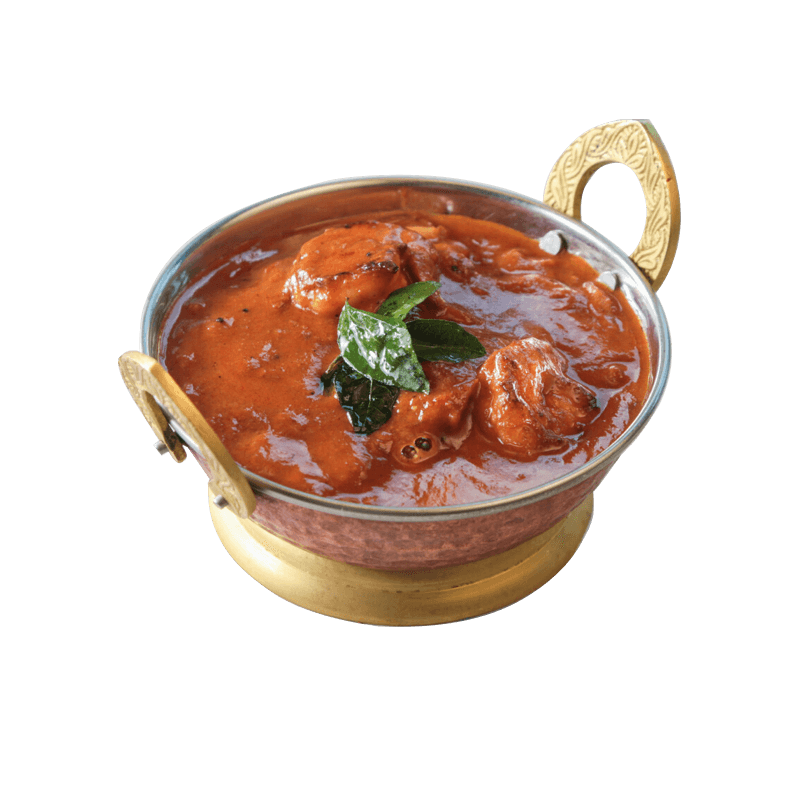
The fiercest curry from the Jaffna coast.
Jet-black roasted Jaffna spice paste, tamarind, fresh coconut milk. The spiciest dish on our menu — three out of three for heat.
What Is Jaffna Prawn Kari?
Jaffna Prawn Kari (pronounced iraal kari in Tamil; iraal means prawn) is the fiery, tamarind-laced seafood curry that sits at the very top of the Jaffna Tamil flavour spectrum. It is the darkest, boldest, most uncompromising curry on Sri Lanka's northern coast — a dish that does not negotiate with timidity. Succulent prawns are simmered in a jet-black roasted spice paste, balanced with the sharp sourness of tamarind and the silk of fresh coconut milk, until the gravy clings to each prawn like a second skin.
There is no single recipe. The version cooked in Karainagar differs from the one in Gurunagar, which differs from the one in Kayts, which differs from the one a grandmother carried to Toronto in 1987 and never changed again. But beneath all the variations, a single foundation holds: Jaffna curry powder — eleven spices, individually dry-roasted until almost black — and prawns so fresh that the salt of the sea is still on them.
At THAMARAI in Heilbronn, we roast and grind our own Jaffna curry powder in small batches every week. We balance the ferocious heat with tamarind and fresh coconut milk, the way it has been done in the fishing villages of the Jaffna coast for longer than anyone can remember. This is the spiciest dish on our menu — rated three out of three for heat — and it is the one our Tamil guests order when they want to know whether we are serious.
The Morning the Nets Came In
Imagine a morning in 1980. Not the Jaffna of textbooks or travel brochures, but the Jaffna that smells of salt and kerosene and jasmine threaded into wet hair. The village is Gurunagar — a Catholic Tamil fishing settlement on the western edge of the peninsula, where nearly every house belongs to a family that earns its living from the sea. The lanes are narrow, pressed between low walls of palmyra-frond fencing. There is a church at the centre. There is a harbour at the edge. There is no boundary between the two.
The men left before dawn. Not on trawlers — Gurunagar in 1980 does not have trawlers. They went out on vallam, small wooden boats with outrigger stabilisers, powered by oar and occasionally by a temperamental outboard engine that someone's brother-in-law bought secondhand from a fisherman in Trincomalee. The nets were cast by hand — heavy nylon gill nets, flung in a wide circle, the lead weights pulling the edges down while the men waited, smoking beedis, watching the surface of the water for the telltale shimmer of a shoal.
By seven in the morning, the boats are returning. The wives know the catch before the boats reach shore — they read it in the posture of the men. A good catch: the men stand, waving, shouting across the water. A poor catch: they sit, quiet, pulling the nets in without theatre. Today is a good day. The nets are heavy with prawns — Penaeus indicus, the Indian white prawn, smaller than the tiger prawns that fetch export prices but sweeter, more delicate, and destined not for Colombo hotels but for the kitchens of Gurunagar itself.
The women are already at the shore. What happens next is not romantic — it is efficient, practised, and fast. The catch is sorted on the sand. The largest prawns go into a basin for the morning market at Jaffna town. The medium ones go to the mudalali — the middleman who supplies restaurants and hotels. The smallest ones, and whatever the family decides to keep, go home. The fisherman's wife always picks first. This is not generosity — it is protocol. The woman who manages the household economy decides what the family eats, and she takes what she wants before anyone else touches the catch.
Today, she takes a kilo of medium prawns — not the smallest, because this is a day for guests. Her husband's sister is visiting from Kayts with her children. There will be rice, there will be sambol, there will be rasam. But the centrepiece, the dish that says welcome, sit, eat, you are family, will be iraal kari.
People of the Shore
The fishing communities of the Jaffna peninsula — the Karaiyar and their neighbours — are not a footnote in Tamil history. They are its oldest maritime chapter. The name itself tells the story: karai means shore, yar means people. People of the shore. They have been exactly that for at least three thousand years.
Archaeological evidence confirms it. On Velanai Island — the large island connected to the Jaffna mainland by a narrow causeway — a shell midden dating to 3,400 years ago was excavated, revealing the remnants of organised fishing and seafood processing by proto-Tamil coastal populations. These were not occasional fishermen. They were communities whose entire existence was shaped by the rhythm of tides, the migration of fish, and the moods of the Indian Ocean.
In the classical Tamil literature of the Sangam period — roughly 300 BCE to 300 CE — the seashore was given its own poetic landscape: Neithal, the mode of longing and separation, named after the water lily that grows in coastal lagoons. The people of the Neithal landscape were the Parathavar — sailors and fishermen — and the Nulaiyar — divers who plunged for pearls and conch shells in the Gulf of Mannar. The Sangam poets did not treat these people as marginal. They celebrated them. The poems speak of nets drawn up on moonlit beaches, of the smell of drying fish carried on the wind, of fishermen's wives peering through Pandanus hedges, waiting for boats that may or may not return.
The Karaiyar were more than fishermen. In the medieval period, they served as the naval warriors of the Jaffna kings — the Aryacakravarti dynasty that ruled the peninsula from the thirteenth to the seventeenth century. They were assigned the western harbours of the kingdom, including Gurunagar itself. An inscription from Sirkazhi dated 1187 CE records a naval officer with the title Tandalnayagam — commander of the forces — from the Karaippadaiyilaar, the army of the seashore. These were warriors who fought on water, traded in pearls and conch shells, and sailed their vessels to India, Myanmar, and the islands of Southeast Asia.
The Tamil word for a traditional fishing vessel — kattumaram, from kattu (tied) and maram (wood) — is the origin of the English word catamaran. The original kattumaram was a simple raft of three to seven tree trunks lashed together with coir rope, designed to be unsinkable: the water passed through the gaps between the logs rather than swamping the vessel. It was engineering born from intimacy with the sea, and it carried generations of Tamil fishermen through the surf of the Coromandel coast and the waters around Jaffna.
The Darkest Curry Powder in Sri Lanka
Every Jaffna curry begins with the same foundation: a curry powder so dark it is almost black. This is not the golden-yellow "curry powder" of supermarket shelves. It is not the mild Sinhalese thunapaha used in southern Sri Lanka. It is a different substance entirely — darker, fiercer, and more complex than any other curry powder on the island.
The Jaffna curry powder blend contains eleven core ingredients: coriander seeds, cumin seeds, fennel seeds, fenugreek seeds, black peppercorns, dried red chillies, cinnamon bark, cloves, cardamom, curry leaves, and mace. Some families add turmeric; others dismiss it as an impurity. The proportions are guarded like heirlooms — handed down through kitchens, never written, rarely discussed outside the family, and defended with a stubbornness that borders on theology.
What matters is the roasting. Each spice is dry-roasted individually — not together — in a heavy iron pan over a low flame. Coriander goes first, because it is the most forgiving. Then cumin. Then fennel. Then fenugreek. Then black pepper. The dried red chillies and curry leaves go last, because they burn fastest. Each spice is roasted for approximately sixty seconds, or until it releases its aroma and begins to change colour. The target is not golden. The target is dark — a deep, smoky, red-brown that sits just this side of black. A few seconds too long and the batch is ruined: bitter, acrid, fit only for the bin.
This roasting is where Jaffna curry powder acquires its character. The high heat transforms the volatile oils in the spices, creating Maillard compounds — the same chemical reaction that browns bread crusts and sears steaks — and producing flavour molecules that raw or lightly toasted spices simply do not contain. The smokiness, the depth, the almost-charred intensity of a well-made Jaffna curry powder: these are the products of heat applied with precision and nerve.
At THAMARAI in Heilbronn, we roast our own curry powder every week. It is one of the few steps in our kitchen that we cannot delegate to anyone who has not been taught by hand. The difference between good Jaffna curry powder and bad Jaffna curry powder is measured in seconds.
Kuzhambu or Kari?
In Jaffna Tamil kitchens, not all curries are the same preparation. Two words describe two fundamentally different approaches to the same ingredient, and if you want to understand Jaffna Prawn Kari, you need to understand both.
Kuzhambu (also written kulambu, குழம்பு) is the thinner, more liquid preparation. The gravy is soupy, pourable, designed to be ladled generously over rice and mixed in until every grain is coated. A prawn kuzhambu stretches a modest catch further — more tamarind water, more thin coconut milk, fewer prawns per serving. It is the everyday version, the one cooked on a Tuesday when the catch was average and the family is large.
Kari is the older Tamil word, and it describes something different: a thicker, more concentrated gravy where the sauce has been reduced until it clings to the protein. In a prawn kari, the spice paste and coconut milk are cooked down. The gravy is dense, dark, and deeply flavoured. The prawns are the star, and the sauce exists to serve them, not the other way around. This is the version cooked when the catch is excellent, when guests are expected, when a mother-in-law needs to be impressed, when the occasion calls for something that announces itself on the table.
At THAMARAI, we serve the kari — the concentrated, thick-gravy version. It is the more dramatic preparation, the one that carries the full, undiluted force of the Jaffna curry powder, and the one that tends to stop a conversation mid-sentence at the first spoonful.
From Lagoon to Kitchen
The Jaffna Lagoon is vast — over four hundred square kilometres of shallow, warm, nutrient-rich water stretching between the Jaffna and Kilinochchi districts. Most of it is less than two metres deep. Extensive mudflats, seagrass beds, and mangrove fringes — nine species of true mangrove have been identified — create an ecosystem that functions as a nursery for juvenile prawns. The mangroves shelter the young. The seagrass feeds them. The shallow, sun-warmed water accelerates their growth. By the time they reach the fishermen's nets, they are plump, sweet, and full of the mineral richness of the lagoon.
Five species of penaeid prawn have been identified in the Jaffna lagoon system: Penaeus indicus (the Indian white prawn, the most commercially important), Penaeus monodon (the black tiger prawn, the largest and most prized), Penaeus latisulcatus (the western king prawn), Penaeus semisulcatus (the green tiger prawn), and Metapenaeus monoceros (the speckled shrimp). The lagoon is equally famous for its crabs — Jaffna nandu kari, crab curry, is the other great coastal dish of the peninsula.
The prawn season runs primarily from October to April, when current patterns favour prawn movement through the lagoon. Traditional fishing methods include cast nets thrown by hand from the shallow water, stake nets set against the current and left overnight, gill nets and trammel nets for larger catches, and — in the shallowest areas — simply wading in and hand-picking shrimp from the mudflats. The nets are typically set at dusk and harvested at dawn. The rhythm of prawn fishing has not fundamentally changed in centuries.
The distribution of the catch follows a hierarchy that is old and understood by everyone. The fisherman's wife selects the family's share first. Then the catch goes to the local market — where women from fishing families sell directly to buyers from the town — or to the mudalali, the middlemen who supply hotels and restaurants. The largest tiger prawns, the ones that command the highest prices, often go to export or to the upscale restaurants of Colombo. What stays in the fishing village is the everyday catch: the smaller white prawns, the speckled shrimp, the ones that taste sweetest and that no restaurant in Colombo will ever serve as well as a Gurunagar kitchen does on a Wednesday morning.
Not Just Hot. Jaffna Hot.
Jaffna Prawn Kari is the spiciest dish on our menu — rated three out of three for heat. But calling it "spicy" is like calling a symphony "loud." The heat of this dish is not one-dimensional. It does not simply burn. It unfolds.
The first thing that hits is black pepper — sharp, biting, immediate. Jaffna cooking uses more black pepper than any other regional cuisine in Sri Lanka, and the roasting of the peppercorns concentrates their piperine into a focused, almost electric bite. Then comes the dried red chilli — a slower, deeper capsaicin heat that builds over ten or fifteen seconds and settles into the back of the throat. Then the fenugreek adds a warm, bitter undercurrent that amplifies the perception of heat without adding any fire of its own. And underneath it all, cinnamon and cloves create a warm, aromatic glow that lingers long after the pepper and chilli have subsided.
This is not the one-note heat of a dish that has simply been loaded with chilli powder. This is layered heat — an orchestra of pungent compounds, each arriving at a different moment, each interacting with the others. The smokiness of the roasted spices adds depth. The sourness of the tamarind creates counterpoint. The fat of the coconut milk rounds everything into a rich, enveloping warmth rather than a raw assault.
The geography of Jaffna shaped this intensity. The hot, dry climate of the northern peninsula — drier and hotter than the lush south of Sri Lanka — demanded bold, assertive seasoning. Spices were not decorative. They were preservative, medicinal, and essential. The same Jaffna curry powder that makes prawn kari so fierce also fights the tropical heat: capsaicin triggers sweating, which cools the body; black pepper aids digestion; fenugreek has been used in traditional medicine for centuries. The flavour is the function.
If you usually avoid very spicy food, we will happily adjust the chilli level. But if you have ever wanted to understand why Jaffna cuisine is considered the spiciest on the island, this dish is the answer.
A Coast That Fell Silent
In 1983, Jaffna's annual fish catch was approximately forty-eight thousand metric tonnes — one quarter of Sri Lanka's entire national fish production. The fishing population of Jaffna district numbered over one hundred thousand people. Myliddy, on the northern tip of the peninsula, was one of the most important fishing harbours in the country, accommodating nearly a third of the national fishing trade.
Then the war came.
By 1984, one year into the civil conflict, the annual fish catch had collapsed to thirteen thousand tonnes — a seventy-three per cent decline in a single year. By the 1990s, it had fallen further, to between one and three thousand tonnes annually. The fisherfolk population dropped from one hundred and one thousand in 1983 to just ten thousand six hundred and eighty-eight in 1999. An estimated ninety per cent of boats, engines, and fishing gear were destroyed during the war and the devastating 2004 tsunami.
Fishermen faced naval restrictions that made their work nearly impossible. They needed passes to go to sea. Checkpoints were erected along the coast. In some areas, fishermen were allowed to leave at night but were not permitted to return until morning, regardless of weather or illness. Entire coastal areas were declared high-security zones and sealed off from civilian access. Myliddy harbour and fifty-four acres of surrounding land were occupied by the military for twenty-seven years — from 1990 to 2017. Approximately fifteen thousand fisher families who had lived around the harbour were displaced.
On 10 June 1986, thirty-three fishermen from Gurunagar — the same village where our story began — were attacked and killed by naval personnel after leaving from the Mandaitivu fisheries harbour. They ranged in age from thirteen to sixty-two. In November 1993, the St. James Church in Gurunagar was bombed from the air. In 1996, the entire area was restricted to military personnel and the population was forced to evacuate. Gurunagar was only reopened in 2010.
We tell this part of the story not because it belongs in a food article, but because it is impossible to understand Jaffna Prawn Kari without understanding what happened to the people who invented it. The fishing families of the Jaffna coast lost their boats, their nets, their harbours, their homes, and in many cases their lives. Yet the knowledge survived — carried in the hands and memories of displaced families who scattered to Colombo, to India, to Toronto, to London, to Paris, to Germany. Iraal kari continued to be cooked in exile, in rented kitchens, with whatever prawns were available, using curry powder ground from spices bought at diaspora grocery shops. The recipe was a thread of continuity when everything else had been severed.
Myliddy harbour was finally released in May 2017. Families are slowly returning. Boats are being rebuilt. Nets are being cast again. The coast is no longer silent. But the scars remain, and the taste of Jaffna Prawn Kari carries all of it — the salt of the lagoon, the smoke of the roasted spices, and the memory of a coast that was once the most productive fishing ground on the island.
Three Milks from One Coconut
The other half of Jaffna Prawn Kari's architecture — the part that balances the fire — is coconut milk. Not coconut milk from a tin. Fresh coconut milk, pressed that morning from a whole coconut grated by hand.
In a traditional Jaffna kitchen, a single coconut yields three milks. The fresh flesh is grated using a thengai thuruval — a coconut scraper — and mixed with a cup of warm water. This is squeezed through cloth to produce the first milk (onnam paal): thick, rich, almost cream-like, with a fat content of around seventeen to twenty per cent. This milk is set aside. It will be added last, at the very end of cooking, to give the curry its final silky richness.
The already-squeezed pulp is mixed with water again and pressed a second time. This produces the second milk (rendaam paal): thinner, lighter, but still carrying coconut flavour. This is the cooking liquid — the base in which the prawns and spice paste simmer. A third extraction, even thinner, is sometimes used instead of plain water for the initial boiling.
This staged approach is fundamental to the dish's balance. The thin milk goes in first, extracting flavour from the spices during the simmer. The thick milk goes in last, off the heat or on the lowest possible flame, to enrich the gravy without splitting the emulsion. The result is a sauce that is simultaneously fierce and luxurious — the heat of the Jaffna spice paste tempered by the cool, sweet richness of the coconut fat.
The other structural element is tamarind — puli in Tamil, which literally means "sour." Tamarind provides the counterpoint to both the heat and the richness. Without it, the spiciness would be overwhelming and the coconut milk cloying. The sourness lifts the entire dish, cutting through the fat, brightening the dark gravy, and creating a flavour architecture that is simultaneously hot, sour, rich, and smoky. In Jaffna, tamarind leans forward; in the south of Sri Lanka, the same role is played by goraka (Garcinia cambogia). The choice of souring agent is one of the clearest markers that distinguishes Jaffna cooking from all other Sri Lankan traditions.
The Science of Fire and Sea
Jaffna Prawn Kari is, beneath its cultural weight, a masterclass in applied chemistry. Three processes combine to produce its distinctive character.
First, the Maillard reaction during spice roasting. When coriander seeds, cumin, and fenugreek are heated to between 140 and 165 degrees Celsius, amino acids in the spices react with reducing sugars to produce melanoidins — complex brown compounds responsible for the dark colour, smoky aroma, and deep savoury flavour of the curry powder. This is the same reaction that browns bread crusts, caramelises onions, and sears steaks. It cannot be replicated by adding colour or flavouring. It requires heat, time, and nerve.
Second, the fat-soluble flavour extraction in coconut milk. Most spice flavour compounds — capsaicin from chillies, piperine from black pepper, eugenol from cloves, cinnamaldehyde from cinnamon — are fat-soluble, not water-soluble. The medium-chain triglycerides in coconut milk (approximately seventeen to twenty per cent fat) dissolve these compounds and distribute them uniformly through the gravy. This is why a coconut-milk-based curry tastes richer and more complex than a water-based one: the fat is not just adding richness, it is carrying flavour molecules that water would leave behind.
Third, the acid-heat balance created by tamarind. Tartaric acid in tamarind stimulates the same sour taste receptors as citric acid in lemon, but with a more complex, fruity profile. When this sourness meets capsaicin heat, the two sensations create a contrast that the brain interprets as depth rather than pain. This is why tamarind-based curries feel more balanced than curries that rely on chilli alone — the acid provides a counterpoint that makes the heat pleasurable rather than punishing.
The prawn itself contributes one final chemical note. Fresh prawns are rich in glycine and alanine — two amino acids that contribute sweetness — and in inosinic acid, a nucleotide that synergises with the glutamic acid released during spice cooking to produce an intense umami effect. The sweetness of the prawn against the darkness of the Jaffna spice paste is not a coincidence. It is biochemistry performing exactly as generations of Jaffna cooks intended.
Frequently Asked Questions
Visit THAMARAI in Heilbronn
If you are searching for authentic Tamil seafood in Heilbronn — a real Jaffna Prawn Kari cooked with hand-roasted spices, fresh coconut milk, and tamarind the way it has been done on the northern coast of Sri Lanka for generations — you will find it at THAMARAI in Heilbronn-Sontheim.
Many of our guests come to us after years of eating at Indian restaurants across Germany, expecting the familiar flavours of North Indian cooking. What they discover is something entirely different — a cuisine that is darker, bolder, more coconut-rich, and more deeply rooted in a specific place and tradition. Sri Lankan Tamil food is not Indian food. It is its own world, and Jaffna Prawn Kari is its fiercest ambassador.
Whether you are a Tamil far from home, searching for the iraal kari your grandmother cooked in a kitchen that no longer exists — or whether you have never tasted Jaffna cooking and are ready to discover why it is considered one of the most intense and rewarding cuisines in South Asia — come and sit down. We will ladle the curry generously, warn you about the heat, and watch with quiet satisfaction as you reach for a second helping anyway.
The sea gave Jaffna its fiercest flavours. We bring them to your table.
Nutrition at a Glance
Per serving, based on a standard portion size.

