Biriyani: From Persia, Through Mughal Palaces, to Jaffna

The word biryani comes from the Persian birian — "fried before cooking." The dish is a descendant of the Persian polow, which travelled east with the Mughal armies from Central Asia and settled, around 1500, in the imperial kitchens of Delhi and Agra. The Mughals layered basmati rice with marinated meat, saffron, rose water, and fried onions, sealed the pot with dough, and slow-cooked it over coals — a technique called dum pukht, "breath-cooked."
From the palace to the street
Mughal biryani stayed in the palaces for two centuries. It escaped into the streets through the kitchens of the Nizams of Hyderabad, who broke from the Mughal court in 1724 and set up their own culinary tradition. Hyderabad biryani is drier, spicier, and more chilli-forward than its Delhi ancestor. By 1800, the dish had fractured into regional variants: Lucknow's pakki biryani (rice and meat cooked separately), Hyderabad's kachchi biryani (raw marinated meat sealed with rice from the start), Calcutta's gentler version with potatoes and eggs.
The South Indian versions
Biryani reached the southern Indian coast via trade. Kerala's Malabar biryani uses short-grain khyma rice and a lot of coconut oil. Tamil Nadu's Ambur biryani, from the town of the same name, uses seeraga samba — a small, nutty, aromatic grain native to the region. The Chettinad version, from the merchant community of the same name, is drier and more heavily spiced than any of its northern ancestors.
The Jaffna version
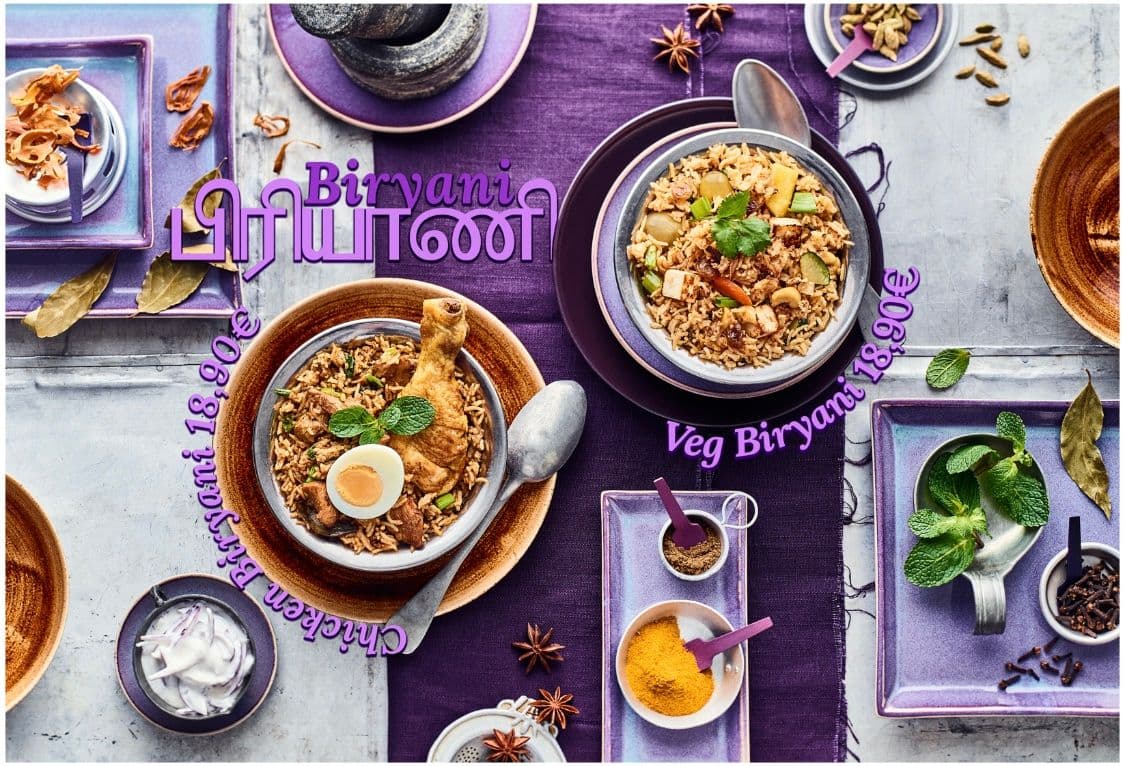
Jaffna biryani is the descendant closest to our kitchen. It uses the same seeraga samba rice as Ambur; it is less oily than Hyderabad; it is always served with sothi, a coconut-milk gravy, and a boiled egg sliced in half. In Jaffna households, biryani was a Sunday food — a celebration dish, not a weekday staple. On Sundays, the smell of slow-cooked meat and saffron would drift through the streets, and the neighbours knew who was cooking biryani.
At Thamarai, we cook two versions: a Jaffna-style lamb biryani in seeraga samba rice, and a vegetable biryani with basmati. Both are slow-cooked, both are sealed with dough on the pot, both are served with sothi and a boiled egg. The recipe has travelled two thousand kilometres from Persia, through Mughal palaces, through Hyderabad, down to Jaffna, and now to Heilbronn. It has picked up character everywhere. That is what makes it a biryani.
Weiterlesen
Mehr aus der Thamarai-Küche.